
DevOps Transformation:
Culture, Tools, and Practices
Table of Contents
Introduction
In the rapidly evolving digital economy, speed, reliability, and collaboration have become fundamental to competitive advantage. Customers expect seamless digital experiences, updates without disruption, and innovation at a pace that traditional IT operating models simply cannot sustain.
This demand has given rise to DevOps transformation — a strategic realignment of people, processes, and technology designed to unify software development and IT operations. The goal is not merely faster deployments but continuous business value delivery through automation, measurement, and shared accountability.
Originally coined from the fusion of “development” and “operations,” DevOps has matured into a philosophy that encompasses the entire software delivery lifecycle. It integrates cultural principles, modern tooling, and continuous improvement practices to enable organizations to build, test, and deploy with unprecedented speed and confidence.
However, DevOps transformation is not a turnkey solution. It is a cultural and operational metamorphosis requiring visionary leadership, disciplined execution, and unwavering commitment to collaboration.
This guide explores the three pillars of DevOps transformation — culture, tools, and practices — with detailed insights into how they collectively drive digital agility.
Understanding DevOps Transformation
DevOps transformation refers to the end-to-end reconfiguration of how an organization conceptualizes, builds, and maintains software. It involves aligning business objectives, engineering workflows, and IT infrastructure to foster a continuous delivery ecosystem where innovation flows seamlessly from code commit to customer experience.
Unlike isolated technology adoptions, DevOps transformation is holistic. It extends across governance, leadership, workforce enablement, and performance measurement.
At its core, it aims to:
- Shorten the software delivery cycle,
- Increase deployment reliability, and
- Build a feedback-driven culture that continually learns and adapts.
Evolution of DevOps
The DevOps movement originated from frustration with traditional IT models characterized by long release cycles and rigid silos. The 2008 “Agile Infrastructure” and subsequent 2009 DevOpsDays events formalized a growing realization: agility in software development required equivalent agility in operations.
Over time, DevOps evolved through several stages:
- Collaboration phase (2009–2013): Emphasis on breaking silos between development and operations.
- Automation phase (2013–2016): Proliferation of CI/CD pipelines and configuration management tools.
- Cloud-native phase (2016–2020): Containers, microservices, and orchestration became mainstream.
- Intelligent DevOps (2020–present): Integration of AI, observability, and predictive analytics.
Why DevOps Transformation Matters
DevOps transformation is not a technological luxury; it is a business necessity. In industries where market conditions change by the quarter and customer expectations evolve daily, software has become the primary channel of differentiation.
Business Imperatives
Organizations that successfully adopt DevOps experience measurable business outcomes:
(Source: DORA State of DevOps Report 2023)
Competitive Advantage
- Accelerated Innovation: Continuous delivery allows rapid experimentation and feature rollout.
- Enhanced Reliability: Automated testing and monitoring reduce human error.
- Improved Customer Experience: Faster feedback loops result in products that evolve with user needs.
- Operational Efficiency: Infrastructure automation optimizes resource utilization and reduces costs.
By institutionalizing DevOps, organizations achieve the agility to innovate confidently while maintaining compliance and stability — the ultimate balance of speed and safety.
Explore: The Role of DevOps in Accelerating Digital Transformation
The Cultural Foundation of DevOps Transformation
Culture is the foundation upon which every successful DevOps initiative is built. Tools can automate processes, but only people and mindsets can sustain transformation.
Collaboration Over Silos
Traditional structures isolate teams into narrow functions — developers write code, testers validate, and operations deploy. These divisions breed inefficiency and miscommunication.
DevOps replaces this model with cross-functional collaboration. Teams share objectives, visibility, and accountability, resulting in:
- Seamless knowledge transfer
- Faster incident resolution
- Reduced friction between development and IT support
Shared Responsibility
The DevOps principle of “You build it, you run it” encapsulates shared responsibility. Engineers own the entire lifecycle of the software they create — from design and deployment to maintenance and monitoring. This ownership drives higher quality, accountability, and resilience.
Continuous Learning and Improvement
DevOps thrives on experimentation and learning. High-performing teams conduct blameless post-mortems, encouraging open discussion of failures to prevent recurrence.
Organizations that institutionalize learning through retrospectives, internal conferences, and hackathons sustain momentum and innovation.
Leadership and Psychological Safety
Transformation requires leadership that promotes trust, transparency, and empowerment. Psychological safety — the freedom to voice concerns without fear — is directly correlated with high performance.
Leaders must act as cultural architects, rewarding collaboration and discouraging blame.
Key DevOps Tools Powering Transformation
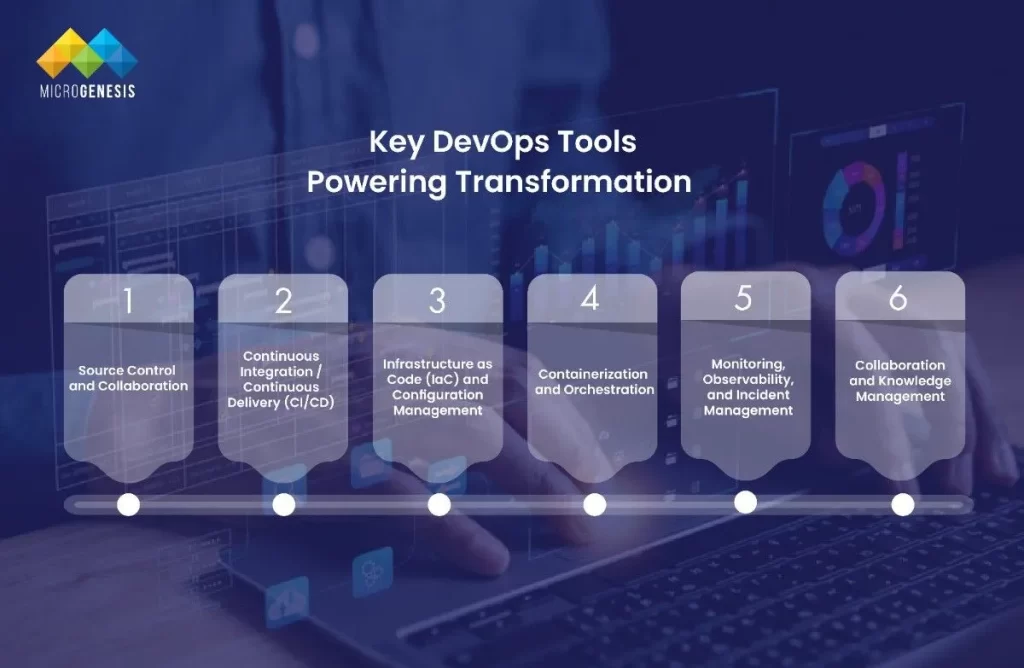
Tools enable automation, integration, and measurement — the operational backbone of DevOps. However, successful tool adoption requires strategic alignment with workflows and skillsets.
Source Control and Collaboration
- Git, GitHub, GitLab, Bitbucket — Version control systems that facilitate parallel development and maintain audit trails.
- They underpin branching strategies (GitFlow, trunk-based development) and enable peer reviews, ensuring code integrity.
Continuous Integration / Continuous Delivery (CI/CD)
- Jenkins, GitHub Actions, GitLab CI, CircleCI, Azure DevOps Pipelines — automate the build, test, and deployment pipeline.
- CI/CD pipelines ensure that every code change passes through automated validation before release, minimizing integration errors.
Infrastructure as Code (IaC) and Configuration Management
- Terraform, Ansible, Chef, Puppet, CloudFormation — standardize infrastructure provisioning.
- IaC promotes consistency across environments (dev, staging, production) and facilitates immutable infrastructure.
Containerization and Orchestration
- Docker provides environment isolation;
- Kubernetes and OpenShift orchestrate scaling, self-healing, and load balancing.
Together, they enable microservices deployment and horizontal scalability.
Monitoring, Observability, and Incident Management
- Prometheus, Grafana, ELK Stack, Datadog, New Relic, PagerDuty — deliver visibility into performance, availability, and user experience.
- Observability goes beyond monitoring by correlating metrics, logs, and traces to reveal system behavior.
Collaboration and Knowledge Management
Jira, Confluence, Slack, Microsoft Teams — bridge communication gaps.
Documentation and real-time collaboration tools ensure that institutional knowledge persists despite personnel changes.
Dig Deeper: DevOps Automation Tools That Streamline Deployment
Core DevOps Practices Driving Success
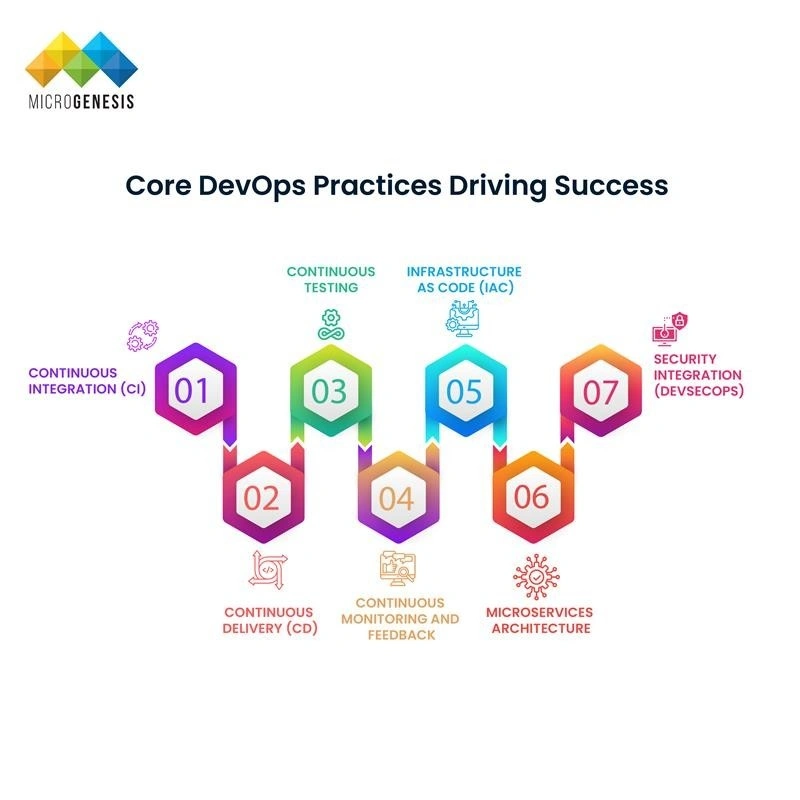
Continuous Integration (CI)
Developers merge code frequently into a shared repository. Automated tests validate functionality, detecting integration issues early. Frequent commits promote small, incremental changes, reducing risk and simplifying rollbacks.
Continuous Delivery (CD)
Extends CI by automating deployment into production-like environments. Through CD pipelines, teams can release on demand with confidence that each build has passed standardized testing and security checks.
Continuous Testing
Quality assurance becomes continuous, not sequential. Automated unit, integration, regression, and performance tests ensure that every release is production-ready.
Continuous Monitoring and Feedback
Real-time monitoring provides operational intelligence. Metrics on latency, error rates, and user satisfaction feed back into the development cycle, fostering rapid iteration.
Infrastructure as Code (IaC)
Declarative configuration files describe infrastructure, enabling reproducibility and eliminating configuration drift. Versioning infrastructure alongside application code enhances transparency and governance.
Microservices Architecture
Microservices divide applications into self-contained modules that can be developed, deployed, and scaled independently. This modularity increases agility but demands mature DevOps orchestration and monitoring capabilities.
Security Integration (DevSecOps)
Security is shifted left — integrated into CI/CD pipelines through automated vulnerability scanning, dependency management, and compliance checks.
DevSecOps ensures that agility never compromises safety.
The DevOps Transformation Roadmap
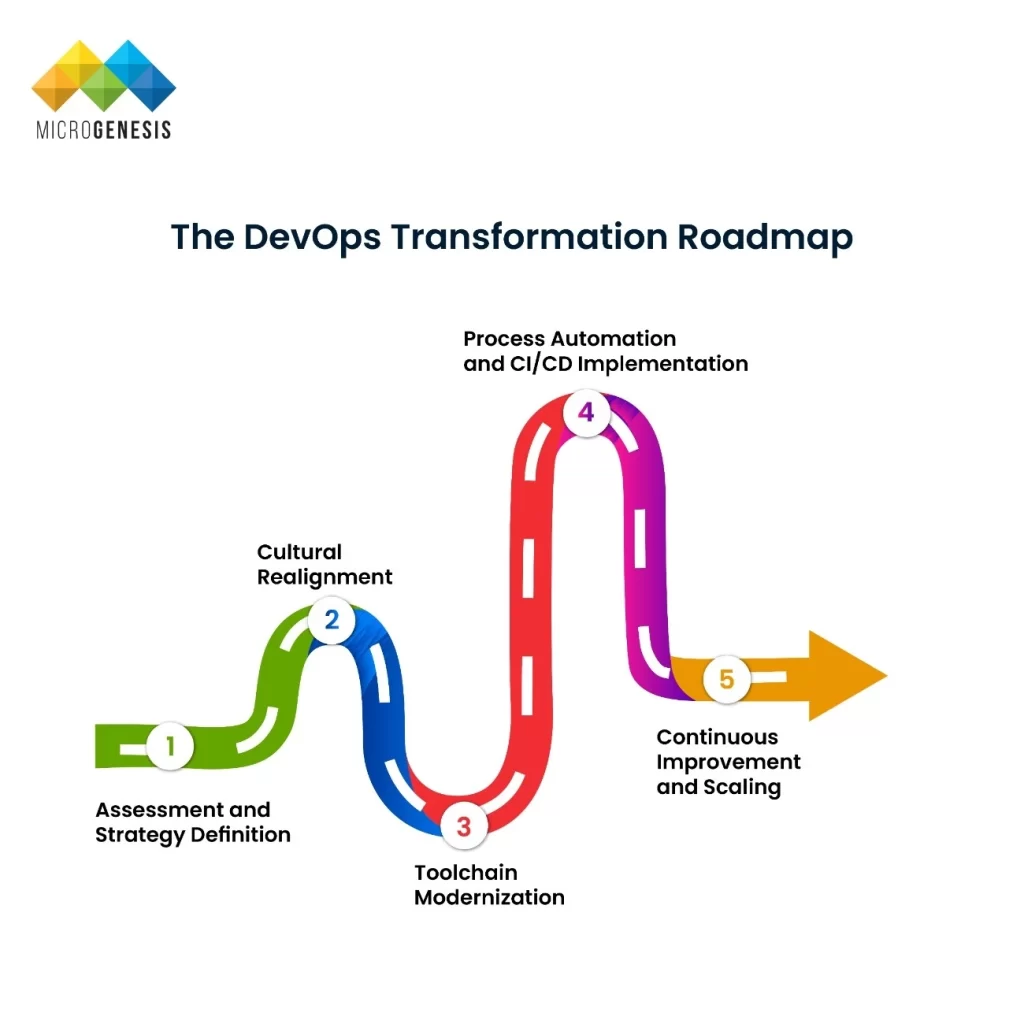
Transitioning to DevOps follows a structured yet iterative path. Successful organizations typically progress through five stages:
Assessment and Strategy Definition
- Conduct a maturity assessment of existing processes, tooling, and culture.
- Identify pain points such as deployment delays, manual testing, or poor visibility.
- Define measurable objectives (e.g., 50 % reduction in lead time).
Cultural Realignment
- Form cross-functional squads blending development, QA, operations, and security.
- Introduce training programs and internal champions.
- Communicate a unified vision linking DevOps outcomes to business value.
Toolchain Modernization
- Standardize on an integrated toolchain aligned with your cloud or on-premises ecosystem.
- Prioritize interoperability, automation, and observability.
- Avoid “tool sprawl” by selecting platforms that cover multiple lifecycle stages.
Process Automation and CI/CD Implementation
- Begin with small pilot projects.
- Automate build, test, and deployment pipelines.
- Expand automation to infrastructure provisioning and monitoring.
Continuous Improvement and Scaling
- Establish feedback loops through metrics and retrospectives.
- Institutionalize governance models to sustain performance.
- Scale successful patterns across departments.
Common Challenges in DevOps Transformation
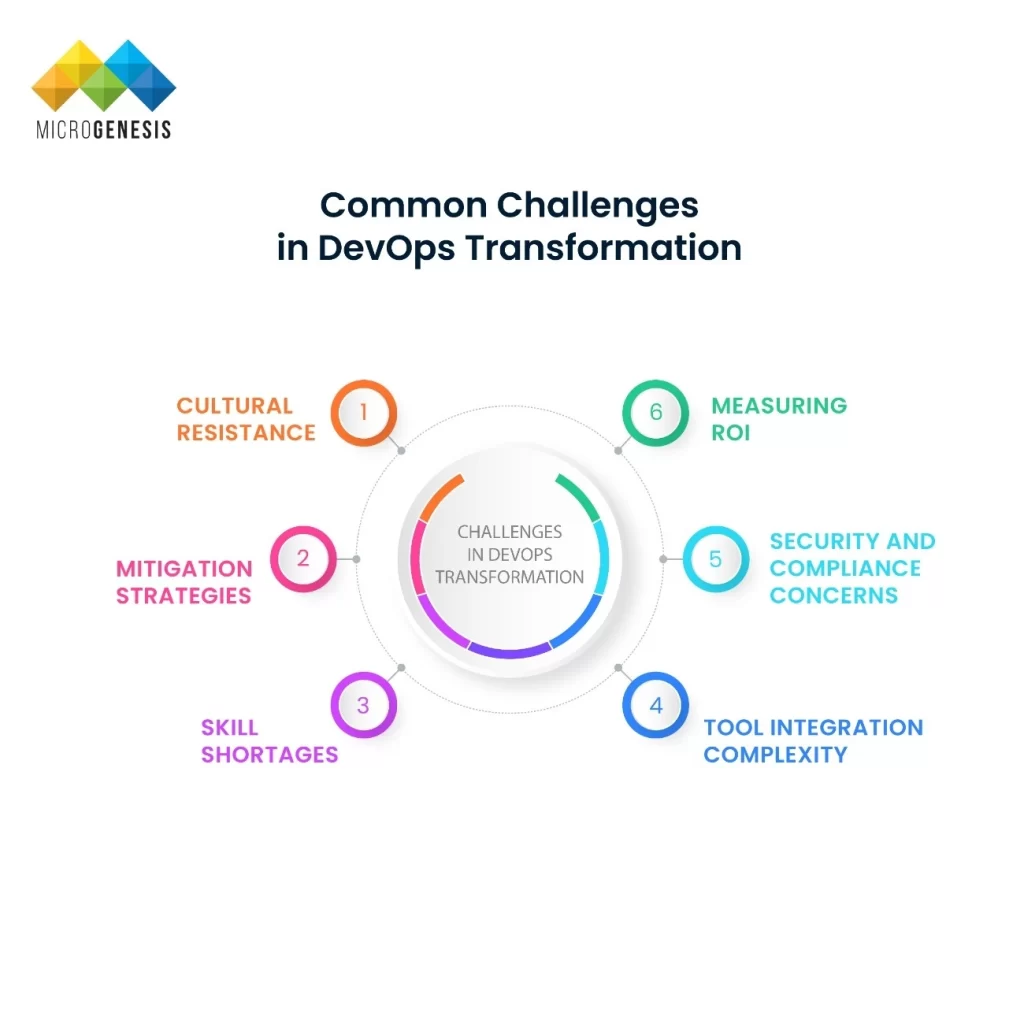
Despite its transformative potential, the journey to DevOps maturity is rarely linear. Many organizations encounter significant obstacles that impede adoption or diminish the expected return on investment.
These challenges often stem from organizational inertia, technical debt, and skill gaps, rather than the DevOps philosophy itself.
Understanding these barriers — and proactively addressing them — is critical to achieving sustainable transformation.
Cultural Resistance
Among all challenges, cultural resistance remains the most persistent and underestimated.
DevOps demands a paradigm shift in mindset — from rigid hierarchies and siloed accountability to open collaboration and shared responsibility. For many teams, this represents a direct challenge to long-established norms and comfort zones.
Sources of Resistance:
- Fear of job displacement: Automation and cross-functional roles may trigger anxiety about relevance.
- Loss of control: Traditional operations teams may feel marginalized as deployment autonomy shifts to development.
- Unclear ownership: Without clearly defined responsibilities, teams may resist shared accountability.
- Legacy processes: Bureaucratic approval chains and outdated governance models slow change adoption.
Mitigation Strategies:
- Transparent Communication: Leaders must clearly articulate the purpose and benefits of DevOps transformation. Explain why change is occurring and how it supports strategic goals.
- Leadership Advocacy: Senior executives should model DevOps behaviors — collaboration, openness, and trust. Their visible support legitimizes transformation efforts.
- Incremental Change: Start small, celebrate early wins, and expand progressively. Pilot projects that demonstrate measurable improvements in speed and quality help convert skeptics.
- Cultural Enablement Programs: Workshops, team-building sessions, and shared learning experiences foster alignment and empathy among previously siloed teams.
Read More: Top DevOps Challenges and Solutions
Key Insight:
Culture cannot be mandated — it must be cultivated. Sustainable DevOps adoption occurs when individuals internalize shared goals, not when compliance is enforced.
Skill Shortages
The multidisciplinary nature of DevOps — blending software development, systems engineering, cloud infrastructure, security, and automation — creates a steep learning curve for many organizations.
Challenges:
- Limited expertise: Traditional IT teams may lack proficiency in scripting, CI/CD tools, or container orchestration.
- Over-reliance on key individuals: Knowledge silos can emerge if only a few engineers understand automation pipelines.
- Talent scarcity: The global demand for skilled DevOps engineers far exceeds supply, driving up hiring costs.
Mitigation Strategies:
- Continuous Learning Culture: Encourage upskilling through internal training, workshops, and certifications (e.g., AWS DevOps Engineer, Kubernetes Administrator).
- Cross-Functional Mentorship: Pair development and operations professionals to share expertise.
- Center of Excellence (CoE): Establish a dedicated DevOps CoE to standardize practices, document frameworks, and mentor teams across departments.
- Strategic Recruitment: Focus hiring on individuals with adaptive learning ability rather than narrow tool proficiency.
- Partner Ecosystems: Leverage managed service providers or consultants to accelerate transformation while internal teams build capability.
Key Insight:
DevOps success is not determined by tools but by people who can bridge disciplines. Skill development should be viewed as a long-term investment, not a one-time training initiative.
Tool Integration Complexity
As organizations adopt DevOps, they often encounter tool sprawl — a proliferation of disconnected platforms for source control, CI/CD, testing, monitoring, and collaboration.
While each tool may excel individually, lack of integration undermines visibility and consistency across the delivery pipeline.
Challenges:
- Inconsistent data flow: Disparate systems hinder end-to-end traceability.
- Duplicate effort: Teams may maintain redundant pipelines or configurations.
- Maintenance overhead: Upgrading and securing multiple tools increases administrative burden.
- Vendor lock-in: Proprietary platforms may limit flexibility or integration with future technologies.
Mitigation Strategies:
- Standardized Toolchain Architecture: Define a unified DevOps toolchain aligned with organizational workflows and business objectives.
- Adopt Open Standards and APIs: Ensure tools support interoperability (e.g., REST APIs, webhooks, and open telemetry standards).
- Automation of Integration: Use orchestration platforms or pipeline-as-code frameworks to unify workflows.
- Centralized Observability: Implement monitoring systems that aggregate logs, metrics, and traces from across tools for holistic visibility.
- Periodic Toolchain Audits: Review tool effectiveness and eliminate redundancy to maintain efficiency.
Key Insight:
DevOps tools should work as a cohesive ecosystem, not as isolated silos. Integration must be designed around workflows, not the other way around.
Security and Compliance Concerns
As deployment velocity increases, so does the risk of security oversights. In many organizations, security and compliance were traditionally addressed late in the release cycle — an approach incompatible with DevOps speed.
The solution is DevSecOps: embedding security as an integral, automated component of every stage in the software lifecycle.
Challenges:
- Late-stage security checks: Vulnerabilities discovered during final testing delay releases.
- Manual compliance processes: Audits and approvals slow down CI/CD pipelines.
- Limited collaboration: Security teams often operate independently, creating friction with developers.
- Regulatory complexity: Compliance frameworks (e.g., GDPR, HIPAA, ISO 27001) impose stringent controls on data and operations.
Mitigation Strategies:
- Shift Security Left: Integrate automated vulnerability scans, dependency checks, and static code analysis into CI/CD pipelines.
- Compliance as Code: Encode regulatory policies (e.g., encryption standards, access control) into infrastructure templates for automated enforcement.
- Security Awareness Training: Educate developers on secure coding practices and common vulnerabilities (e.g., OWASP Top 10).
- Automated Governance: Utilize policy engines such as Open Policy Agent (OPA) to ensure configurations align with compliance standards.
- Collaborative Security Culture: Embed security specialists within development squads to guide early design decisions.
Key Insight:
Security should not be a gatekeeper but a strategic enabler. When automated and embedded into delivery workflows, it strengthens resilience without sacrificing agility.
Measuring ROI
Quantifying the return on investment (ROI) of DevOps initiatives remains one of the most elusive challenges. While benefits such as faster releases or improved collaboration are evident qualitatively, translating them into financial terms requires a disciplined approach.
Challenges:
- Intangible Benefits: Cultural improvements or reduced burnout are difficult to express in monetary terms.
- Inconsistent Metrics: Teams may track different KPIs, making organization-wide analysis impossible.
- Short-Term Focus: Management may expect immediate ROI, overlooking long-term capability building.
Mitigation Strategies:
- Establish Baselines: Measure existing performance (e.g., deployment frequency, failure rates, MTTR) before transformation begins.
- Align Metrics to Business Outcomes: Connect technical improvements to business KPIs — such as revenue growth, customer satisfaction, or operational savings.
- Adopt Industry Benchmarks: Use DORA metrics and industry standards to assess maturity and compare against peers.
- Leverage Observability Data: Use analytics dashboards to visualize delivery speed, resource utilization, and incident trends over time.
- Iterative ROI Tracking: View ROI as a cumulative trajectory — improvement compounds as automation and culture mature.
Key Insight:
DevOps ROI is not a static figure but a continuous performance curve. The real return lies in organizational agility — the ability to innovate, respond to change, and maintain reliability at scale.
Measuring DevOps Success
Measurement transforms perception into evidence. The DORA metrics have become the industry benchmark:
Complement these with business metrics such as customer satisfaction, Net Promoter Score (NPS), and revenue from new features.
Case Studies: DevOps in Practice
Netflix
Netflix pioneered cloud-native DevOps by building a microservices architecture on AWS. Tools like Spinnaker and Chaos Monkey automate deployment and resilience testing, enabling thousands of safe daily releases.
Amazon
Amazon’s mantra — “You build it, you run it” — decentralized ownership to individual teams. The company deploys code every 11 seconds on average, achieving both scale and reliability through complete automation.
Etsy
Etsy transitioned from fragile deployments to a culture of continuous experimentation. Through automated pipelines and blameless post-mortems, it transformed release cycles from days to minutes while improving developer morale.
The Future of DevOps
AI-Driven Operations (AIOps)
Machine learning algorithms analyze logs and metrics to predict failures, optimize capacity, and automate root-cause analysis.
GitOps
Expands DevOps principles by using Git repositories as the single source of truth for infrastructure and application configuration, enhancing traceability and rollback.
Platform Engineering
Organizations are increasingly building internal developer platforms (IDPs) that abstract away infrastructure complexity, enabling developers to self-serve environments and CI/CD pipelines.
Edge and Multi-Cloud DevOps
As systems become more distributed, DevOps practices extend to the edge. Unified observability and automation are essential for managing latency and consistency across multiple clouds.
Conclusion
DevOps transformation represents far more than a technological modernization; it is a strategic reinvention of how organizations deliver value, collaborate across functions, and respond to market dynamics. In an era where speed, innovation, and reliability define competitiveness, DevOps provides the structural and cultural foundation for sustainable digital agility.
By harmonizing culture, tools, and practices, enterprises create a self-reinforcing cycle of collaboration, automation, and continuous improvement. This triad ensures that innovation is not accidental but intentional — driven by data, enabled by technology, and sustained by empowered teams.
Sustained success, however, extends beyond automation or pipelines. It requires visionary leadership that nurtures psychological safety, encourages cross-functional learning, and embraces an iterative, feedback-driven mindset. Organizations that embed these principles evolve from static IT departments into dynamic value creators, capable of adapting to disruption and opportunity alike.
In this transformative journey, partners like MicroGenesis play a pivotal role.
With deep expertise in DevOps consulting, automation frameworks, and enterprise modernization, MicroGenesis helps organizations architect tailored transformation roadmaps — aligning business goals with engineering excellence. By integrating cutting-edge tools, scalable cloud-native platforms, and agile best practices, MicroGenesis accelerates DevOps maturity while minimizing disruption and risk.
Through its proven methodologies, MicroGenesis enables clients to:
- Streamline software delivery pipelines and eliminate deployment bottlenecks.
- Implement Infrastructure as Code and cloud automation for consistent, scalable environments.
- Build security-integrated CI/CD ecosystems to achieve DevSecOps compliance.
- Cultivate a collaborative DevOps culture that bridges development, operations, and business stakeholders.
When executed holistically — and supported by expert partners like MicroGenesis — DevOps becomes not merely a methodology, but a competitive capability. It empowers organizations to innovate fearlessly, deliver reliably, and adapt continuously in a world defined by rapid technological evolution and constant change.
In essence, DevOps transformation is the modern organization’s blueprint for digital resilience — and MicroGenesis stands at the forefront of guiding enterprises to achieve it.
FAQS
DevOps transformation is the process of aligning development and IT operations to enable faster, more reliable software delivery through automation, collaboration, and continuous improvement.
The main goal of DevOps is to deliver continuous business value by improving deployment speed, reliability, and collaboration between teams.
DevOps is important because it helps organizations release software faster, reduce errors, improve customer experience, and stay competitive in a digital-first world.
The key components of DevOps include culture, tools, automation, continuous integration, continuous delivery, and monitoring.
CI/CD stands for Continuous Integration and Continuous Delivery, which automate the process of building, testing, and deploying code.
DevOps transformation improves business performance by accelerating software delivery, reducing downtime, enhancing collaboration, and enabling faster response to market changes.
The main stages include:
Assessment and strategy
Cultural alignment
Toolchain modernization
CI/CD implementation
Continuous improvement and scaling
Common challenges include cultural resistance, skill shortages, tool integration complexity, security concerns, and difficulty measuring ROI.
DevOps supports digital transformation by enabling faster innovation, automation, cloud adoption, and continuous delivery of digital services.
Culture plays a critical role by promoting collaboration, shared responsibility, continuous learning, and psychological safety across teams.
DevOps improves deployment speed, increases reliability, enhances collaboration, reduces costs, and improves customer satisfaction.
Yes, DevOps reduces costs by automating processes, optimizing resource usage, minimizing downtime, and improving efficiency.
DevOps improves quality through automated testing, continuous monitoring, and early detection of issues in the development cycle.
DevOps is suitable for most organizations, especially those focused on software delivery, cloud environments, and digital transformation.
The future of DevOps includes AI-driven operations (AIOps), GitOps, platform engineering, and multi-cloud automation.
DevSecOps integrates security into the DevOps lifecycle, ensuring that security checks are automated and embedded in CI/CD pipelines.
DevOps success is measured using metrics like deployment frequency, lead time, change failure rate, and mean time to recovery (MTTR).
Common DevOps tools include Git, Jenkins, Docker, Kubernetes, Terraform, Prometheus, and Jira.
DevOps transformation can take several months to years depending on organizational size, culture, and technical complexity.
DevOps is primarily a culture supported by practices, tools, and processes that enable continuous delivery and collaboration.