
Embedded Firmware DevOps: Challenges and Solutions

In today’s technology-driven world, embedded systems power everything from automobiles and medical devices to industrial IoT machines and consumer electronics. At the core of these systems lies firmware, the software that bridges the gap between hardware and higher-level applications. With growing complexity, compliance requirements, and connectivity demands, traditional firmware development approaches often fall short. This is where embedded firmware DevOps comes in. By applying DevOps principles—automation, continuous integration, testing, and monitoring—specifically to firmware, organizations can achieve faster delivery, higher quality, and improved compliance. But while the opportunities are significant, implementing embedded firmware DevOps also comes with unique challenges. This blog explores those challenges in depth and provides actionable solutions to help organizations succeed in their DevOps transformation. What is Embedded Firmware DevOps? Embedded firmware DevOps is the application of DevOps practices and services—such as CI/CD (continuous integration and delivery), automated testing, infrastructure as code, and monitoring—to firmware development within embedded systems. Unlike enterprise IT software, embedded firmware interacts directly with hardware, often in resource-constrained, safety-critical, and long-lifecycle environments, making specialized DevOps services crucial for efficiency, reliability, and continuous improvement. The goals of embedded firmware DevOps are to: In short, embedded firmware DevOps brings the speed, automation, and reliability of modern DevOps into the specialized world of embedded development. Why Embedded Firmware DevOps Matters As industries embrace digital transformation, embedded systems are no longer static. Automotive ECUs now receive OTA (over-the-air) updates, medical devices require continuous security patches, and industrial IoT controllers need frequent performance tuning. Without embedded firmware DevOps, organizations struggle with: By contrast, organizations adopting embedded firmware DevOps gain: Key Challenges in Embedded Firmware DevOps While the benefits are clear, embedded firmware DevOps introduces unique challenges that don’t exist in standard software DevOps. Hardware Dependency and Availability Firmware is tightly coupled with hardware. Unlike cloud apps, you can’t fully test firmware without the target board or chip. Teams often face: Embedded development often relies on vendor-specific SDKs, compilers, and debuggers. These toolchains can: Compliance and Safety Standards Industries like automotive, aerospace, and healthcare require strict compliance with standards like: Challenges include: Testing Complexity Firmware testing is more complex than app testing because it must validate: Testing requires expensive HIL (hardware-in-the-loop) setups and often cannot be fully virtualized. Long Lifecycle Management Firmware often supports devices for 10–15 years. Managing updates, patches, and compatibility across such lifespans is difficult, especially when older hardware is no longer widely supported. Cultural and Skills Gaps Many embedded teams are highly skilled in low-level programming (C/C++, assembly) but may lack exposure to DevOps practices. This creates resistance to cultural change and slows adoption of embedded firmware DevOps. Solutions for Embedded Firmware DevOps Challenges For each challenge, there are proven solutions that organizations can adopt to succeed with embedded firmware DevOps. Addressing Hardware Dependence Streamlining Toolchains Automating Compliance Enhancing Testing Automation Managing Long Lifecycles Bridging Cultural and Skills Gaps These practices become more effective when integrated into a structured embedded CI/CD pipeline. Learn more about CI/CD for embedded systems, including tools, pipelines, and strategies. Best Practices for Embedded Firmware DevOps Successfully implementing embedded firmware DevOps requires more than tools and automation—it demands discipline, standardization, and a culture of continuous improvement. The following best practices help organizations streamline their pipelines, reduce risks, and maximize value from DevOps adoption in embedded environments. Shift Left Testing In embedded systems, late-stage bugs discovered during hardware validation or field testing can be catastrophic—delaying launches, increasing costs, and risking safety. Shifting testing left means catching defects earlier in the development cycle by automating: By embedding these checks into pipelines, embedded firmware DevOps ensures issues are detected before firmware even touches physical hardware. This not only improves quality but also reduces reliance on scarce test boards. Design for Modularity Traditional firmware development often results in monolithic codebases, which are hard to test, update, and maintain. With embedded firmware DevOps, modularity is critical: Modularity also supports long-term lifecycle management—making it easier to patch, enhance, or replace components without overhauling the entire system. Embed Security Early Security cannot be an afterthought in connected embedded systems. Vulnerabilities in firmware can lead to device hijacking, data breaches, or safety risks. Embedded firmware DevOps integrates security into every pipeline stage: This DevSecOps mindset ensures that devices are secure from day one and remain protected throughout their lifecycle. Standardize Pipelines One of the most common challenges in embedded development is toolchain fragmentation across different boards, chips, and product lines. To address this, organizations should: Standardization reduces errors, accelerates onboarding, and makes scaling embedded firmware DevOps across multiple teams and products much easier. Close the Feedback Loop In embedded firmware DevOps, the job isn’t done when firmware is deployed. Continuous monitoring and feedback are critical for improvement: This closed-loop approach helps organizations improve quality continuously and respond quickly to issues in the field. Prioritize Scalability Most organizations don’t just manage one embedded product—they oversee entire product portfolios. Scalability in embedded firmware DevOps means: Scalable pipelines reduce duplication of effort and allow engineering teams to work faster, even as product lines expand. Balance Simulation and Hardware Simulation and emulation are powerful tools in embedded firmware DevOps, enabling rapid iteration without waiting for hardware. However, real-world testing is still essential: This balanced approach speeds up development while ensuring firmware behaves correctly on actual hardware under real-world conditions. ✅ Together, these best practices create a resilient, repeatable, and compliant embedded firmware DevOps pipeline—enabling organizations to deliver firmware faster, safer, and with higher quality. The Future of Embedded Firmware DevOps The landscape of embedded firmware DevOps is evolving rapidly. Future trends include: Organizations that embrace these trends will deliver firmware that is faster, safer, and future-ready. Conclusion: Partnering with MicroGenesis Adopting embedded firmware DevOps is not without challenges—hardware bottlenecks, fragmented toolchains, compliance burdens, and cultural barriers all stand in the way. But with the right solutions—automation, simulation, compliance-as-code, and pipeline standardization—these challenges can be overcome. At MicroGenesis, we specialize in helping automotive, medical, and industrial organizations modernize their embedded firmware DevOps pipelines. Our DevOps consulting services help organizations design CI/CD pipelines, automate engineering workflows,
Automating the Embedded Software Lifecycle with DevOps

The embedded systems industry is under unprecedented pressure. From automotive ECU development to medical device firmware and industrial IoT controllers, products are becoming more software-driven, safety-critical, and connected. Yet, many organizations still rely on slow, manual, and siloed processes that hinder innovation and compliance. This is where embedded software lifecycle automation with DevOps makes the difference. By applying DevOps principles—automation, continuous integration, testing, compliance, and monitoring—across the entire lifecycle, organizations can accelerate delivery, reduce risk, and future-proof their embedded products. In this blog, we’ll explore what embedded lifecycle automation looks like, why it matters, the challenges it addresses, and how organizations can get started. Understanding the Embedded Software Lifecycle The embedded software lifecycle is more complex than traditional IT software development because it bridges both hardware and software domains, often under strict regulatory requirements. The lifecycle typically includes: Requirements & Design Development & Build Integration & Testing Validation & Certification Deployment & Maintenance Unlike enterprise IT applications, embedded systems often have lifecycles spanning 10–15 years, meaning software updates, compliance requirements, and hardware dependencies must be supported long-term. Why Automate the Embedded Software Lifecycle? Manual processes no longer scale in industries demanding fast innovation and high reliability. Partnering with DevOps consulting services helps organizations automate the software lifecycle using proven DevOps principles—driving faster delivery, improved quality, and greater operational efficiency. For industries like automotive (autonomous driving), medtech (connected devices), and industrial IoT (predictive maintenance systems), lifecycle automation is becoming a strategic enabler, not just a technical upgrade. Embedded DevOps is also part of broader digital transformation, helping engineering teams connect automation, software delivery, testing, and operational feedback. Where DevOps Fits into the Embedded Software Lifecycle Applying DevOps to embedded systems means aligning automation to each stage of the lifecycle: Requirements & Design Automation Build & Compilation Automation Testing & Validation Automation These practices are particularly important when embedded teams need repeatable CI/CD workflows across simulation and physical hardware. Explore CI/CD for embedded systems to understand the tools and pipeline strategies involved. Compliance Automation Deployment Automation Monitoring & Feedback Automation In short, embedded software lifecycle automation is about creating a continuous feedback loop—from requirements to deployment and back again. Key Tools for Embedded Software Lifecycle Automation Building an automated embedded DevOps pipeline requires a well-curated toolchain: 🔑 The success of automation lies not in tools alone but in integration. Each tool should feed into the pipeline for seamless lifecycle coverage. Selecting the right DevOps automation tools can help teams standardize builds, testing, deployment, and monitoring across the lifecycle. Challenges in Automating the Embedded Software Lifecycle While the benefits are clear, organizations face specific hurdles in adopting embedded DevOps: Mitigation requires a phased approach—start with build/test automation, integrate compliance, then expand into deployment and monitoring. These challenges are closely related to the broader issues organizations face when implementing DevOps. See Embedded Firmware DevOps: Challenges and Solutions for a deeper look at hardware dependencies, toolchains, compliance, testing, and skills gaps. Best Practices for Embedded Software Lifecycle Automation Organizations that succeed in automating their embedded lifecycle tend to follow these best practices: The Future of Embedded Lifecycle Automation The next decade will redefine how embedded software lifecycle automation works: Organizations that embrace these trends will gain a significant competitive edge in speed, compliance, and reliability. Conclusion: How MicroGenesis Can Help Automating the embedded software lifecycle with DevOps is no longer optional—it’s essential for industries like automotive, medical devices, and industrial IoT. By embedding automation into builds, testing, compliance, deployment, and monitoring, organizations working with a top software company can achieve faster releases, higher quality, and improved operational efficiency. However, implementation is challenging. Hardware bottlenecks, compliance complexity, and skill shortages often stall progress. This is where MicroGenesis can help. With deep expertise in embedded DevOps, CI/CD for embedded systems, and lifecycle automation, we support organizations in: By partnering with MicroGenesis, you gain more than automation—you gain a strategic partner committed to making your embedded software lifecycle faster, safer, and future-ready. Looking for DevOps services and solutions? Connect with us today to accelerate your transformation.
CI/CD for Embedded Systems: Tools, Pipelines, and Strategies
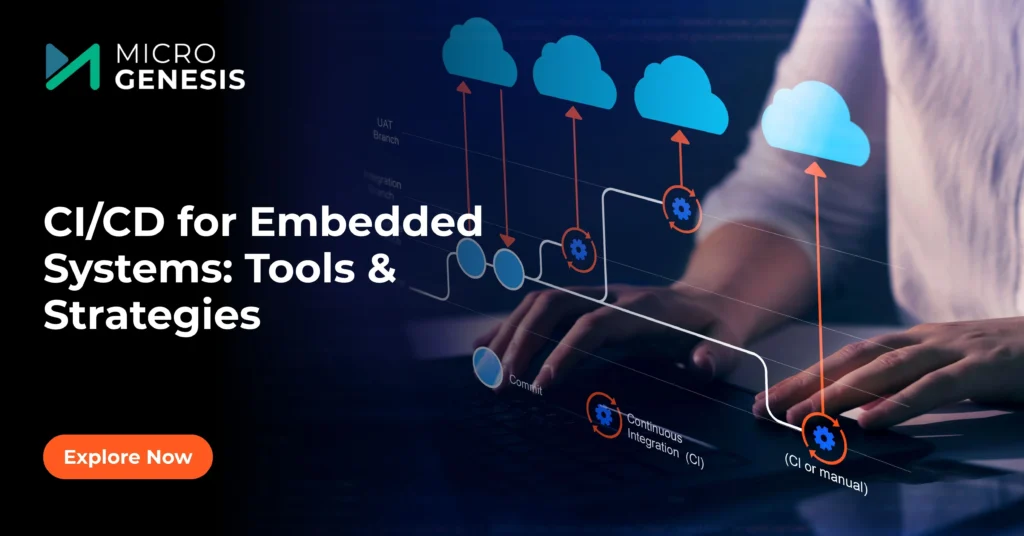
The rise of connected devices, automotive electronics, and industrial IoT has put embedded software at the center of innovation. But while enterprise software teams have embraced DevOps and CI/CD to accelerate delivery, embedded engineering often lags behind — constrained by hardware dependencies, safety standards, and long development cycles. That’s changing fast. Today, CI/CD for embedded systems is no longer a luxury — it’s a necessity for organizations that want to deliver faster, safer, and more reliable embedded products. With embedded continuous integration and automated pipelines, teams can reduce defects, accelerate time-to-market, and stay compliant with industry regulations. In this blog, we’ll dive deep into tools, pipelines, and strategies for implementing CI/CD in embedded systems, along with best practices for building a sustainable embedded software pipeline. 1. Why CI/CD Matters for Embedded Systems In traditional embedded software projects, development often followed a waterfall model — long design phases, months of coding, and extensive manual testing before release. The result? Slow time-to-market, late detection of defects, and painful certification cycles. But industries like automotive, healthcare, and industrial IoT no longer have the luxury of slow iteration. Products must evolve quickly, securely, and in compliance with strict regulations. For example, an automotive ECU update can’t wait for six months of testing; customers expect over-the-air (OTA) fixes within days. Here’s why CI/CD for embedded systems has become indispensable: In short, CI/CD turns embedded development into a continuous, iterative process, allowing companies to compete on both speed and reliability. 2. Key Components of an Embedded Software Pipeline An embedded software pipeline looks similar to enterprise CI/CD but includes embedded-specific layers tailored for hardware integration, testing, and compliance. It acts as a bridge between hardware, software, and regulatory requirements. Partnering with a trusted DevOps service provider ensures this pipeline is optimized for automation, security, and scalability—helping teams accelerate delivery while maintaining reliability. This layered embedded continuous integration pipeline ensures that quality, compliance, and security are built into every stage. 3. Tools for CI/CD in Embedded Systems Selecting the right tools is critical because embedded pipelines combine enterprise DevOps tooling with domain-specific frameworks. Here’s how the ecosystem maps out: 🔑 Best practice: Don’t overload teams with too many tools. Instead, design a well-integrated toolchain tailored to compliance needs and hardware platforms. 4. Strategies for Designing CI/CD Pipelines in Embedded Systems Unlike traditional software DevOps, embedded CI/CD requires domain-specific strategies to overcome hardware and compliance barriers. a. Start with Simulation First Since boards are scarce early in development, start with virtual prototypes and emulators. Run unit and integration tests in simulation while hardware is being developed. b. Modularize the Pipeline Avoid monolithic builds. Instead, design modular jobs (e.g., firmware drivers, middleware, application logic) that can run in parallel for faster feedback. c. Integrate Compliance from Day One Regulated industries can’t afford compliance as an afterthought. Bake MISRA checks, static analysis, and traceability reports directly into your CI/CD workflows. d. Layered Testing Stages Adopt a staged test approach: e. Secure the Pipeline CI/CD pipelines themselves are now attack targets. Implement: f. Automate OTA Updates For IoT and automotive, CD pipelines should extend to OTA updates with rollback strategies in case of failed updates. By combining these strategies, organizations can build resilient, compliant, and hardware-aware CI/CD pipelines. 5. Challenges in Embedded CI/CD While embedded continuous integration offers huge benefits, teams often face unique roadblocks: Addressing these challenges means embedding simulation, compliance automation, and cross-functional collaboration into the pipeline from the start. 6. Best Practices for Embedded CI/CD Pipelines To maximize success, organizations should follow these best practices: By following these embedded CI/CD best practices, organizations can balance innovation speed with compliance and reliability — the holy grail of embedded development. 7. The Future of CI/CD in Embedded Systems Embedded systems are evolving faster than ever, driven by autonomous vehicles, connected medical devices, industrial IoT, and smart consumer electronics. As complexity grows, CI/CD pipelines must also adapt. The future of CI/CD for embedded systems lies in making pipelines smarter, more scalable, and compliance-aware by default. Here are the major trends shaping the future: a. AI-Driven Testing and Automation Manual test creation is often the biggest bottleneck in embedded software pipelines. With AI, teams can: This reduces time-to-feedback dramatically and ensures more defects are caught earlier in the lifecycle. b. Digital Twins and Virtual Labs Physical hardware test rigs will always be necessary, but they’re expensive and limited in scale. The next frontier is digital twins — virtual replicas of hardware that mimic real-world performance. c. Cloud-Native Embedded DevOps Historically, embedded pipelines ran on-premise labs. But as hardware emulation and compliance automation move to the cloud, embedded teams will: This shift makes CI/CD more scalable and accessible, especially for distributed teams. d. Compliance-as-Code Currently, generating compliance artifacts (e.g., for ISO 26262, IEC 62304, DO-178C) is manual and tedious. In the future, pipelines will handle compliance-as-code: This will make compliance a continuous process rather than a painful, late-stage hurdle. e. Quantum-Safe and Secure Pipelines As IoT and automotive systems become more connected, pipeline security becomes critical. Future CI/CD workflows will: This is especially vital in automotive, defense, and healthcare, where compromised pipelines can endanger human lives. f. Composable Pipelines and Reusable Modules Instead of building one massive pipeline per project, future embedded pipelines will be composable: This modularity will enable large enterprises to standardize DevOps practices across multiple product lines while still allowing customization. Learn More: The Role of DevOps in Accelerating Digital Transformation g. Continuous Field Validation (CFV) Beyond CI/CD, the future is continuous monitoring and validation of devices in production: Essentially, the line between development, deployment, and operations will blur, creating a true closed-loop embedded DevOps ecosystem. 🔑 The Bottom Line: The future of CI/CD for embedded systems will be about automation at scale, compliance baked in, and intelligence powered by AI and cloud computing. Teams that embrace these trends will deliver faster, safer, and more competitive products in industries where embedded systems are mission-critical. Conclusion: How MicroGenesis Can Help CI/CD for embedded systems is no longer optional — it’s a
The Role of DevOps in Accelerating Digital Transformation

In today’s highly competitive digital landscape, organizations must continuously evolve to meet customer expectations, innovate rapidly, and remain agile. Digital transformation is no longer optional—it is a critical business imperative. However, transformation is only successful when technology, people, and processes align to deliver value efficiently. DevOps, a set of practices that bridges development and operations, plays a pivotal role in accelerating digital transformation by fostering collaboration, streamlining processes, and enabling faster, more reliable software delivery. DevOps as an Enabler of Digital Transformation Faster Releases One of the core benefits of DevOps is the ability to release software more frequently and reliably. Traditional development models, like the Waterfall approach, often involve long release cycles that delay time-to-market. DevOps promotes continuous integration and continuous deployment (CI/CD), allowing organizations to deliver incremental updates in smaller, manageable batches. Frequent releases enable teams to respond to customer feedback quickly, fix defects faster, and deploy new features without disrupting operations. This agility is a key driver of digital transformation, as it allows organizations to adapt to changing market demands promptly. Real-World Example: A global e-commerce company implemented automated CI/CD pipelines, reducing release cycles from monthly to daily. This shift allowed them to roll out personalized features and promotions in real time, enhancing customer engagement and satisfaction. Improved Collaboration Between Development and Operations DevOps emphasizes breaking down silos between development, operations, and other stakeholders. By leveraging expert DevOps consulting services and fostering a culture of shared responsibility, DevOps ensures that teams communicate effectively, share knowledge, and collaborate throughout the software lifecycle. Cross-functional teams can anticipate operational issues during development and proactively address them, reducing errors and rework. Enhanced collaboration accelerates digital transformation by aligning technical initiatives with business goals. Real-World Example: A multinational software firm reorganized its teams into DevOps squads combining developers, operations engineers, and QA specialists. This approach reduced friction, improved issue resolution times, and accelerated deployment of new features across multiple regions. Automation and Efficiency Automation is the backbone of DevOps. By automating repetitive tasks such as code compilation, testing, deployment, and infrastructure provisioning, organizations reduce human errors and save time. Automation also supports consistent and repeatable processes, enabling teams to scale operations efficiently. The efficiency gained through DevOps automation allows IT teams to focus on strategic initiatives, innovation, and enhancing customer value, rather than spending time on manual tasks. Key Automation Areas: Enhanced Customer Experience DevOps contributes directly to a superior customer experience. Frequent releases, improved reliability, and faster response to issues ensure that customers consistently interact with high-quality applications. Continuous monitoring and feedback mechanisms allow organizations to understand user behavior and performance in real time, enabling them to make informed improvements that enhance user satisfaction. The ability to rapidly respond to changing customer needs is a hallmark of digital transformation. Real-World Example: A fintech startup leveraged DevOps practices to release new payment features weekly. Real-time monitoring and automated alerts allowed the team to quickly address issues, resulting in a 35% increase in customer retention within six months. Measuring Success in DevOps-Driven Digital Transformation Key Metrics for Tracking Progress Measuring the impact of DevOps on digital transformation is critical to ensure initiatives align with business objectives. Organizations should track the following metrics: Tracking these metrics helps organizations understand where improvements are needed, validate ROI, and make data-driven decisions that support the ongoing digital transformation journey. Read more: Top DevOps Challenges and Solutions: Unlocking Success with MicroGenesis Benchmarking and Continuous Improvement Organizations can further enhance their transformation by benchmarking their performance against industry leaders. The DevOps Research and Assessment (DORA) metrics provide a framework for comparing deployment frequency, lead time, MTTR, and change failure rate with industry standards. Continuous assessment enables teams to identify gaps, implement best practices, and refine processes to achieve higher efficiency and innovation rates. Case Examples of DevOps Accelerating Digital Transformation 1. Retail Sector A large retail chain adopted DevOps to modernize its e-commerce platform. By implementing CI/CD pipelines, automated testing, and container orchestration, the company reduced downtime during updates, increased release velocity, and personalized customer experiences in real time. This digital transformation helped the retailer compete effectively with online-first competitors. 2. Financial Services A banking institution faced challenges with slow software updates and regulatory compliance. Integrating DevOps with automated compliance checks and secure pipelines enabled faster release cycles, improved system reliability, and ensured adherence to financial regulations. This transformation allowed the bank to launch new digital products ahead of competitors. 3. Healthcare A healthcare software provider leveraged DevOps practices to manage critical patient data applications. Automation, monitoring, and robust security practices ensured compliance with healthcare regulations while enabling rapid feature delivery. The result was improved patient engagement and operational efficiency across clinics and hospitals. Best Practices for Leveraging DevOps in Digital Transformation Conclusion and Call to Action DevOps is not just a methodology—it is a catalyst for digital transformation. By enabling faster releases, fostering collaboration, promoting automation, and enhancing customer experience, DevOps empowers organizations to innovate rapidly and remain competitive. Measuring success through key metrics ensures that initiatives deliver tangible business value. At MicroGenesis, a top software company, we specialize in driving DevOps-led digital transformation. Our experts help organizations design strategies, implement automation, optimize pipelines, and monitor success metrics to achieve measurable outcomes. Partner with MicroGenesis to accelerate your innovation, enhance operational efficiency, and unlock the full potential of DevOps for your digital transformation journey.
Top DevOps Challenges and Solutions: Unlocking Success with MicroGenesis

DevOps adoption promises faster software delivery, improved collaboration, and higher-quality products. However, many organizations face challenges implementing DevOps effectively due to cultural, technical, and operational obstacles. Understanding these issues and adopting the right strategies is key to achieving the full benefits of DevOps. Common DevOps Challenges 1. Cultural Resistance Resistance to change is one of the most significant challenges. Development and operations teams may be accustomed to working in silos with differing priorities and workflows. Fear of change, uncertainty about new processes, or discomfort with automation can slow DevOps adoption. Leadership, communication, and fostering a collaborative culture are essential to overcome this. 2. Siloed Teams Even with a DevOps mandate, teams often maintain separate responsibilities and limited communication. Silos hinder collaboration, delay problem-solving, and reduce visibility across delivery pipelines. Cross-functional teams and shared KPIs help break down these barriers. 3. Toolchain Complexity The DevOps ecosystem offers numerous tools for CI/CD, configuration management, container orchestration, and monitoring. Selecting, integrating, and managing these tools can be overwhelming. Without proper planning, tool sprawl creates inefficiencies. Standardizing on a cohesive toolchain is crucial. 4. Security and Compliance Automating deployments and scaling quickly introduces new security and compliance risks. Ensuring code and infrastructure meet regulatory requirements while maintaining speed is challenging. Integrating security early into the DevOps lifecycle (DevSecOps) mitigates risk. 5. Scaling Pipelines As organizations grow, maintaining pipeline efficiency becomes harder. Poorly designed pipelines can create bottlenecks, slowing delivery and impacting release quality. Continuous optimization and monitoring are essential. 6. Knowledge Gaps and Skills Shortage Many teams struggle with a lack of expertise in modern DevOps tools and practices. Continuous training, workshops, and mentorship programs are essential to bridge these skill gaps. 7. Resistance to Automation Some teams hesitate to adopt automation due to fear of job loss or mistrust of technology. Demonstrating automation’s value in reducing repetitive tasks and improving quality can overcome this challenge. 8. Measuring Success Without clear metrics, organizations cannot gauge the effectiveness of DevOps adoption. Selecting meaningful KPIs like deployment frequency, lead time, and change failure rate ensures initiatives deliver measurable business outcomes. Solutions and Best Practices Foster Collaboration and a DevOps Culture Encourage shared responsibility between development, operations, and security teams. Promote open communication, regular feedback loops, and cross-functional training. Recognize collaboration and experimentation to build ownership and drive continuous improvement. Implement a Unified Toolchain Choose tools that integrate seamlessly across the DevOps lifecycle, from version control to deployment and monitoring. Standardizing reduces complexity, improves workflow efficiency, and provides better visibility. Integrate DevSecOps Practices Embed security and compliance checks into CI/CD pipelines to catch vulnerabilities early. By leveraging expert DevOps service providers, organizations can automate code analysis, dependency scanning, and compliance reporting. DevSecOps ensures security becomes a shared responsibility, minimizing organizational risk. Optimize and Scale Pipelines Regularly review pipelines to identify inefficiencies and potential delays. Use automation, parallelization, and monitoring to ensure pipelines scale while maintaining high quality. Provide Training and Support Equip teams with knowledge through continuous training, workshops, and mentorship. Ongoing support reduces skill gaps, builds confidence, and accelerates adoption. Implement Clear Metrics Establish KPIs such as deployment frequency, lead time for changes, MTTR, and change failure rate. Align these metrics with business objectives to demonstrate tangible impact. Dig Deeper: DevOps Metrics That Matter: How to Measure Success Encourage Automation of Repetitive Tasks Identify repetitive manual processes and automate testing, builds, and deployments. This reduces errors, frees team members for strategic work, and accelerates time-to-market. Promote Continuous Feedback Loops Set up real-time feedback mechanisms from monitoring systems, user analytics, and performance metrics. Early detection allows teams to adapt quickly and continuously improve. Implement Change Management Practices Document processes, create clear guidelines, and communicate changes transparently. Change management reduces friction and builds trust when adopting new tools and practices. Real-World Example A multinational software firm faced delayed releases due to siloed teams and fragmented tools. By adopting a unified DevOps toolchain, creating cross-functional squads, integrating automated security checks, and automating repetitive tasks, the company achieved remarkable results: Conclusion DevOps offers tremendous benefits, but challenges like cultural resistance, fragmented toolchains, and inefficient pipelines can hinder adoption and diminish ROI. By fostering collaboration, standardizing tools, integrating DevSecOps, optimizing pipelines, automating repetitive tasks, promoting continuous feedback, implementing change management, providing training, and measuring success with clear metrics, organizations can unlock the full potential of DevOps. At MicroGenesis, a top software company, we guide businesses through their DevOps journey. Our expertise spans strategy, tool integration, pipeline optimization, automation, and continuous improvement. Partnering with us ensures successful adoption, measurable results, and sustained digital transformation.
DevOps Automation: Tools That Streamline Deployment
In modern software development, speed and reliability are non-negotiable. Organizations must deliver features faster while maintaining stability, security, and scalability. This is where DevOps automation plays a critical role. By automating repetitive tasks and streamlining deployment processes, DevOps teams can achieve higher efficiency and consistency. This blog explores the tools and best practices that make DevOps automation successful. Why DevOps Automation Matters Manual deployment and configuration slow down delivery and introduce human error. Automation: In short, automation is the backbone of modern DevOps. Key Categories of DevOps Automation Tools Understanding the key categories of DevOps automation tools is essential for organizations to optimize workflows, improve quality, and accelerate delivery. These categories include: 1. Continuous Integration and Continuous Deployment (CI/CD) CI/CD tools automate building, testing, and deploying code, ensuring faster, more reliable releases. By integrating code changes frequently and deploying automatically, teams reduce manual errors and get rapid feedback. Example: A retail company using Jenkins reduced release times from weekly to multiple times a day, significantly improving customer experience. 2. Configuration Management These tools ensure systems and infrastructure remain consistent across environments, reduce configuration drift, and enable automated provisioning. Example: Ansible helped a financial services firm automate server configurations across multiple data centers, saving hundreds of hours per year. 3. Containerization and Orchestration Containers package applications with dependencies, while orchestration platforms manage deployment, scaling, and availability. Example: A SaaS provider leveraged Kubernetes to scale globally with zero downtime during peak usage. 4. Infrastructure as Code (IaC) IaC tools manage infrastructure through code, ensuring repeatability, consistency, and version control. Example: Terraform enabled a healthcare startup to replicate cloud environments instantly, improving compliance and disaster recovery readiness. 5. Monitoring and Observability Automation doesn’t end with deployment—continuous monitoring ensures systems remain stable, performant, and resilient. Example: A logistics company used Prometheus and Grafana to detect performance degradation early, reducing downtime by 40%. 6. Testing Automation Automated testing ensures rapid delivery without sacrificing quality, improving reliability and customer satisfaction. Example: Automated API testing helped a telecom firm cut regression testing time from days to hours. By understanding and strategically implementing these categories, organizations can create a cohesive DevOps automation ecosystem that accelerates delivery, reduces errors, and supports continuous improvement. Choosing the Right Tools With so many options available in the DevOps ecosystem, selecting the right tools can be overwhelming. A poor choice may create friction, increase costs, or complicate workflows. On the other hand, a thoughtful selection ensures smoother adoption and long-term value. When evaluating tools, consider the following factors: A practical approach is to run proof-of-concept (POC) trials with shortlisted tools to evaluate ease of use, performance, and integration capabilities in your real environment. Collect feedback from engineers, operations staff, and security teams before making final decisions. Organizations often start with one category (like CI/CD) and gradually expand to orchestration, IaC, and monitoring as maturity grows. By treating tool selection as an iterative process rather than a one-time decision, businesses can evolve their DevOps toolchain alongside their transformation journey. Learn More: Integrating DevOps with Agile ALM: Driving Continuous Delivery Best Practices for DevOps Automation Automation is only as effective as the strategy behind it. While tools provide the foundation, best practices ensure long-term success and sustainable growth. Here are some expanded guidelines: Pro Tip: Encourage a culture of collaboration—automation should empower, not replace, teams. Foster open communication between developers, operations, security, and leadership. When automation is seen as a shared enabler rather than a threat, adoption is smoother and morale is higher. By following these best practices, organizations can transform automation from a tactical tool into a strategic advantage that Conclusion DevOps automation is not just about tools—it’s about creating a culture of speed, reliability, and continuous improvement. By partnering with a top software company and adopting the right mix of CI/CD, configuration management, container orchestration, IaC, and monitoring tools, organizations can streamline deployments and accelerate innovation. The right automation strategy ensures that DevOps delivers not just faster releases, but also resilient, high-quality software.
DevOps Metrics That Matter: How to Measure Success

Introduction In today’s fast-paced digital world, organizations rely heavily on DevOps to deliver software faster, with better quality, and greater efficiency. But adopting DevOps practices is only half the battle—measuring success is what truly defines whether DevOps is adding value. Metrics give teams visibility into performance, highlight bottlenecks, and ensure continuous improvement. Without meaningful metrics, DevOps risks becoming just another buzzword. This blog explores the DevOps metrics that matter most and provides guidance on how organizations can measure success effectively. Why Metrics Matter in DevOps Metrics act as the compass of DevOps. Without clear measurement, teams may feel they are moving fast but have no sense of direction. By contrast, metrics: Moreover, effective metrics serve as a communication tool between technical teams and business leaders. They bridge the gap by translating technical performance into business value, making it easier for executives to understand the impact of DevOps initiatives. However, tracking the wrong metrics (like vanity metrics) can mislead teams. For example, counting lines of code written does not equal progress—it may just mean more complexity. Similarly, tracking only uptime without context may overlook customer experience issues. The right metrics drive meaningful outcomes, ensuring DevOps teams are aligned with both technical excellence and business objectives. They foster a culture of accountability, continuous learning, and innovation, which is essential in today’s competitive digital landscape.- Help balance speed, stability, and customer satisfaction However, tracking the wrong metrics (like vanity metrics) can mislead teams. For example, counting lines of code written does not equal progress—it may just mean more complexity. With expert DevOps consulting, organizations can identify and measure the right metrics that drive meaningful outcomes, ensuring teams stay aligned with both technical excellence and business goals. The Four Key DevOps Metrics According to research like the DORA (DevOps Research and Assessment) State of DevOps Report, four key metrics have become industry standards for measuring DevOps success: 1. Deployment Frequency How often does your team deploy changes into production? High-performing DevOps teams release small, incremental updates frequently, ensuring faster innovation and quicker customer feedback. Frequent deployments also reduce the risk associated with large, monolithic releases. 2. Lead Time for Changes How long does it take for a code change to go from commit to production? Shorter lead times indicate streamlined workflows, effective collaboration, and greater agility. When teams can deliver features quickly, they can respond faster to customer needs and market demands. 3. Mean Time to Recovery (MTTR) How quickly can your team recover when incidents occur? A lower MTTR demonstrates resilience and strong incident response processes. In a customer-centric world, downtime directly impacts trust and revenue, making MTTR one of the most business-critical DevOps metrics. 4. Change Failure Rate What percentage of deployments result in a failure (rollback, hotfix, or incident)? A lower change failure rate reflects quality practices like thorough automated testing, code reviews, and proactive monitoring. High-performing teams manage to balance rapid deployments with dependable releases. Additional Metrics Worth Tracking While the DORA metrics are the gold standard, other supporting metrics provide deeper insights into DevOps maturity: These metrics provide a more holistic view by combining operational performance with customer-centric outcomes. Balancing Speed and Quality One common pitfall in DevOps is focusing only on speed. Fast deployments with high failure rates defeat the purpose. Metrics should always balance velocity with reliability. For instance: The most successful teams understand that speed means nothing without stability. They focus on delivering value faster but never compromise on software quality. Read More: Integrating DevOps with Agile ALM: Driving Continuous Delivery Implementing Metrics in Practice Adopting DevOps metrics isn’t just about tracking numbers—it’s about embedding a culture of measurement and continuous improvement. Metrics should serve as tools that empower teams to make informed decisions and deliver value, not as rigid scorecards. Here are some best practices to make metrics actionable: By embedding metrics into daily workflows and using them to drive decisions, teams create a feedback loop that supports innovation, resilience, and long-term cultural transformation. Conclusion Measuring DevOps success goes beyond speed—it requires tracking the right metrics that reflect business outcomes, customer experience, and operational excellence. By leveraging expert Top DevOps services companyand focusing on deployment frequency, lead time, MTTR, and change failure rate—supported by customer and business metrics—organizations can ensure DevOps is delivering true value. At MicroGenesis, we help organizations implement DevOps practices backed by meaningful metrics. As a trusted partner, we guide teams in adopting automation, monitoring, and data-driven strategies that accelerate delivery while maintaining quality. With the right DevOps metrics in place, businesses can unlock faster innovation, greater efficiency, and long-term customer satisfaction.
Integrating DevOps with Agile ALM: Driving Continuous Delivery

1. Introduction: From Agile to DevOps Agile has fundamentally changed how software teams operate. It promotes iterative development, rapid feedback, and adaptive planning, allowing teams to respond to changing business requirements and deliver incremental value to customers. However, even in Agile organizations, releasing software frequently and reliably remains challenging. Bottlenecks often appear in testing, deployment, and operations. This is where DevOps complements Agile. DevOps extends Agile principles beyond development to operations, integrating automation, monitoring, and collaboration across the entire software lifecycle. When combined with Agile Application Lifecycle Management (ALM) tools, organizations gain end-to-end traceability from requirement capture to production deployment, ensuring consistent delivery quality. Real-world example: A global automotive company used Agile ALM with IBM ELM for requirements and Polarion for traceability. By integrating DevOps pipelines with Jenkins, they reduced deployment times from weeks to hours, while ensuring compliance with ISO 26262 safety standards. 2. The Connection Between Agile ALM and DevOps Agile ALM focuses on iterative development and requirement management, while DevOps emphasizes automation, continuous integration, deployment, and monitoring. When combined: Key benefit: Teams achieve continuous delivery, meaning software is always in a deployable state, reducing time-to-market and operational risks. Real-world example: A healthcare software provider integrated Polarion ALM with Docker-based deployment pipelines. This allowed development teams to link requirements to automated tests and monitor patient data workflows in real-time, ensuring both compliance and performance. 3. Key Components of DevOps in Agile ALM 3.1 Continuous Integration (CI) CI involves frequently integrating code changes into a shared repository with automated builds and testing. Benefits: Tools & Integration: Jenkins, GitLab CI, Bamboo, integrated with IBM ELM or Polarion for requirement traceability. Example Workflow: 3.2 Continuous Delivery (CD) Continuous Delivery automates deployments to staging or production, making software releases predictable and repeatable. Benefits: Tools & Integration: Jenkins, GitLab CI/CD, Bamboo, Docker, Kubernetes. Example Workflow: 3.3 Infrastructure as Code (IaC) IaC automates infrastructure provisioning and configuration. Instead of manual server setup, scripts define the environment, ensuring consistency and repeatability. Benefits: Tools: Terraform, Ansible, Puppet, Chef, integrated with Agile ALM tools for end-to-end traceability. Example: A financial services company used Terraform scripts stored in Git repositories linked to Jira issues. Changes to environments were automatically tested and approved before deployment, ensuring compliance with regulatory standards. Learn more: Benefits of Automated Testing in QA Workflows 3.4 Continuous Monitoring Monitoring is critical to detect performance issues, security vulnerabilities, and user experience problems in real-time. Benefits: Tools: Prometheus, ELK Stack, Datadog, integrated with Agile ALM for feedback loops. Example: After deploying a new billing module, real-time monitoring flagged API latency spikes. DevOps engineers updated deployment scripts, and Agile ALM logged the issue for sprint planning, ensuring it was addressed in the next iteration. 4. Benefits of DevOps in Agile ALM Integrating DevOps practices into Agile Application Lifecycle Management (ALM) creates a powerful synergy that enables enterprises to deliver high-quality software faster, with greater reliability and business impact. Here’s a detailed look at the benefits: 4.1 Faster Release Cycles 4.2 Improved Collaboration 4.3 Enhanced Product Quality 4.4 Greater Business Agility 4.5 Increased Customer Satisfaction 5. Tools for Agile ALM + DevOps Integration 5.1 IBM ELM + Jenkins/GitLab CI 5.2 Atlassian Bitbucket + Jira + Bamboo 5.3 Polarion + Docker/Kubernetes Tip: Choose tools based on existing workflows, compliance requirements, and team skill sets. 6. Best Practices for Success Successfully integrating DevOps with Agile ALM requires more than just implementing tools—it demands a cultural shift, strategic planning, and continuous improvement. Here are the most effective best practices organizations should follow: 6.1 Define a Shared DevOps-Agile Culture 6.2 Automate Everything Possible 6.3 Align Metrics Across DevOps and Agile ALM 6.4 Governance and Compliance 6.5 Start Small, Scale Fast 6.6 Continuous Feedback Loops 7. Real-World Use Cases 8. Challenges and How to Overcome Them Solution: Partnering with experts like MicroGenesis can accelerate adoption and mitigate these challenges. 9. The Future of Agile ALM + DevOps 10. Conclusion Integrating DevOps into Agile ALM is not just a technical improvement — it’s a strategic enabler. Organizations can achieve: At MicroGenesis, we specialize in helping enterprises integrate Agile ALM with DevOps, leveraging tools like IBM ELM, Polarion, Codebeamer, Bitbucket, and Jenkins. Our solutions ensure a secure, scalable, and automated software delivery process, enabling organizations to deliver continuous value while maintaining regulatory compliance. Takeaway: Agile without DevOps may speed development, but Agile + DevOps ensures true continuous delivery, turning digital transformation into a measurable business advantage.