
How Digital Twins Enable Predictive Compliance in MedTech & Manufacturing
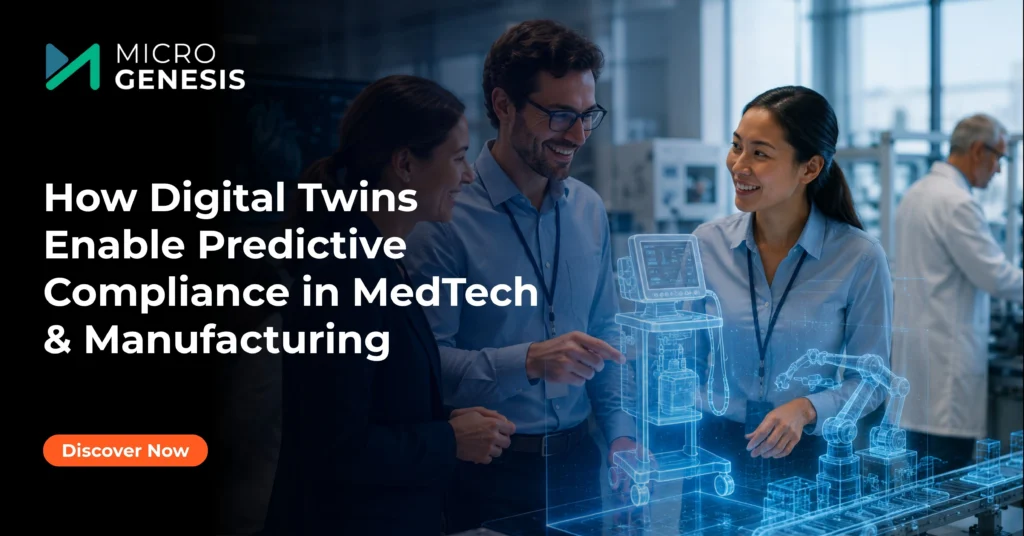
Written by Dhananjaya KVice President – Global Markets When Your Compliance Framework Knows About a Violation Before the Auditor Does Picture this: A leading Class III medical device manufacturer is six weeks away from a critical FDA Pre-Approval Inspection. Buried within millions of sensor data points across their cleanroom production lines, a thermal drift pattern is quietly forming-one that, left undetected, would constitute a critical GMP deviation and trigger a Warning Letter. Their digital twin system flags it forty-eight hours before it crosses the regulatory threshold. The process engineer makes a targeted adjustment. The deviation never happens. Traditional quality assurance teams would have caught it during the next quarterly audit—if they were lucky. Instead, compliance was maintained in real time, before a regulator, an auditor, or a patient ever faced risk. This is not hypothetical. This is where MedTech and advanced manufacturing are heading, and the organizations building digital twin infrastructure today are creating compliance advantages that will be nearly impossible to replicate in two years. The Compliance Problem That Gets Harder Every Year FDA’s QMSR rule, EU MDR/IVDR, and ICH Q10 have fundamentally raised the bar. Regulators no longer want to see process control. They want process understanding. That’s a different ask entirely. Periodic audits, manual sampling, and retrospective CAPA were built for a world where data was scarce. That world is gone. The gap between what compliance teams are being asked to demonstrate and what legacy QMS infrastructure can deliver is widening every year. From Engineering Tool to Compliance Infrastructure The mainstream digital twin conversation focuses on operational efficiency: predictive maintenance, yield optimization, throughput improvement. These are legitimate and valuable outcomes. But for MedTech and regulated manufacturing leaders, the more profound value proposition is compliance—and specifically, the shift from reactive compliance to predictive compliance. A digital twin continuously reflects what your process is doing and what it’s about to do. Applied to compliance-critical parameters, that means knowing before the threshold is crossed, not after. McKinsey data shows organizations with integrated quality monitoring digital twins report 30–50% reductions in quality-related non-conformances. For a MedTech manufacturer, a non-conformance isn’t just a cost event. It’s a potential regulatory action. Three Mechanisms That Make It Real Understanding why digital twins enable predictive compliance requires looking at the specific mechanisms that create regulatory foresight, not just operational visibility. Continuous Process Verification Traditional CPV gives you snapshots. A digital twin gives you continuous intelligence against your validated design space, flagging critical quality attributes trending toward spec limits in real time, not at the next monthly review. Audit-Ready Documentation, Always Audit prep typically mobilizes weeks of resources. Digital twins integrated with MES and QMS create a continuously maintained, time-stamped process record. The trail doesn’t need reconstruction; it already exists. Pharma manufacturers report up to 60% reduction in audit preparation time. Prospective Change Control Simulate a process change against your validated design space before it touches the physical environment. Quantify risk before it’s real. This is the risk-based approach ISO 14971 and ICH Q9 describe, executed at the speed regulators now expect. The Regulatory Direction Is Clear The FDA’s 2023 discussion paper on AI in Drug Manufacturing signals a direction the industry needs to read carefully: data-driven process understanding is becoming an expectation, not a differentiator. The EU AI Act adds transparency and auditability requirements for AI in safety-critical manufacturing. Gartner predicts that by 2026, 75% of organizations implementing digital twins will demonstrate measurable compliance improvements. The organizations treating this as a differentiator today will find it’s simply the cost of doing business in three years. The Compliance Advantage Compounds Every process run refines the predictive model. Every clean regulatory interaction strengthens your standing with oversight bodies. Every faster change control cycle frees capacity for innovation. The auditor who never writes a Warning Letter because your system caught the deviation first isn’t a hypothetical. It’s a design choice. The window to build this advantage is open now—but it won’t stay that way.
The Great ALM Dilemma: Racing in the Cloud Without Crashing

Written by Dhananjaya KVice President – Global Markets If you’d have watched F1, the movie, there’s a nail-biting sequence during the British Grand Prix at Silverstone. During lap 20, Joshua Pearce (played by Damson Idris) makes a quick pitstop, when a wheel gun operator (Jody) fumbles, dropping a malfunctioning gun on the pit lane floor. As Joshua leaves the pit, his tyre runs over the fastener. “I hit something, what was that?” exclaims Joshua. “7 seconds! That’s double the time they should have taken. APXGP wouldn’t be happy with that,” is the commentary. A few moments later, Sonny Hayes (played by Brad Pitt) makes a pitstop, and this time, the jack does not work, adding confusion and chaos. “Whatever could go wrong is going wrong for this team!” says the commentator. This whole scenario ultimately leads to both drivers racing against time, bumping into each other and ultimately crashing on the gravel. “This is mad! A cardinal sin of motor racing. A double DNF, just when it couldn’t get any worse!” exclaimed the commentator. The result: Their F1 team APXGP loses the race categorized as DNF (did not finish), a major embarrassment for all involved. A world-class automotive team builds a hyper-efficient pit crew that can change all four tyres in less than two seconds to shaving entire laps off their race time. But in their relentless focus on speed, they forget to tighten the lug nuts. The result isn’t a victory; it’s a catastrophic failure. Now, let’s put it into perspective. This metaphor painfully mirrors the state of Application Lifecycle Management (ALM) in the cloud era. Engineering leaders are under immense pressure to deliver software at the pace of market expectations, deploying daily, hourly, or even on every commit. While the cloud provides the ultimate pit lane, i.e., infinite scalability, on-demand resources, and collaborative tools that dissolve geographical barriers. Yet, if security is an afterthought, more like a final “lug nut check” just before production, you’re not racing toward success; you’re accelerating toward a potential breach. The stakes have never been higher. A 2024 IBM report found that the average cost of a data breach soared to $4.45 million, with cloud misconfigurations being one of the leading causes. Remember the Capital One Breach in 2019? A misconfigured web application firewall (WAF) in their cloud environment led to the exposure of over 100 million customer records. This wasn’t a failure of cloud technology, but of cloud process, a stark reminder that in the cloud, engineering and security are inextricably linked. The False Choice: Speed vs. Security For too long, enterprise ALM has framed speed and security as a zero-sum game. Development teams push for rapid feature releases, while security and compliance teams are seen as gatekeepers, slowing progress with late-cycle audits and penetration tests. This creates friction, shadow IT, and ultimately, risk. In the cloud-native world, this dichotomy is obsolete. The real competitive advantage lies in orchestrating speed and security as synergistic forces. The goal isn’t to choose one, but to embed security so seamlessly into the development lifecycle that it enables faster, more reliable innovation. Engineering the Shift: Security as Code, Not as Gate The solution lies in transforming our ALM philosophy from a linear, gated model to an integrated, continuous “DevSecOps” loop. Here’s how engineering leaders can architect this balance: Shift Security “Left,” But Also “Right” “Shifting left” is table stakes, integrating static and dynamic application security testing (SAST/DAST) directly into developer integrated development environments (IDEs) and continuous integration (CI) pipelines. This allows a developer in Pune or Austin to catch vulnerabilities as they write the code. But we must also “shift right” with continuous monitoring in production. Use cloud-native tools to monitor runtime behavior, detect anomalous patterns, and automate responses. Security becomes a living, breathing layer across the entire lifecycle. Treat Infrastructure as Code (IaC) as a Security PerimeterIaC) as a Security Perimeter Your cloud configuration is your new security frontier. IaC templates (Terraform, CloudFormation) must have security policies baked in. Scan these templates for misconfigurations before they provision a single cloud resource. This ensures that every environment spun up from a developer’s sandbox to production, is compliant by default, not by exception. Empower with Platform Engineering Top tech talent craves autonomy, not obstacles. Instead of imposing restrictive controls, build secure, internal developer platforms (IDPs). Provide curated, self-service “golden paths” to the cloud, pre-approved, security-hardened templates for microservices, data pipelines, or ML models. This reduces cognitive load, accelerates development, and ensures governance is inherent. For elite engineers from Mumbai to Munich, this is the tooling that attracts and retains. Cultivate a Shared Responsibility Culture The cloud operates on a shared responsibility model. The provider secures the cloud, you secure what’s in the cloud. This must be mirrored internally. Foster a culture where developers own the security of their code, and platform teams own the security of the underlying fabric. Regular “chaos engineering” drills and gamified security training can make this proactive, not punitive. The Finish Line: Resilience as the Ultimate Metric Ultimately, the measure of modern ALM isn’t just deployment frequency or mean time to recovery (MTTR). It’s Cyclomatic Resilience, the ability of your entire system, from code to cloud config, to withstand shocks and adapt securely. It’s about building a race car and a pit crew so intrinsically safe and well-coordinated that speed becomes a byproduct of excellence, not its adversary. The cloud is not just a destination; it’s the new engineering landscape. The winners in this space won’t be those who simply move fast, but those who build securely, from the first line of code to a global scale. Ready to architect an ALM strategy that wins the race without risking the crash? Let’s move beyond theory. Let’s build fast and build to last! Let’s get you a tailored ALM resilience assessment for your organization.
Why Your $2M Self-Service Portal Is Gathering Digital Dust: The 3 Pillars of Self-Service Culture Every ITSM Leader Must Master

A few weeks ago, I was talking to a CIO of a large manufacturing company who shared something that made me pause for a bit. He mentioned that even after spending more than a couple of million on a state-of-the-art self-service portal,
The 50% Ticket Reduction Blueprint: How to Liberate Your IT Team for Strategic Work.

Imagine your most skilled cloud architect, the one who should ideally be designing your AI integration roadmap. Now picture them manually provisioning software access for another new hire for the 15th time this month. This isn’t just inefficient; rather, it’s a strategic crisis.
Beyond Compliance: The Future of Software Engineering in Regulated Healthcare and the Role of AI-Driven ALM
Written by Dhananjaya KVice President – Global Markets For MedTech Product Managers, Healthcare IT Leaders, and Regulatory Pioneers: The pressure is immense. Software engineering in regulated healthcare (MedTech, digital health, and health IT) is all about delivering life-saving software in record time. It is all about ensuring ironclad compliance, managing complicated supply chains, and maintaining the highest standards of patient safety and sustainability. This adds up to the workload for engineering teams busy with research, innovation, and development. The traditional Application Lifecycle Management (ALM) tools have limited capability to address this issue. Here comes the AI-Driven ALM: not a mere step up, but a paradigm shift that is going to transform how we create, check, and sustain the critical health software, greatly in line with fundamental values and the digital aspirations of Europe. The ALM Evolution: From Tracking to Intelligence ALM has always been the backbone for governing requirements, development, testing, deployment, and maintenance. Yet, in regulated environments, it often becomes an added responsibility. AI-driven ALM brings intelligence into all stages: Navigating the Shifting Regulatory Landscape Regulators (EMA, FDA, and notified bodies) are actively assessing AI’s role. The EU’s proposed AI Act emphasizes safety, transparency, and human oversight—principles directly applicable to AI tools used in development. AI-driven ALM isn’t about replacing human judgment; it’s about augmenting it with superhuman speed, scalability, and evidence-based decision-making. With expert ALM consulting services, organizations can ensure their AI-driven development processes remain compliant, efficient, and aligned with evolving regulatory expectations. AI-Driven ALM: Resonating with Nordic Values and EU Competitiveness This transformation isn’t just technical; it aligns profoundly with core European and Nordic values: The Future is Intelligent: Embrace the Shift AI-Driven ALM is not science fiction; it’s the next evolutionary step for software engineering in regulated health. For: The convergence of AI and ALM is inevitable. The question isn’t if, but how and how well we will adopt it. Start by: By harnessing AI-driven ALM responsibly, we can build the future of healthcare software: faster, safer, more compliant, and fundamentally aligned with the values of patient welfare and sustainable progress that define the European health tech landscape. Let’s engineer that future together. Conclusion:In the evolving world of regulated healthcare, the future of software engineering lies in intelligent automation and data-driven compliance. AI-powered ALM transforms how teams manage traceability, validation, and risk—enabling faster, safer, and more transparent innovation. At MicroGenesis, our digital transformation consultants help healthcare organizations integrate AI-driven ALM solutions that not only ensure compliance but also accelerate product delivery, enhance quality, and drive sustainable innovation in a highly regulated environment.
Digital Twin for Automotive: Beyond Simulation to Real-Time Engineering Insight
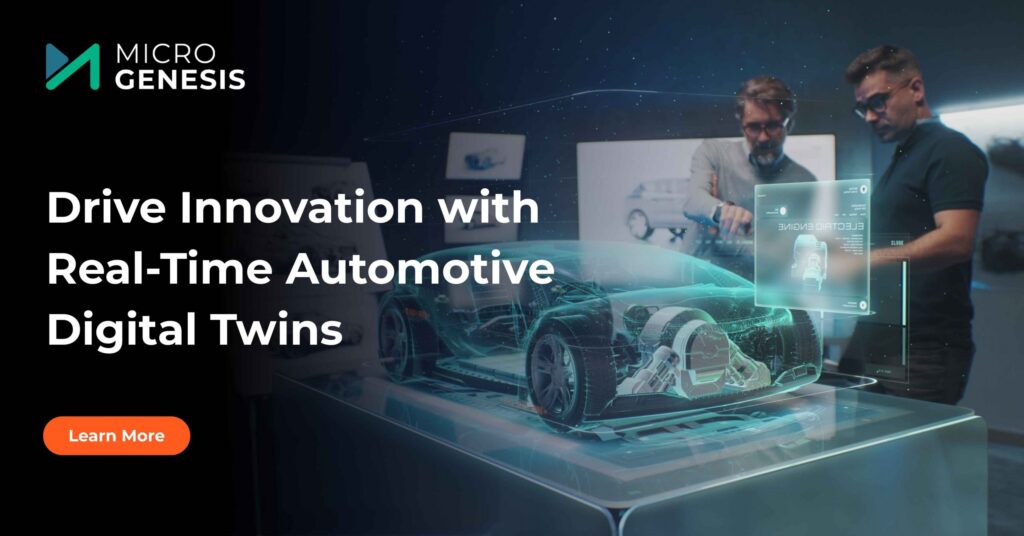
Written by Dhananjaya KVice President – Global Markets The Paradigm Shift That’s Redefining Automotive Excellence Picture this: One fine night at Tesla, an anomaly was detected in the regenerative braking pattern across hundreds of vehicles. The company’s digital twin system was able to detect it, and within six hours, an over-the-air update was pushed to 1.2 million vehicles globally, preventing what could have been a massive recall (Mckinsey). The traditional automotive industry would have taken months to identify this pattern, validate the fix, and implement the solution. Tesla did it before most of their customers even knew there was an issue. As automotive leaders, we’ve witnessed digital transformation waves before, but digital twin technology represents something fundamentally different. We’re not just talking about another incremental improvement to our engineering toolkit. We’re looking at a complete reimagining of how we design, manufacture, and optimize vehicles throughout their entire lifecycle. Global consulting firm EY in its tech trends report revealed that early adopters report a 20–25% uplift in equipment effectiveness and a 10–12% reduction in unplanned downtime through predictive maintenance enabled by digital twins. The traditional approach to automotive engineering has relied heavily on simulation models that, while sophisticated, operate in isolation from real-world conditions. These static models served us well in the past, but today’s market demands something more dynamic, more responsive, and infinitely more intelligent. The gap between what we simulate and what actually happens on the road, on the factory floor, and in the supply chain has become our biggest competitive vulnerability. From Static Models to Living Digital Ecosystems The evolution from traditional simulation to real-time digital twins marks a watershed moment in automotive engineering. Where simulation gave us predictions, digital twins give us continuous intelligence. The difference isn’t just technical, it’s strategic. Consider the implications: instead of designing a vehicle based on predetermined scenarios, we now engineer systems that learn and adapt in real-time. Our digital twins don’t just model how a component should perform; they continuously ingest data from actual vehicles, manufacturing processes, and supply chains to refine their understanding of performance, reliability, and optimization opportunities. This shift enables what I call “predictive engineering”, the ability to anticipate and address challenges before they manifest in the physical world. When a digital twin of your production line can predict equipment failure three weeks before it occurs, or when a vehicle’s digital twin can optimize its performance based on real driving patterns from millions of connected cars, you’re no longer just responding to problems, you’re preventing them. The competitive advantage here is profound. Organizations that master this transition will fundamentally outpace those still operating with yesterday’s engineering paradigms. Automakers are already deploying digital twins across design, production, and after-sales to simulate vehicle development, reduce quality defects, and streamline new-model launches. KPMG in its report titled “How Automakers Can Turbocharge Efficiency” reveals that virtual prototypes enable engineers to catch and correct production issues before they occur on the factory floor, cutting introduction times by up to 30% and lowering scrap rates by 15%. Real-World Applications Across the Automotive Value Chain The practical applications of real-time digital twins span every aspect of our operations, creating value in ways that were previously impossible to achieve. In vehicle design and development, digital twins are revolutionizing how we approach everything from aerodynamics to user experience. Instead of waiting for physical prototypes to validate design decisions, we can test and iterate continuously using real-world data streams. A digital twin of a new electric vehicle, for instance, can incorporate real-time traffic patterns, charging infrastructure utilization, and driver behavior data to optimize everything from battery placement to energy management algorithms. Manufacturing operations see perhaps the most immediate ROI. Digital twins of production lines provide unprecedented visibility into bottlenecks, quality variations, and maintenance needs. When BMW’s digital twin of their Spartanburg plant can simulate the impact of a supply chain disruption in real-time and automatically adjust production schedules, we’re seeing operational excellence redefined. Supply chain management transforms when digital twins provide end-to-end visibility. Real-time tracking of components, predictive logistics optimization, and dynamic supplier performance modeling create resilience that traditional planning methods simply cannot match. Research firm IDC predicts that by 2027, 35% of Global 2000 companies, including major automotive OEMs, will employ digital twins for supply-chain orchestration, cutting logistics costs by up to 7%. Even post-sale customer experience benefits dramatically. Connected vehicles feeding data to their digital twins enable predictive maintenance, personalized feature optimization, and continuous improvement of both individual vehicles and entire model lines. Read more : Beyond Compliance: The Future of Software Engineering in Regulated Healthcare and the Role of AI-Driven ALM The Strategic Imperative: Leading or Following Looking ahead, the organizations that will dominate the automotive landscape are those that recognize digital twins not as a technology initiative, but as a business transformation imperative. This isn’t about implementing another software tool—it’s about fundamentally changing how we think about the relationship between digital and physical assets. Gartner suggests that 47% of manufacturing organizations plan to increase IoT and digital-twin investments over the next two years, with automotive factories leading investment volumes. The early movers are already seeing results. Companies implementing comprehensive digital twin strategies report 15-30% reductions in development cycles, 20-40% improvements in manufacturing efficiency, and dramatic enhancements in customer satisfaction scores. These aren’t marginal gains, they’re competitive moats. But the real opportunity lies in the network effects. As more vehicles become connected, as more manufacturing processes become instrumented, and as more supply chain partners join digital ecosystems, the value of digital twin insights grows exponentially. The data advantage becomes self-reinforcing. The question for automotive leaders today isn’t whether digital twins will transform our industry it’s whether we’ll be leading that transformation or scrambling to catch up. The window for gaining first-mover advantage is narrowing, but for those bold enough to commit fully to this paradigm shift, the rewards will be substantial. The future of automotive engineering isn’t just digital, it’s intelligently digital. And that future is being built today by the leaders who understand that in a world of real-time insights, static thinking is the only true risk. Conclusion: Digital twins are