
Agile Application Lifecycle Management:
Processes and Best Practices
Table of Contents
In today’s fast-paced digital world, organizations must deliver high-quality software at speed while staying aligned with business goals. Traditional Application Lifecycle Management (ALM) approaches often struggle to keep up with these demands. That’s where Agile ALM comes in—an approach that integrates Agile principles, DevOps automation, and collaborative governance into the full software lifecycle.
This comprehensive guide explores what Agile Application Lifecycle Management is, how it differs from traditional ALM, the processes that define it, best practices for success, and the future of Agile ALM in enterprise environments.
What is Agile Application Lifecycle Management?
Application Lifecycle Management (ALM) is the structured process of managing an application’s life from inception to retirement—including requirements gathering, development, testing, deployment, maintenance, and governance.
In traditional ALM, processes were often linear, rigid, and document-heavy. Agile ALM, by contrast, applies Agile values (collaboration, flexibility, continuous delivery, customer focus) across the lifecycle.
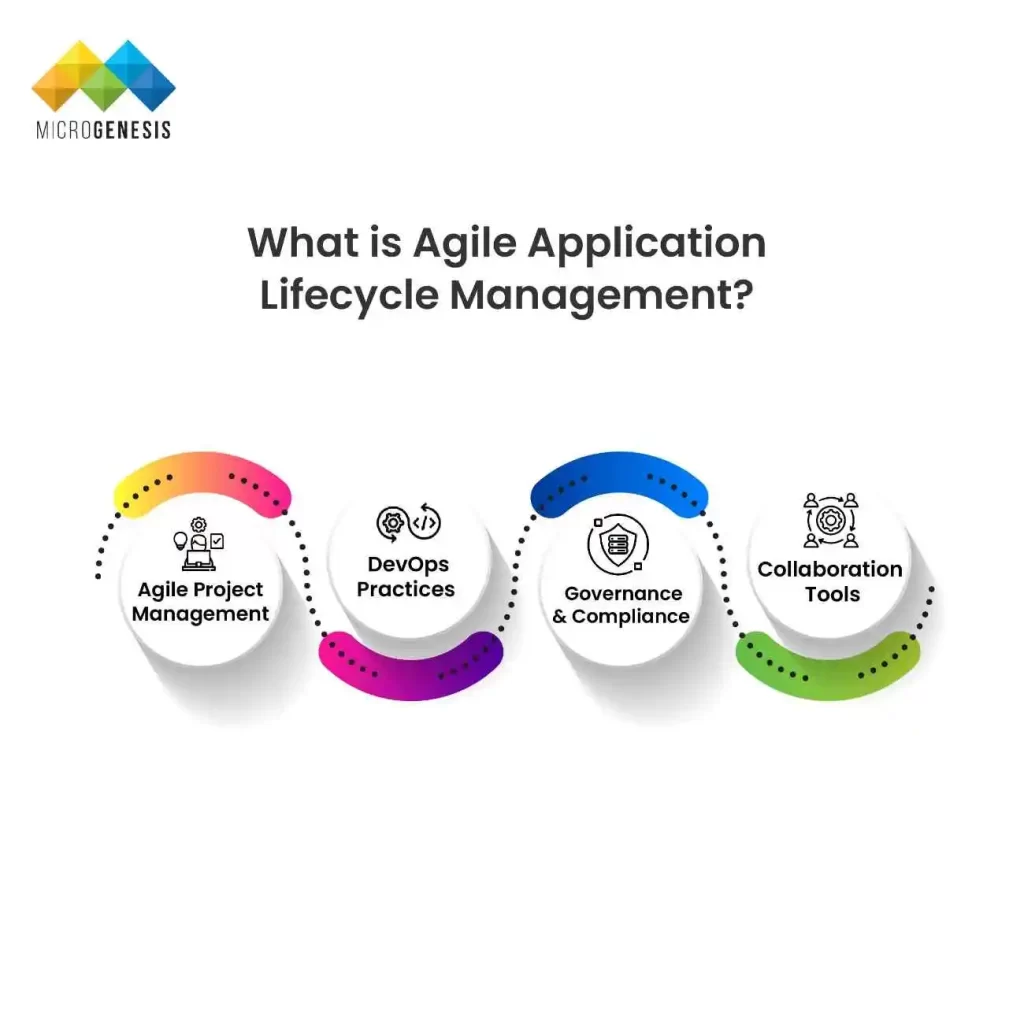
Agile ALM integrates:
- Agile Project Management – Iterative planning, Scrum or Kanban workflows.
- DevOps Practices – CI/CD automation, infrastructure as code, continuous monitoring.
- Governance & Compliance – Traceability, audit-readiness, and reporting built into workflows.
- Collaboration Tools – Platforms that unify business, development, and operations teams.
The goal of Agile ALM is to accelerate software delivery without sacrificing quality, compliance, or business alignment.
Why Agile ALM Matters Today
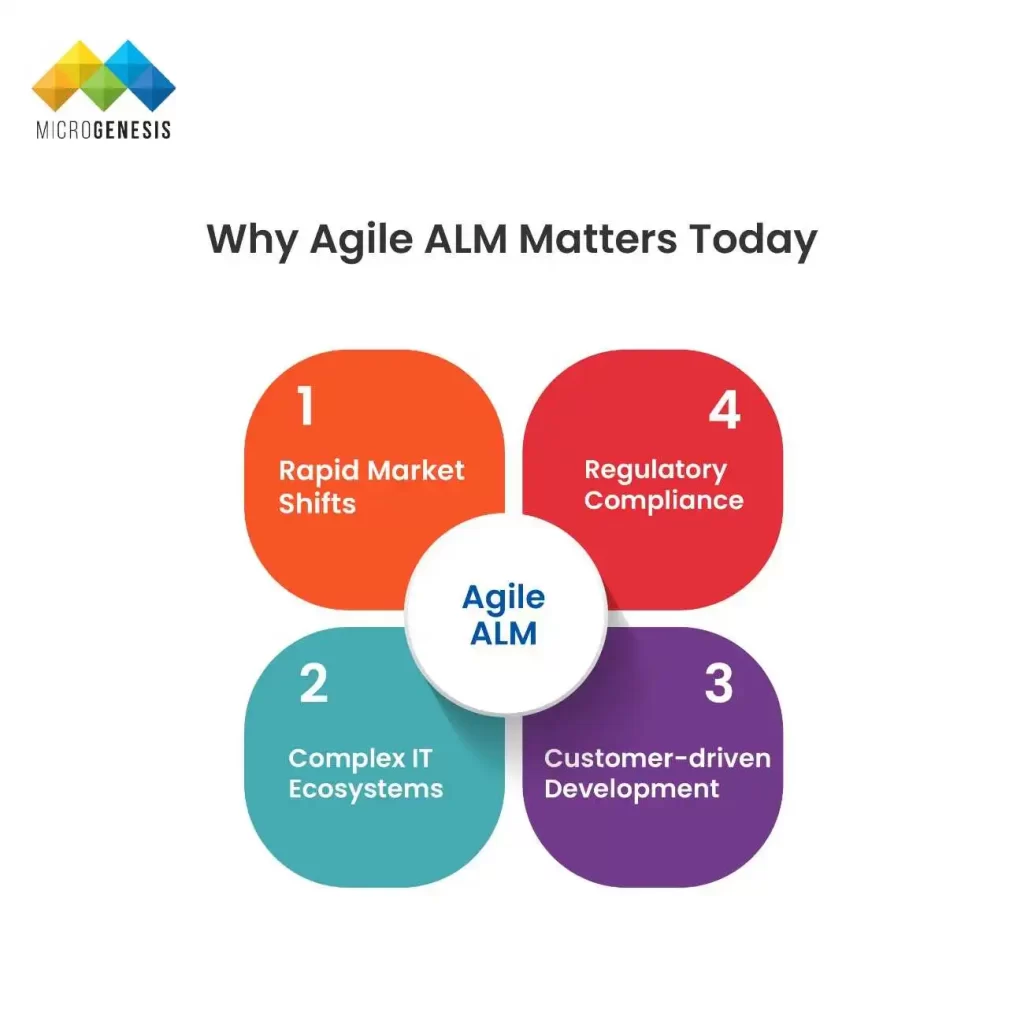
Agile ALM is not just a methodology; it’s a strategic necessity for organizations facing:
- Rapid market shifts – Faster release cycles and competitive differentiation.
- Complex IT ecosystems – Multi-cloud, microservices, and distributed architectures.
- Customer-driven development – Products must evolve based on feedback and user data.
- Regulatory compliance – Industries like healthcare, finance, and automotive demand traceability and documentation.
By adopting Agile ALM, companies can:
- Shorten time-to-market.
- Deliver software aligned with user needs.
- Maintain compliance seamlessly.
- Improve collaboration across functions.
Core Components of Agile ALM
Agile ALM consists of several interconnected components that align business, development, and operations into a single lifecycle.

Requirements Management
- User stories, epics, and backlogs replace rigid specifications.
- Continuous refinement through stakeholder feedback.
- Tools like Jira, Rally, Polarion integrate requirements directly into workflows.
Agile Project Management
- Scrum or Kanban boards track progress.
- Sprint planning and retrospectives enable continuous improvement.
- Metrics like velocity, burndown, and lead time guide decision-making.
Development & Build Automation
- Continuous integration pipelines automate builds and code validation.
- Modular, reusable codebases improve scalability.
- Integration with Git-based repositories ensures traceability.
Testing & Quality Assurance
- Shift-left testing ensures early defect detection.
- Test automation across unit, integration, and regression levels.
- Continuous testing tools integrated into CI/CD pipelines.
Deployment & Release Management
- CI/CD automates deployment to multiple environments.
- Strategies like blue-green or canary releases minimize risk.
- Rollback mechanisms ensure resilience.
Operations & Monitoring
- Observability through logging, metrics, and distributed tracing.
- Feedback loops with real-time user data.
- Continuous performance monitoring ensures SLAs.
Governance & Compliance
- Traceability from requirements → code → test → deployment.
- Automated reporting for audits (ISO, SOX, GDPR).
- Security integrated as DevSecOps.
Together, these components create a closed-loop Agile ALM system where development and operations reinforce one another.
The Agile ALM Process: A Step-by-Step View
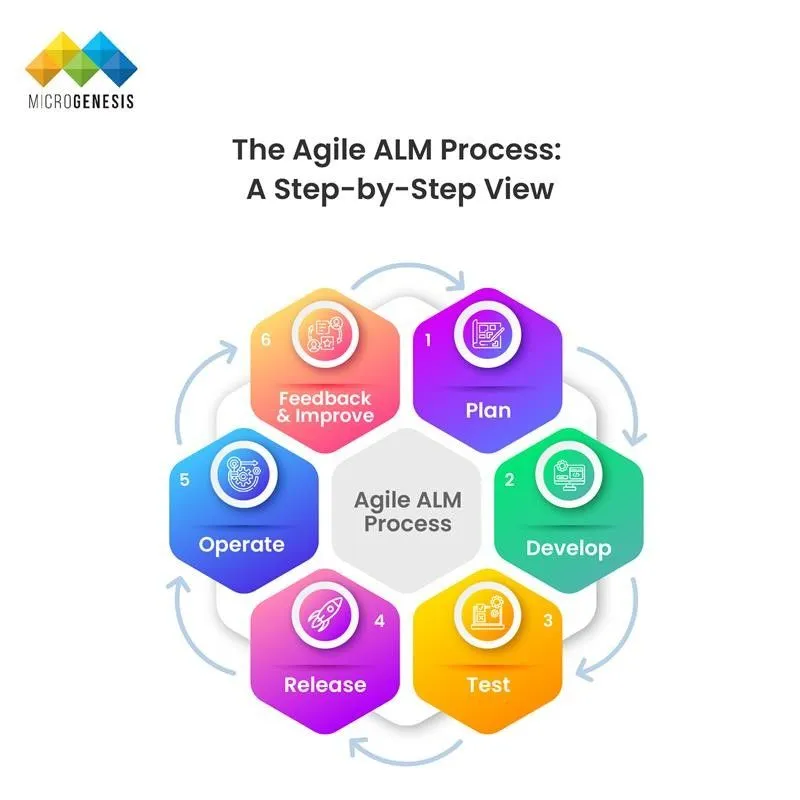
Unlike traditional software development models, where each stage is sequential and rigid, Agile Application Lifecycle Management (ALM) emphasizes a continuous, iterative cycle. Every stage connects with the next, creating an ongoing loop of delivery, feedback, and improvement. This ensures that applications remain aligned with business needs, user expectations, and compliance requirements.
Here’s a closer look at each step in the Agile ALM process:
Plan
Planning in Agile ALM is not a static, one-time exercise. Instead, it is a dynamic and ongoing process.
- Epics and User Stories: Work is broken down into epics (large initiatives) and user stories (smaller, actionable requirements).
- Backlog Prioritization: Teams maintain a product backlog that evolves continuously based on business value, customer feedback, and technical feasibility.
- Agile Ceremonies: Sprint planning, backlog grooming, and release planning sessions ensure alignment between business stakeholders and development teams.
- Business Alignment: Unlike traditional ALM, planning in Agile is outcome-driven—every requirement is tied to measurable business goals.
Key Benefit: Planning becomes more adaptive and customer-focused, reducing the risk of delivering features that don’t provide value.
Develop
The development phase in Agile ALM emphasizes iterative coding and continuous integration.
- Iterative Sprints: Development is broken into short cycles (1–4 weeks) where teams deliver incremental functionality.
- Continuous Integration (CI): Every code commit is automatically built and integrated into a shared repository to detect issues early.
- Collaboration: Cross-functional teams—developers, testers, and business analysts—work together to ensure rapid progress and immediate feedback.
- Code Quality: Practices such as pair programming, peer reviews, and static code analysis help maintain high coding standards.
Key Benefit: Faster delivery of working software with fewer defects and better adaptability to change.
Test
Testing is deeply embedded into the Agile ALM process and begins as early as the planning and development stages.
- Shift-Left Testing: Testing happens earlier in the cycle, reducing the cost of defect fixes.
- Automated Testing: Unit, integration, regression, and acceptance tests run automatically in CI pipelines.
- Continuous Testing: Every build is validated, ensuring that defects are caught before release.
- Exploratory Testing: In addition to automation, manual exploratory testing adds flexibility to uncover edge cases.
- Compliance Testing: For regulated industries, compliance checks are automated alongside functional tests.
Key Benefit: Improved software quality, reduced rework, and better compliance readiness.
Release
Releasing software is no longer a stressful “big bang” event—it’s continuous and incremental.
- Continuous Delivery (CD): Ensures that software is always in a deployable state.
- Deployment Automation: CI/CD pipelines handle deployments into testing, staging, and production environments.
- Release Strategies: Approaches like blue-green deployments, feature toggles, and canary releases minimize risks while introducing new functionality.
- Rollback Mechanisms: Automated rollback ensures that issues in new releases don’t disrupt users.
Key Benefit: Reduced release risk, faster value delivery, and higher user satisfaction.
Operate
Once the application is deployed, the focus shifts to monitoring and operations.
- Observability: Metrics, logs, and traces provide real-time insights into system performance.
- Monitoring Tools: Solutions like Prometheus, Grafana, and Datadog help track uptime, latency, and errors.
- Incident Response: Automated alerts and on-call practices ensure rapid resolution of issues.
- Performance Optimization: Continuous monitoring helps optimize infrastructure usage and costs, particularly in cloud environments.
Key Benefit: Ensures reliability, resilience, and continuous compliance in live environments.
Feedback & Improve
The final stage in Agile ALM is all about learning and continuous improvement.
- User Feedback: Direct input from end-users, captured via surveys, analytics, and usage data.
- Retrospectives: Teams reflect on what worked, what didn’t, and what can be improved after each sprint.
- Data-Driven Decisions: Performance data and customer analytics guide future planning and backlog prioritization.
- Continuous Improvement: Enhancements and fixes flow back into the planning stage, restarting the Agile ALM cycle.
Key Benefit: Software remains relevant, user-centric, and continuously aligned with business outcomes.
The Continuous Improvement Cycle
When stitched together, these stages create a continuous improvement cycle:
- Plan → Develop → Test → Release → Operate → Feedback → Plan again.
This cycle ensures that applications evolve with changing requirements, technology shifts, and market needs. Unlike traditional ALM, which often treats development as a project with a start and end, Agile ALM treats it as an ongoing journey of evolution and optimization.
Best Practices for Agile Application Lifecycle Management
To succeed with Agile ALM, organizations should adopt these proven best practices:
Align Business and IT Through Shared Backlogs
- Use a single source of truth for requirements across business and development.
- Align roadmaps with measurable business outcomes.
Automate Everything Possible
- Automate builds, tests, deployments, and compliance checks.
- Use Infrastructure as Code (IaC) to manage environments consistently.
- Apply automation to documentation and reporting for audit readiness.
Build Cross-Functional Teams
- Bring together developers, testers, operations, and business analysts.
- Use DevOps culture to eliminate silos.
- Empower teams with ownership of the entire application lifecycle.
Embrace Shift-Left Practices
- Run static analysis and security scans early in development.
- Automate regression and compliance testing before release.
- Involve operations in planning phases for better reliability.
Prioritize Security with DevSecOps
- Automate vulnerability scans in pipelines.
- Use secure coding standards and code reviews.
- Integrate compliance checks (GDPR, HIPAA, ISO) into workflows.
Establish Continuous Feedback Loops
- Capture telemetry data, error logs, and user analytics.
- Feed real-time feedback into sprint retrospectives.
- Use A/B testing for feature validation.
Optimize for Scalability
- Use modular architectures (microservices, APIs).
- Build reusable pipeline templates.
- Scale Agile ALM practices across product lines and geographies.
Foster a Culture of Continuous Learning
- Encourage regular retrospectives and improvements.
- Train teams on Agile ALM tools and DevOps practices.
- Promote knowledge-sharing across teams.
Tools & Technologies for Agile ALM
One of the defining features of Agile ALM is the reliance on a well-integrated toolchain. Unlike traditional ALM, where tools often worked in silos, Agile ALM requires seamless integration across requirements, development, testing, deployment, monitoring, and compliance. This creates a unified lifecycle where information flows effortlessly, reducing bottlenecks and ensuring traceability.
Here’s a deeper look at the essential categories of tools in Agile ALM:
Requirements & Backlogs
- Examples: Jira, Rally (CA Agile Central), Azure Boards, Polarion.
- Role: These tools provide a central hub for capturing, prioritizing, and managing epics, user stories, and defects. Agile teams rely on backlog management for transparency and alignment with business outcomes.
- Why Important: A shared backlog ensures that business and IT stay aligned. Stakeholders can track progress in real time, while developers stay focused on delivering the highest-priority features.
Version Control
- Examples: Git, GitHub, GitLab, Bitbucket.
- Role: Version control systems provide the foundation for collaboration, code sharing, and traceability. They allow multiple developers to work in parallel, manage branches, and roll back changes when necessary.
- Why Important: In Agile ALM, code must always be in a deployable state. Git-based workflows, combined with branching strategies, help maintain clean, production-ready codebases.
CI/CD Pipelines
- Examples: Jenkins, GitLab CI, Azure DevOps, CircleCI.
- Role: Continuous Integration and Continuous Delivery pipelines automate builds, run tests, and deploy applications across environments.
- Why Important: They eliminate manual handoffs and reduce release risks, enabling teams to deliver value faster and more frequently.
Testing Automation
- Examples: Selenium, JUnit, Cucumber, TestComplete.
- Role: Automated testing frameworks validate functionality, performance, and compliance throughout the lifecycle.
- Why Important: Agile ALM thrives on early feedback. Automated tests allow teams to detect and fix issues before they impact production, reducing the cost of defects.
Monitoring & Observability
- Examples: Prometheus, Grafana, ELK (Elasticsearch, Logstash, Kibana) Stack, Datadog.
- Role: These tools provide real-time visibility into application performance, user behavior, and infrastructure health.
- Why Important: Monitoring ensures that once applications are deployed, they remain reliable, performant, and secure. Observability closes the feedback loop by feeding insights back into planning.
Collaboration & Documentation
- Examples: Confluence, Slack, Microsoft Teams.
- Role: Agile ALM thrives on collaboration. These platforms connect distributed teams, centralize documentation, and support asynchronous communication.
- Why Important: Agile is as much about culture as it is about processes. Effective collaboration tools enable transparency, speed, and stronger teamwork.
Compliance & Traceability
- Examples: Jama, IBM DOORS, Xray, Polarion.
- Role: These solutions provide end-to-end traceability, linking requirements to code, tests, and deployments.
- Why Important: For regulated industries (automotive, healthcare, finance), compliance is non-negotiable. Automated traceability ensures that audits and certifications can be handled efficiently without slowing down innovation.
The Key: Integration
While each category of tools plays a critical role, the real strength of Agile ALM comes from toolchain integration. A fragmented toolset creates silos; an integrated toolchain creates transparency, speed, and compliance readiness.
Example: A user story in Jira can automatically trigger a build in Jenkins, run automated tests with Selenium, deploy to a staging environment, and generate compliance reports in Polarion—all in one seamless pipeline.
Benefits of Agile ALM
When organizations adopt Agile ALM effectively, the benefits extend far beyond faster delivery. Agile ALM transforms team culture, customer experience, regulatory compliance, and cost management. Let’s expand on the key benefits:
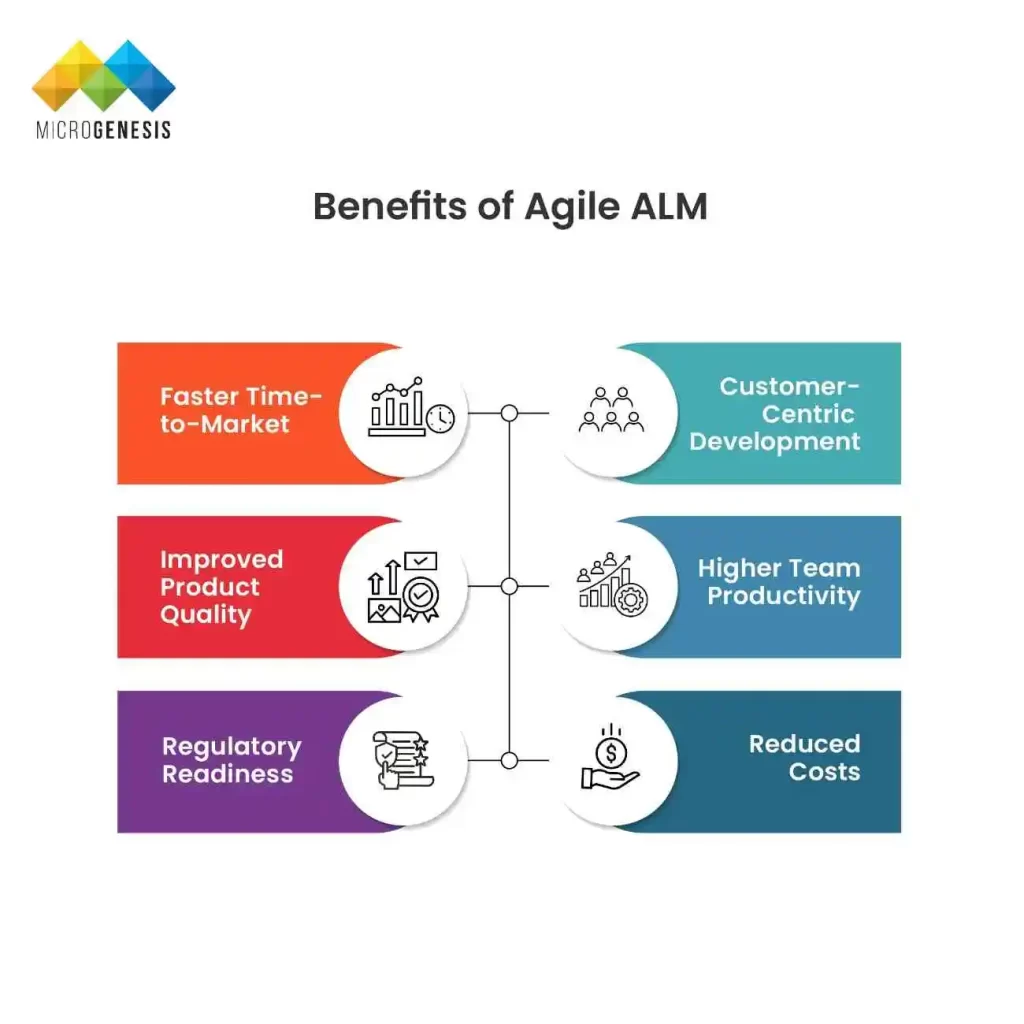
Faster Time-to-Market
- With CI/CD pipelines, features and fixes are deployed continuously rather than waiting for large releases.
- Teams can respond quickly to customer demands and market shifts.
- Faster iterations reduce the time between ideation and customer impact.
Impact: Organizations gain a competitive edge by being first to market with innovative solutions.
Improved Product Quality
- Shift-left testing ensures defects are detected early in the lifecycle.
- Automated regression testing prevents old bugs from resurfacing.
- Peer reviews, static code analysis, and compliance checks ensure high standards.
Impact: Customers receive more reliable, secure, and high-performing applications.
Regulatory Readiness
- Agile ALM integrates compliance into the development process instead of treating it as an afterthought.
- Traceability tools automatically link requirements to implementation and testing.
- Automated audit trails reduce the manual burden of regulatory reporting.
Impact: Businesses in regulated industries (finance, healthcare, automotive) can innovate without fear of compliance bottlenecks.
Customer-Centric Development
- Agile ALM ensures that customer feedback is continuously integrated into the backlog.
- Analytics and monitoring data help prioritize features that matter most to users.
- Teams focus on delivering measurable business outcomes, not just code.
Impact: Applications remain relevant, user-friendly, and competitive.
Higher Team Productivity
- Automation reduces repetitive manual tasks such as builds, tests, and deployments.
- Developers focus more on innovation and less on firefighting.
- Transparent workflows improve collaboration across distributed teams.
Impact: Teams deliver more value with the same or fewer resources.
Reduced Costs
- Early defect detection avoids expensive late-stage fixes.
- Automation minimizes labor costs tied to manual QA and deployments.
- Optimized cloud usage and infrastructure automation lower operational costs.
Impact: Agile ALM delivers a strong return on investment by reducing waste while accelerating delivery.
Beyond the Obvious: Strategic Benefits
- Business Alignment: Every feature maps back to a business outcome.
- Scalability: Standardized pipelines and processes scale across product lines.
- Resilience: Continuous monitoring ensures issues are detected and resolved before they affect users.
In short, Agile ALM isn’t just about building software faster—it’s about building the right software, faster, and with greater confidence.
Challenges in Agile ALM
While Agile ALM offers transformative benefits, the journey to adoption is not without hurdles. Many organizations underestimate the cultural, technical, and compliance complexities involved. Understanding these challenges is the first step toward overcoming them.
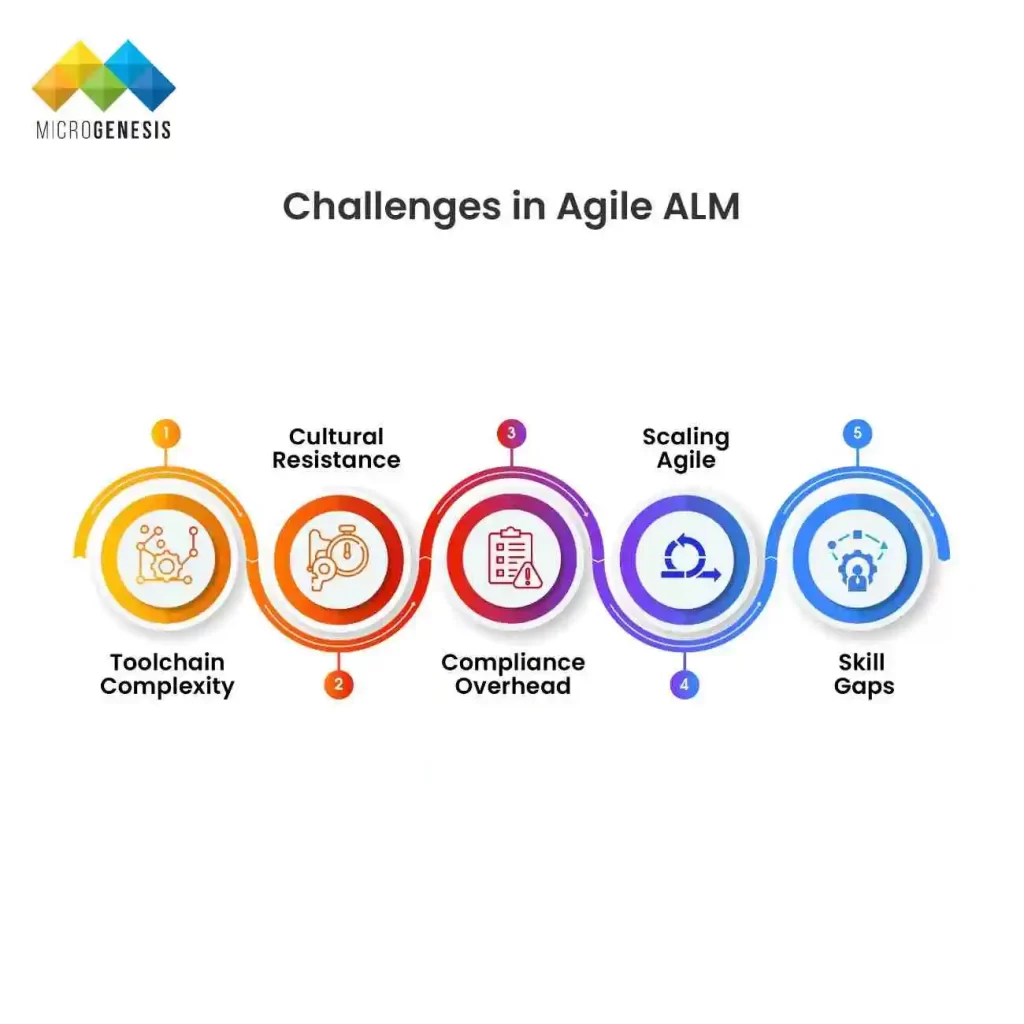
Toolchain Complexity
Agile ALM depends on a diverse ecosystem of tools for requirements, coding, testing, deployment, monitoring, and compliance.
- The Challenge: Tools often come from different vendors, use different data models, and may not integrate smoothly. Teams risk creating new silos instead of achieving end-to-end visibility.
- Example: A Jira backlog might not automatically sync with Jenkins builds or Polarion compliance reports, forcing manual workarounds.
- Solution: Invest in integration platforms, APIs, and toolchain governance. Standardize around a core set of tools that can scale across teams.
Cultural Resistance
Shifting from traditional waterfall ALM to Agile ALM requires more than new tools—it requires a cultural transformation.
- The Challenge: Teams accustomed to sequential processes may resist iterative planning, continuous feedback, or shared ownership.
- Example: Developers who are used to “throwing code over the wall” to QA may struggle with test-driven development and continuous testing.
- Solution: Leadership must champion Agile values. Training, coaching, and pilot projects can help teams experience the benefits firsthand.
Compliance Overhead
For industries such as healthcare, finance, and automotive, compliance and regulatory obligations cannot be ignored.
- The Challenge: Agile emphasizes speed and iteration, while compliance demands documentation, traceability, and evidence of control. This can feel like a conflict.
- Example: A medical device software team must meet IEC 62304 requirements while still delivering updates quickly.
- Solution: Integrate compliance into the pipeline (DevSecOps + traceability tools). Automate audit reports instead of treating them as afterthoughts.
Scaling Agile
Agile works beautifully for small teams, but scaling it across hundreds of teams in a large enterprise introduces governance challenges.
- The Challenge: Without standardization, teams adopt different practices, creating chaos and inconsistent outcomes.
- Example: One team uses Scrum, another uses Kanban, but reporting rolls up to a single portfolio dashboard.
- Solution: Frameworks like SAFe (Scaled Agile Framework) or LeSS (Large-Scale Scrum) provide governance structures while preserving agility.
Skill Gaps
Agile ALM requires skills in Agile, DevOps, automation, and compliance—skills not all teams currently possess.
- The Challenge: Without proper expertise, toolchains are underutilized, pipelines are brittle, and Agile values are misunderstood.
- Example: A team may adopt CI/CD tools but lack the testing automation expertise needed to make them effective.
- Solution: Invest in training, mentorship, and managed services. Building a strong DevOps culture takes time, but the payoff is substantial.
In Summary:
Overcoming these challenges requires a balanced approach: strong leadership commitment, thoughtful toolchain selection, governance for scaling, and continuous investment in people and skills. Organizations that address these head-on unlock the full potential of Agile ALM.
The Future of Agile ALM
Agile ALM is not static—it continues to evolve in response to technology advances, business pressures, and regulatory demands. Forward-looking organizations that embrace these trends position themselves to outpace competitors in speed, quality, and compliance.
AI-Driven ALM
Artificial Intelligence is set to transform every stage of the application lifecycle.
- How It Helps: AI can generate test cases automatically, predict code defects, recommend backlog priorities, and even optimize infrastructure usage.
- Impact: Reduces manual effort while improving accuracy and speed. Teams can focus more on innovation instead of repetitive tasks.
Value Stream Management (VSM)
Organizations are shifting from tracking “team velocity” to measuring business outcomes.
- How It Helps: VSM tools map the flow of value from idea to customer delivery, helping leaders see where bottlenecks exist and how work contributes to strategic goals.
- Impact: Ensures Agile ALM investments translate directly into business value rather than just technical activity.
Cloud-Native ALM
As cloud adoption accelerates, Agile ALM must adapt to hybrid and multi-cloud environments.
- How It Helps: Cloud-native ALM uses containers, microservices, and serverless computing to enable faster, more flexible pipelines.
- Impact: Teams gain the ability to deliver at scale without being tied to rigid infrastructure, enabling global delivery and compliance.
Composable ALM
Future ALM platforms are moving toward a composable architecture.
- How It Helps: Organizations can assemble modular ALM processes from reusable building blocks, tailoring workflows without starting from scratch.
- Impact: Speeds up adoption while reducing the complexity of customizing ALM to unique business and regulatory needs.
End-to-End Security
As cyber threats increase and quantum computing looms, security must be embedded across the lifecycle.
- How It Helps: Agile ALM is adopting DevSecOps practices where security checks, compliance scans, and encryption are part of every pipeline stage.
- Impact: Reduces vulnerabilities, ensures continuous compliance, and prepares organizations for quantum-safe encryption.
Conclusion: Why Partner with MicroGenesis
Agile Application Lifecycle Management is no longer optional—it’s the foundation for modern, competitive software delivery. By aligning business and IT, automating pipelines, embedding compliance, and fostering collaboration, Agile ALM enables organizations to deliver faster, safer, and more customer-centric applications.
At MicroGenesis, we help enterprises across Europe, automotive, healthcare, and industrial sectors implement Agile ALM solutions that:
- Align requirements with development and compliance.
- Automate CI/CD pipelines for continuous delivery.
- Integrate testing, monitoring, and security into workflows.
- Provide end-to-end traceability for regulatory readiness.
- Scale Agile ALM practices across product lines and geographies.
By partnering with MicroGenesis, you gain more than just a toolchain—you gain a strategic partner who ensures your ALM is future-ready, compliant, and aligned with business success.