
IT Service Management Explained:
Frameworks and Implementation
Table of Contents
Introduction
In today’s digital-first business landscape, technology is no longer just a support function — it is the foundation of how organizations deliver value. As enterprises adopt cloud computing, remote operations, and automation, managing IT services efficiently has become a strategic priority.
IT Service Management (ITSM) provides the framework and processes for designing, delivering, and improving IT services that align with business objectives. It helps organizations move beyond reactive firefighting toward a structured, proactive, and customer-focused approach to IT.
This comprehensive guide explains what ITSM is, why it matters, key frameworks like ITIL, COBIT, and ISO/IEC 20000, and how to implement ITSM effectively to enable digital transformation.
What Is IT Service Management (ITSM)?
In every modern organization, technology has become the driving force behind operational excellence, innovation, and customer satisfaction. However, as IT ecosystems grow increasingly complex — spanning on-premises infrastructure, cloud platforms, SaaS applications, and hybrid networks — managing technology effectively becomes a challenge.
This is where IT Service Management (ITSM) comes into play.
ITSM provides a structured framework for designing, delivering, managing, and continuously improving IT services to ensure they meet both business objectives and user expectations. It transforms IT from a technical support function into a strategic service provider that drives measurable business outcomes.
1.Definition
IT Service Management (ITSM) refers to a coordinated set of policies, processes, and procedures that guide how organizations plan, deliver, and support IT services.
It encompasses everything from incident resolution and change management to service delivery and customer support — creating a standardized approach that ensures reliability, efficiency, and transparency.
Unlike traditional IT operations, which often focus on infrastructure maintenance, ITSM emphasizes service value. Each IT process or task is evaluated not just by its technical success but by how well it contributes to the organization’s strategic goals — such as increased agility, operational efficiency, or customer experience.
In essence, ITSM is about managing IT as a business within a business, ensuring that technology investments translate directly into measurable business performance.
2.The Purpose of ITSM
The core purpose of ITSM is to establish a service-oriented mindset within the IT department — one that focuses on value delivery, accountability, and continual improvement.
Historically, IT was viewed as a cost center — a necessary but reactive function that responded to problems rather than driving innovation. ITSM changes that perception by introducing governance, measurement, and customer-focused principles.
By defining clear roles, standardized processes, and service-level metrics, ITSM enables IT teams to deliver predictable and high-quality outcomes. It also promotes collaboration between technical and non-technical departments, bridging the gap between IT capabilities and business expectations.
Furthermore, ITSM provides a foundation for strategic alignment, ensuring that every IT service — whether it’s user support, infrastructure provisioning, or cybersecurity — directly supports key business objectives such as productivity, compliance, and customer satisfaction.
In short, ITSM shifts IT from reactive problem-solving to proactive value creation.
3.Key Characteristics
The strength of ITSM lies in its systematic, structured, and customer-focused approach. Some of its defining characteristics include:
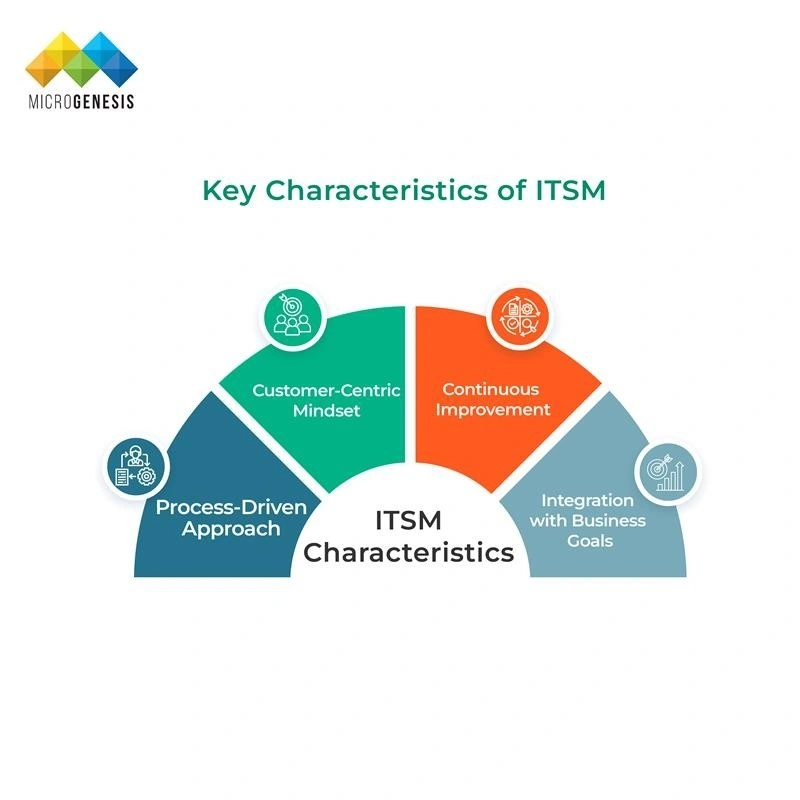
3.1 Process-Driven Approach
- ITSM revolves around well-defined processes that bring consistency, predictability, and control to IT operations.
- Frameworks like ITIL (Information Technology Infrastructure Library) provide clear guidance for processes such as incident management, change management, and problem management.
- This process orientation minimizes ambiguity, improves collaboration, and ensures that every task follows an established best-practice workflow — leading to higher efficiency and reduced risk.
3.2 Customer-Centric Mindset
- At its core, ITSM is about delivering value to customers — both internal users and external clients.
- It prioritizes user experience, service reliability, and responsiveness over purely technical metrics. For instance, success isn’t just measured by server uptime but by how that uptime impacts productivity and user satisfaction.
- By viewing IT through the customer’s lens, ITSM transforms technical support into a partnership that continuously enhances user experience.
3.3 Continuous Improvement
- Continuous Service Improvement (CSI) is a fundamental ITSM principle that ensures ongoing optimization of processes, services, and technologies.
- Through regular reviews, feedback loops, and performance measurements, ITSM encourages organizations to adapt to evolving business needs and technological advancements.
- This commitment to incremental progress helps maintain agility, competitiveness, and resilience in rapidly changing markets.
3.4 Integration with Business Goals
- Every IT activity within ITSM is aligned with business outcomes. Whether the objective is improving service uptime, reducing operational costs, or accelerating time to market, ITSM ensures that IT initiatives support measurable business value.
- This integration bridges the long-standing divide between IT and business functions — establishing a shared vision where technology becomes a catalyst for achieving strategic objectives.
4.Why ITSM Matters More Than Ever
In a digital economy where customer expectations evolve rapidly, ITSM plays a pivotal role in enabling scalability, resilience, and innovation. It ensures that IT departments are not just maintaining systems but orchestrating value creation across the organization.
From improving employee productivity through reliable IT services to supporting enterprise agility through automation and cloud integration, ITSM acts as the connective tissue between technology and business success.
As organizations embrace digital transformation, ITSM provides the governance, structure, and flexibility required to manage complexity while maintaining control, compliance, and consistency.
Importance of ITSM in Modern Enterprises
In an era where technology underpins nearly every business function, IT Service Management (ITSM) has evolved into a strategic enabler rather than a back-office discipline. By aligning IT capabilities with business outcomes, ITSM helps organizations achieve consistency, accountability, and scalability across their operations.
It ensures that IT not only supports but also drives business growth through structure, governance, and continual improvement.
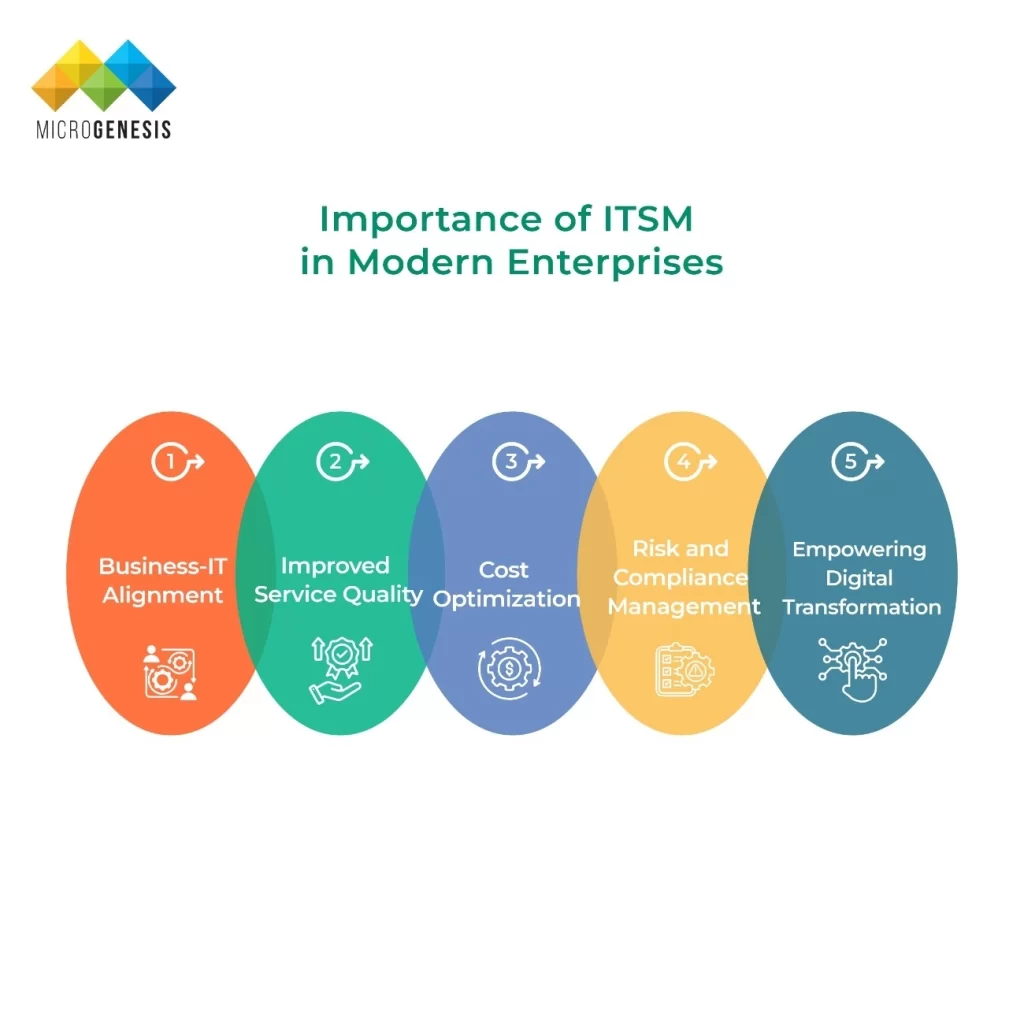
1.Business-IT Alignment
ITSM ensures that IT services directly support business priorities — from customer experience to revenue generation. It establishes governance structures where IT decisions are made collaboratively with business stakeholders.
Through this alignment, IT teams move from being technology providers to strategic partners, ensuring that every service and investment contributes measurable value to the organization’s long-term goals.
2.Improved Service Quality
By standardizing processes and defining Service Level Agreements (SLAs), ITSM reduces service variability and improves predictability. Users receive consistent, high-quality support regardless of issue type or location.
This consistency builds trust between IT and business users, while proactive monitoring and feedback loops ensure that quality remains at the heart of every service interaction.
3.Cost Optimization
Process efficiency and automation reduce operational waste by eliminating redundant tasks and streamlining resource usage. ITSM also enables better visibility into IT spending through transparent cost allocation and performance tracking.
By linking costs to outcomes, organizations can make informed decisions about where to invest — ensuring that technology budgets directly enhance performance, scalability, and innovation.
4. Risk and Compliance Management
ITSM frameworks embed governance and compliance into daily operations, providing structure for policy enforcement, auditability, and accountability. This ensures adherence to standards like ISO/IEC 27001 (information security) and GDPR (data protection).
By integrating compliance management into IT workflows, organizations can reduce regulatory risk, maintain operational integrity, and respond quickly to audits or security incidents.
5.Empowering Digital Transformation
ITSM provides the foundation for modern IT initiatives such as DevOps, cloud adoption, automation, and AI-driven service management. It establishes the governance, collaboration, and feedback mechanisms necessary for agile innovation.
With ITSM as a backbone, enterprises can modernize at scale — introducing new technologies faster while maintaining control, quality, and compliance across their digital ecosystem.
Key Frameworks and Standards in ITSM
1.ITIL (Information Technology Infrastructure Library)
ITIL is the most widely adopted ITSM framework globally. Developed by the UK Government in the 1980s and now managed by AXELOS, ITIL provides best practices for managing IT services throughout their lifecycle.
ITIL 4: The Modern Evolution
ITIL 4 expands beyond process efficiency to include agile, DevOps, and digital transformation principles. It emphasizes co-creation of value between IT and the business.
Five ITIL Lifecycle Stages:
- Service Strategy: Define business goals and customer needs.
- Service Design: Develop IT solutions to meet those needs.
- Service Transition: Move services from design to live environments safely.
- Service Operation: Ensure stability and responsiveness in day-to-day IT.
- Continual Service Improvement (CSI): Regularly refine services for better performance.
Benefits of ITIL:
- Global standardization of IT processes.
- Improved incident and change management.
- Enhanced customer satisfaction and service reliability.
2.COBIT (Control Objectives for Information and Related Technologies)
COBIT, developed by ISACA, focuses on IT governance and control. While ITIL focuses on “how” to deliver services, COBIT focuses on “what” should be achieved through IT.
It provides metrics, maturity models, and governance principles to ensure IT investments deliver business value while maintaining compliance.
Key Principles:
- Meeting stakeholder needs.
- Covering the entire enterprise end-to-end.
- Enabling a holistic governance framework.
3.ISO/IEC 20000
ISO/IEC 20000 is the international standard for IT Service Management systems (SMS). It outlines requirements for establishing, implementing, maintaining, and continually improving an SMS.
Organizations that meet ISO 20000 standards can achieve certification — demonstrating a commitment to quality and continual improvement.
Advantages:
- Enhances credibility and customer confidence.
- Aligns internal processes with international best practices.
- Supports compliance and audit readiness.
4.Other Complementary Frameworks
- MOF (Microsoft Operations Framework): A set of guidelines aligned with ITIL for managing Microsoft-based environments.
- FitSM: A lightweight ITSM framework ideal for smaller organizations.
- Agile and DevOps: Though not traditional ITSM frameworks, these methodologies integrate seamlessly with ITSM to promote rapid delivery and collaboration.
ITSM Processes Explained
1.Incident Management
Restores normal service operation as quickly as possible after an incident occurs.
Key steps include identification, logging, categorization, prioritization, resolution, and closure. Automation and self-service portals can accelerate response times.
2.Problem Management
Focuses on identifying and addressing the root cause of recurring incidents.
By analyzing patterns and implementing long-term fixes, problem management prevents future disruptions and improves overall stability.
3.Change Management
Ensures all IT changes (software updates, infrastructure upgrades, configuration modifications) are implemented in a controlled and safe manner.
Change Advisory Boards (CABs) evaluate potential risks before deployment to minimize service impact.
4.Configuration Management
Tracks all hardware, software, and network components through a Configuration Management Database (CMDB).
This enables visibility into asset relationships and dependencies — essential for impact analysis during incidents or changes.
5.Service Level Management
Defines and monitors Service Level Agreements (SLAs) between IT and business units.
SLM ensures service quality aligns with user expectations, using KPIs like uptime, response time, and resolution time.
6.Continual Service Improvement (CSI)
ITSM’s ongoing improvement process focuses on learning from performance data, customer feedback, and audits to refine service quality and efficiency.
The PDCA (Plan-Do-Check-Act) cycle ensures systematic, incremental enhancement of IT operations.
Implementing ITSM in Your Organization
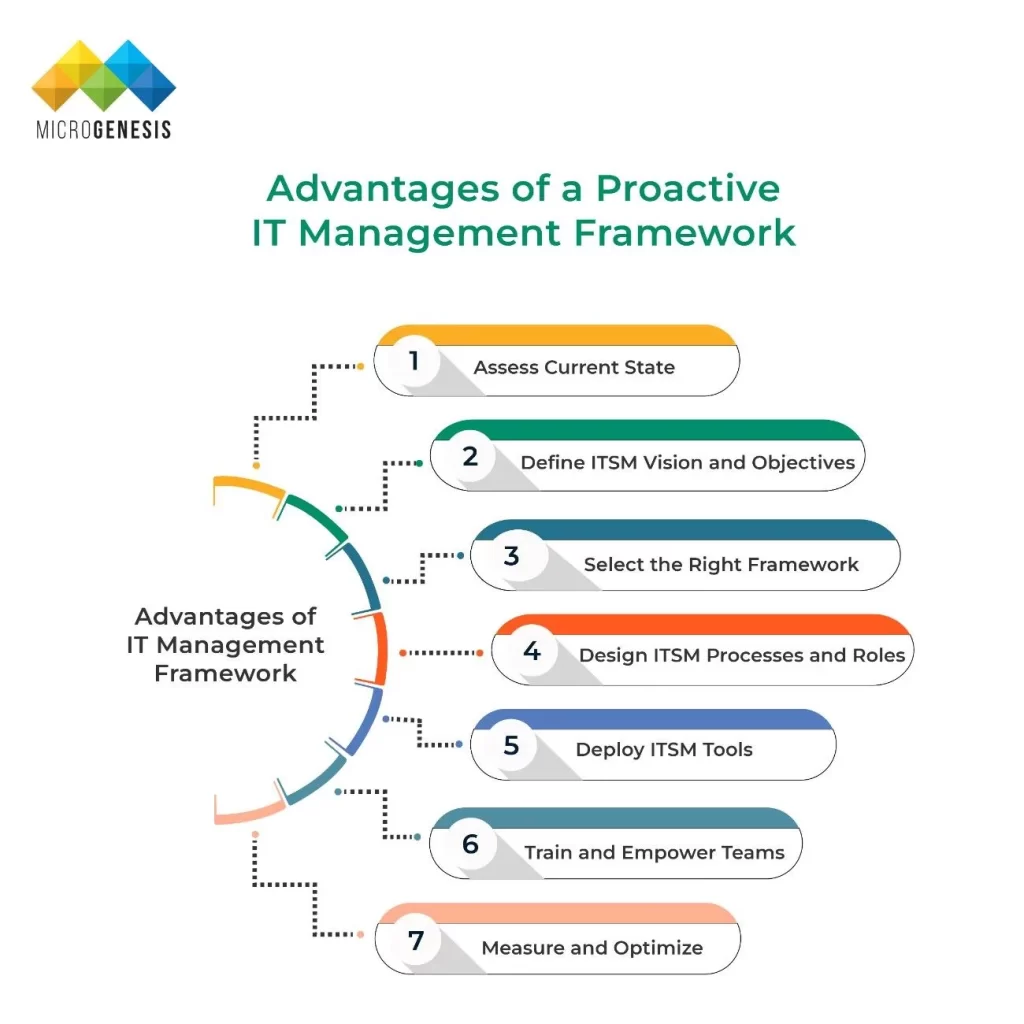
Step 1: Assess Current State
Begin by evaluating existing IT processes, tools, and capabilities. Identify gaps, redundancies, and bottlenecks. Conduct stakeholder interviews to align ITSM goals with business expectations.
Step 2: Define ITSM Vision and Objectives
Establish a clear roadmap that links ITSM objectives to business outcomes — such as improved service uptime, customer satisfaction, or compliance.
Set measurable goals (e.g., reduce incident resolution time by 30%) and secure executive sponsorship.
Step 3: Select the Right Framework
Choose an ITSM framework (ITIL, ISO 20000, or hybrid) based on organizational size, maturity, and regulatory environment.
Large enterprises may adopt ITIL or COBIT, while smaller firms might opt for FitSM for simplicity.
Step 4: Design ITSM Processes and Roles
Define workflows for core ITSM processes such as incident, problem, and change management. Establish clear ownership for each process and role-based responsibilities (e.g., service desk, change manager, process owner).
Step 5: Deploy ITSM Tools
Adopt ITSM software platforms like ServiceNow, BMC Helix, Jira Service Management, or Freshservice.
Ensure these tools integrate with monitoring, CMDB, and automation systems to create a unified service ecosystem.
Step 6: Train and Empower Teams
Cultural transformation is vital. Provide ITIL certification programs and soft-skills training to help teams adopt a service-oriented mindset.
Encourage collaboration between IT and business units to promote shared accountability for service outcomes.
Step 7: Measure and Optimize
Track performance using Key Performance Indicators (KPIs) such as:
- Mean Time to Resolution (MTTR)
- Customer Satisfaction (CSAT)
- SLA Compliance Rate
- Change Success Rate
Use data analytics to identify trends and guide continuous improvement initiatives.
Benefits of Effective ITSM Implementation
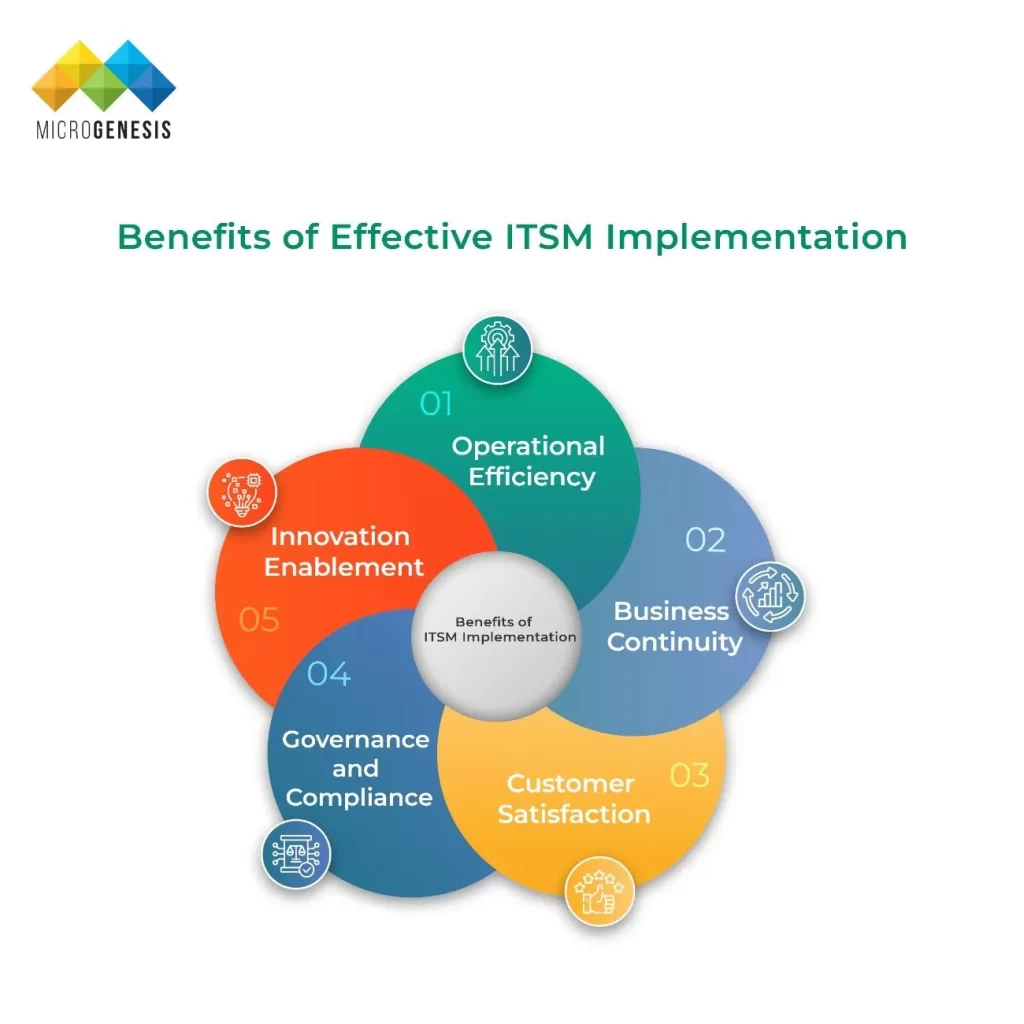
1.Operational Efficiency
Standardized processes and automation reduce redundancy, manual effort, and downtime — improving IT productivity and responsiveness.
2.Business Continuity
By maintaining service availability and rapid recovery capabilities, ITSM safeguards business continuity even during crises or cyber incidents.
3.Customer Satisfaction
Structured service delivery, transparent SLAs, and faster issue resolution enhance user trust and experience.
4.Governance and Compliance
ITSM frameworks embed governance principles, ensuring that IT policies align with corporate risk and compliance requirements.
5.Innovation Enablement
By automating routine tasks, ITSM frees resources for innovation — such as developing digital products or adopting AI-driven tools.
Common Challenges in ITSM Adoption

Implementing IT Service Management (ITSM) is a transformative process that reshapes how technology supports the business. However, as with any large-scale organizational change, the journey often encounters obstacles related to culture, complexity, and alignment. Recognizing these challenges early allows organizations to plan mitigation strategies that ensure successful, sustainable ITSM adoption.
1.Cultural Resistance
Employees accustomed to informal or ad-hoc IT support often struggle to adapt to structured, process-driven workflows. They may perceive ITSM as bureaucratic or time-consuming compared to the flexibility of their old methods.
To overcome this, leadership must communicate the why behind ITSM — emphasizing how standardization improves service quality, accountability, and career growth for IT professionals. Engaging teams through workshops, transparent communication, and early involvement in process design fosters ownership and reduces resistance to change.
2.Tool Complexity
- ITSM platforms like ServiceNow, BMC Helix, or Jira Service Management offer powerful functionality, but their complexity can become overwhelming, especially for organizations new to structured IT governance. Implementing too many modules or features at once often leads to confusion, duplication, and user fatigue.
- A practical approach is to start small — deploy only essential modules such as incident and change management, and gradually expand as teams mature. Regularly reviewing configurations and simplifying workflows ensures the tool enhances productivity rather than creating administrative overhead.
3.Data Accuracy
- The accuracy of the Configuration Management Database (CMDB) is the backbone of effective ITSM. If the data within the CMDB — such as asset inventories, dependencies, or configurations — is incomplete or outdated, it can undermine incident resolution, change control, and impact assessments.
- Establishing clear data ownership, validation routines, and automated discovery tools helps maintain accuracy and consistency. Regular audits and governance policies ensure that data remains reliable, supporting smarter decision-making and faster problem resolution.
4.Lack of Executive Buy-In
- Without sustained executive sponsorship, ITSM initiatives often lose momentum. Leadership engagement is crucial not only for securing funding but also for driving cultural change and cross-departmental collaboration.
- Executives should see ITSM as a strategic investment rather than an operational cost — one that enhances agility, compliance, and customer experience. Demonstrating early wins such as faster incident resolution, improved SLA compliance, or better visibility into IT costs helps build credibility and ensures long-term commitment from decision-makers.
The Future of IT Service Management
1.AI and Automation
- AI-powered service desks and AIOps platforms are transforming ITSM with predictive analytics, virtual assistants, and self-healing capabilities.
- Chatbots can handle routine incidents, freeing human agents for strategic problem-solving.
2.Integration with DevOps and Agile
ITSM is evolving to support faster, more iterative delivery cycles. Agile practices streamline change management, while DevOps fosters collaboration between development and operations.
3.Cloud-Native ITSM
As cloud adoption accelerates, ITSM platforms are becoming cloud-native — offering scalability, real-time analytics, and global accessibility.
4.Experience Management (XLA)
The future of ITSM will go beyond SLAs to focus on Experience Level Agreements (XLAs) — measuring how IT services impact user experience and satisfaction.
5.Sustainability and Green IT
Organizations are integrating sustainability metrics into ITSM — optimizing resource usage and reducing the carbon footprint of data centers and IT operations.
Conclusion
IT Service Management (ITSM) is the cornerstone of modern enterprise IT — aligning technology operations with business strategy to deliver consistent, measurable value.
By implementing the right framework, fostering a service-oriented culture, and leveraging automation, organizations can transform IT from a reactive function into a proactive, innovation-driven powerhouse.
As ITSM continues to evolve through AI, cloud, and agile methodologies, it remains a critical enabler of resilience, efficiency, and digital transformation in the modern enterprise.