Engineering organizations today operate in one of the most challenging business environments in history. Products are becoming increasingly intelligent, connected, software-driven, and data-centric, while customer expectations continue to rise. Whether developing industrial automation systems, automotive software, medical devices, telecom platforms, or cloud-native applications, engineering leaders must deliver innovation faster without compromising quality, security, or compliance.
At the same time, organizations across Europe are facing another major challenge—a growing shortage of experienced engineering talent. Recruiting specialists in software engineering, embedded systems, cloud technologies, AI, DevOps, cybersecurity, and digital engineering has become increasingly competitive. Many organizations also struggle to scale engineering teams quickly enough to meet changing business priorities.
Traditional hiring models often fail to provide the flexibility required for modern engineering. Recruiting permanent employees takes time, project demands fluctuate, and maintaining large internal teams can significantly increase operational costs.
This is why more organizations are adopting Managed Engineering Services as a strategic delivery model.
Rather than simply outsourcing individual tasks or hiring temporary contractors, Managed Engineering Services provide dedicated engineering teams, proven delivery processes, engineering governance, and measurable business outcomes. This enables organizations to accelerate product development while maintaining complete visibility, quality, and control.
Managed Engineering Services are a structured approach to engineering delivery where a specialized engineering partner assumes responsibility for delivering defined engineering capabilities, projects, or functions.
Instead of supplying individual engineers, a managed services partner provides complete engineering teams supported by project management, quality assurance, governance frameworks, delivery methodologies, and continuous performance monitoring.
This allows organizations to focus on product strategy and innovation while experienced engineering professionals manage execution and delivery.
Unlike traditional outsourcing, Managed Engineering Services are based on long-term collaboration, continuous improvement, and shared business objectives.
Modern engineering is no longer confined to a single office or development center. Engineering teams are distributed across countries, suppliers contribute to product development, and software updates continue long after products are released.
To remain competitive, organizations need engineering models that provide:
Managed Engineering Services address these needs by providing dedicated engineering capabilities that can scale as projects evolve.
Engineering leaders face multiple business and operational challenges that directly impact innovation and delivery performance.
The demand for experienced software engineers, embedded developers, cloud architects, DevOps specialists, AI engineers, and cybersecurity experts continues to exceed supply across Europe. This makes it difficult for organizations to recruit and retain the talent needed for complex engineering programs.
Today’s products integrate software, hardware, cloud services, connectivity, AI, and data analytics into a single ecosystem. Managing multidisciplinary engineering teams requires structured processes, collaboration, and integrated delivery models.
Customers expect faster innovation, more frequent releases, and continuous product improvements. Engineering organizations must shorten development cycles while maintaining quality and regulatory compliance.
Building and maintaining internal engineering teams involves significant investment in recruitment, training, infrastructure, and ongoing operations. Organizations increasingly seek delivery models that optimize engineering costs without compromising quality.
Many organizations operate engineering centers across multiple countries and time zones. Without effective governance and collaboration, distributed teams can experience communication gaps, inconsistent processes, and reduced productivity.
Organizations that adopt Managed Engineering Services achieve measurable improvements across engineering performance, operational efficiency, and business outcomes.
Managed Engineering Services also help organizations adopt modern engineering practices, including:
By integrating modern technologies with proven engineering methodologies, organizations create a more agile and future-ready engineering environment.
Managed Engineering Services support organizations developing complex products across a wide range of industries.
These include:
Although each industry has unique engineering challenges, the objective remains the same: deliver innovative products faster while maintaining quality, compliance, and operational excellence.
Selecting a Managed Engineering Services partner is about more than expanding engineering capacity. It is about establishing a long-term relationship that improves delivery performance, supports digital transformation, and enables sustainable innovation.
The right partner brings not only technical expertise but also structured delivery frameworks, engineering governance, and continuous improvement practices that align with your business objectives.
In the next section, we’ll explore why organizations across Europe—particularly in the Nordic region are increasingly adopting Managed Engineering Services and how this approach helps them overcome talent shortages, accelerate innovation, and build resilient engineering organizations.
Engineering organizations are under constant pressure to innovate faster, deliver high-quality products, and respond quickly to changing market demands. At the same time, engineering leaders must balance increasing product complexity with limited resources, rising operational costs, and growing customer expectations.
Across Sweden and the Nordic region, businesses are moving away from traditional engineering models toward Managed Engineering Services to improve agility, optimize costs, and gain access to specialized engineering expertise.
Unlike conventional outsourcing, Managed Engineering Services provide long-term engineering capabilities supported by governance, performance management, and continuous improvement. This allows organizations to focus on innovation while their engineering partner manages delivery, scalability, and operational excellence.
Engineering organizations are under constant pressure to innovate faster, deliver high-quality products, and respond quickly to changing market demands. At the same time, engineering leaders must balance increasing product complexity with limited resources, rising operational costs, and growing customer expectations.
Across Sweden and the Nordic region, businesses are moving away from traditional engineering models toward Managed Engineering Services to improve agility, optimize costs, and gain access to specialized engineering expertise.
Unlike conventional outsourcing, Managed Engineering Services provide long-term engineering capabilities supported by governance, performance management, and continuous improvement. This allows organizations to focus on innovation while their engineering partner manages delivery, scalability, and operational excellence.
Finding experienced software engineers, embedded developers, cloud architects, DevOps specialists, AI engineers, and systems engineers has become increasingly difficult. Competition for skilled talent continues to grow, particularly across Sweden and the Nordic countries, making recruitment more time-consuming and expensive.
Many organizations struggle with:
Rather than delaying projects due to hiring challenges, organizations are leveraging Managed Engineering Services to gain immediate access to experienced engineering professionals.
Modern products are no longer standalone systems. They combine software, embedded electronics, cloud services, AI, cybersecurity, and connected platforms into a single digital ecosystem.
Engineering teams must now coordinate multiple disciplines simultaneously, including:
Without structured engineering processes, collaboration becomes increasingly difficult as projects grow.
Customers expect continuous innovation, shorter release cycles, and frequent feature updates. Engineering organizations can no longer rely on lengthy development processes that delay product delivery.
To remain competitive, businesses need to:
Managed Engineering Services help organizations achieve these goals through dedicated teams, standardized delivery processes, and engineering best practices.
Building and maintaining internal engineering teams requires significant investment in recruitment, infrastructure, employee development, and technology.
Organizations must balance:
Managed Engineering Services provide predictable engagement models that help organizations optimize engineering investments while maintaining access to specialized expertise.
Many organizations rely on separate vendors for software development, testing, infrastructure, cloud services, and engineering support. While this may solve short-term resource challenges, it often creates fragmented processes, inconsistent quality, and increased management complexity.
Common challenges include:
Working with a strategic engineering partner helps consolidate engineering capabilities under a single governance framework.
Organizations that adopt Managed Engineering Services consistently improve engineering performance while reducing operational complexity.
Traditional Engineering Model | Managed Engineering Services |
Build internal teams for every project | Scale dedicated engineering teams as needed |
Long recruitment cycles | Immediate access to experienced engineers |
High fixed operational costs | Flexible and predictable engagement models |
Limited access to specialized skills | Multidisciplinary engineering expertise |
Internal management of delivery | Shared governance and outcome-based delivery |
Difficult to scale quickly | Engineering capacity scales with business demand |
The managed model enables organizations to focus on innovation and product strategy while reducing the complexity of day-to-day engineering operations.
Managed Engineering Services are not simply a way to fill resource gaps—they are a strategic approach to building resilient engineering organizations. By combining skilled engineers with standardized delivery frameworks, organizations can improve operational efficiency while creating a scalable foundation for future growth.
Businesses that invest in managed engineering partnerships typically experience:
As organizations continue to modernize their engineering operations, choosing the right engagement model becomes just as important as choosing the right technology.
In the next section, we’ll compare the most common engineering engagement models including Dedicated Development Teams, Staff Augmentation, Managed Services, and Hybrid Delivery Models to help you determine which approach best aligns with your business objectives.
There is no one-size-fits-all approach to engineering delivery. Every organization has different business objectives, engineering maturity, budget constraints, and project requirements. Choosing the right engagement model is essential for balancing flexibility, cost, speed, and long-term scalability.
Some organizations need a few additional specialists to support internal teams, while others require a dedicated engineering partner capable of managing complete product development programs. Understanding the strengths of each model helps businesses make informed decisions and maximize the value of their engineering investment.
A Dedicated Development Team is a long-term engagement model where an engineering partner provides a team of skilled professionals who work exclusively on your projects. Unlike traditional outsourcing, dedicated teams become an extension of your organization, following your processes, tools, quality standards, and business objectives.
This model is particularly valuable for organizations developing complex software products, digital platforms, or long-term engineering initiatives.
Many organizations choose dedicated teams to establish long-term engineering capabilities without the challenges of recruiting and managing large internal teams.
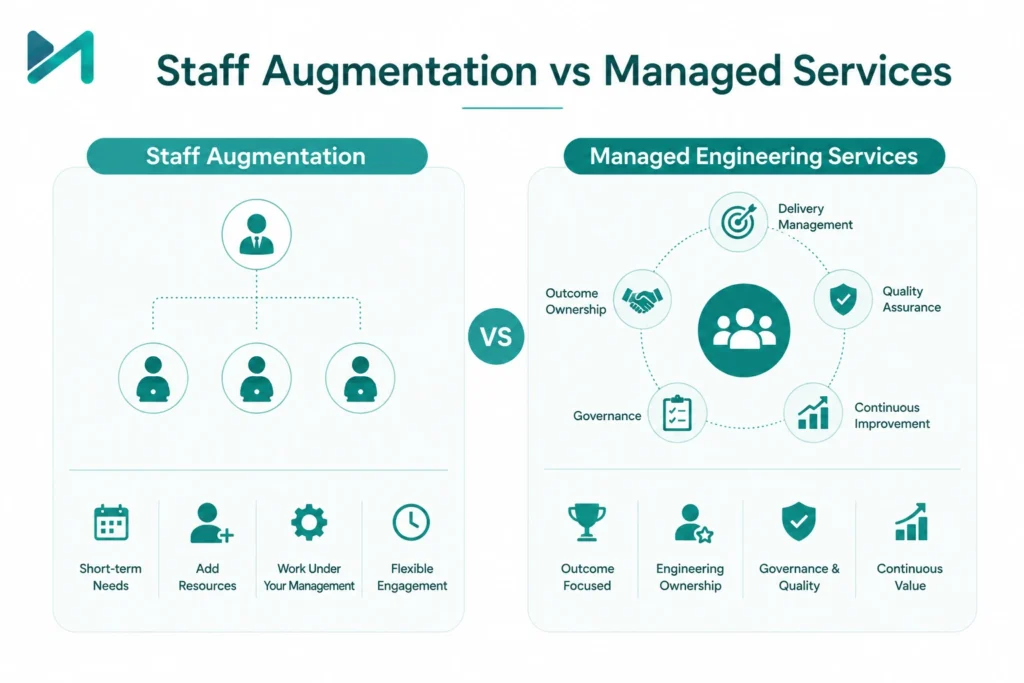
Although Staff Augmentation and Managed Engineering Services are often considered similar, they solve different business challenges.
Staff Augmentation provides additional engineers who work under the customer’s management, making it a suitable option for short-term skill gaps or temporary project support.
Managed Engineering Services, on the other hand, provide complete engineering ownership, including delivery management, governance, quality assurance, and continuous improvement. Instead of managing individual resources, organizations collaborate with an engineering partner responsible for achieving agreed business outcomes.
Staff Augmentation | Managed Engineering Services |
Resource-based engagement | Outcome-based engagement |
Customer manages daily activities | Engineering partner manages delivery |
Suitable for short-term needs | Designed for long-term partnerships |
Limited engineering governance | Structured governance and reporting |
Scaling requires additional management | Teams scale through established delivery models |
Focus on filling skill gaps | Focus on achieving measurable business outcomes |
Organizations increasingly prefer Managed Engineering Services because they reduce management overhead while improving delivery consistency and engineering quality.
Many engineering organizations adopt a Hybrid Delivery Model that combines onsite collaboration with nearshore and offshore engineering capabilities. This approach provides the flexibility to retain strategic expertise internally while leveraging global engineering talent for development, testing, and support.
Hybrid delivery is particularly effective for organizations managing distributed engineering teams across multiple locations.
By combining local business knowledge with global engineering expertise, organizations create resilient and scalable engineering operations.
Rather than replacing internal engineering departments, Managed Engineering Services help organizations build Extended Engineering Teams that work as a natural extension of existing capabilities.
Successful extended teams share common goals, engineering processes, collaboration tools, and performance metrics, creating a unified engineering environment regardless of location.
When implemented effectively, extended engineering teams improve productivity, strengthen collaboration, and accelerate innovation while maintaining a consistent engineering culture.
The right delivery model depends on your business goals, project complexity, available internal expertise, and long-term product strategy.
Business Requirement | Recommended Model |
Short-term specialist support | Staff Augmentation |
Long-term product development | Dedicated Development Teams |
Complete engineering ownership | Managed Engineering Services |
Flexible global collaboration | Hybrid Delivery Model |
Large-scale engineering expansion | Extended Engineering Teams |
Rather than selecting a single model for every project, many organizations combine multiple engagement approaches to create a scalable engineering strategy that evolves with business needs.
By understanding the strengths of each model, engineering leaders can build high-performing teams that deliver innovation faster while maintaining quality, governance, and cost efficiency.
Modern product development is no longer confined to a single office or geographic location. Engineering organizations increasingly rely on globally distributed teams to accelerate innovation, access specialized expertise, and optimize operational costs. Selecting the right delivery model is therefore a strategic business decision that influences project success, engineering productivity, and long-term scalability.
Today’s organizations require delivery models that support collaboration across multiple locations while maintaining engineering quality, governance, and security. Whether expanding engineering capacity, launching new products, or supporting long-term digital transformation initiatives, choosing the right approach enables businesses to respond faster to changing market demands.
One of the most common decisions organizations face is whether to establish nearshore or offshore engineering teams. Both approaches provide access to skilled talent and improved scalability, but they offer different advantages depending on project requirements.
Nearshore development involves working with engineering teams located in nearby countries or regions that offer similar time zones, cultural alignment, and easier collaboration.
Offshore development provides access to larger engineering talent pools while helping organizations optimize engineering costs and scale rapidly.
Nearshore Development | Offshore Development |
Close geographical proximity | Global delivery centers |
Similar time zones | Wider talent availability |
Easier face-to-face collaboration | Greater scalability |
Higher operating costs | More cost-efficient |
Strong regional alignment | Global engineering expertise |
Ideal for collaborative projects | Ideal for long-term engineering delivery |
Many organizations adopt a hybrid approach that combines the advantages of both models.
Modern software development requires more than writing code. Organizations need structured engineering processes, quality assurance, DevOps practices, security, and continuous delivery to remain competitive.
Managed Software Development provides a complete delivery framework where an engineering partner takes responsibility for planning, development, testing, deployment, and ongoing support.
Instead of managing multiple vendors, organizations gain a dedicated engineering partner responsible for delivering measurable business outcomes.
Engineering demand rarely remains constant. Organizations often need to increase engineering capacity rapidly when launching new products, entering new markets, or accelerating digital transformation initiatives.
A scalable engineering delivery model enables businesses to grow engineering teams without lengthy recruitment cycles or significant operational overhead.
Organizations that build scalable engineering capabilities are better positioned to respond quickly to changing customer needs and evolving market conditions.
Global Capability Models enable organizations to combine local business expertise with globally distributed engineering teams. Instead of operating isolated development centers, businesses create integrated engineering ecosystems where teams collaborate across locations using common processes, tools, and governance.
For organizations operating across Europe, combining local leadership with global engineering capabilities creates a flexible and resilient delivery model that supports sustainable growth.
Selecting the right engineering delivery model depends on several factors, including business objectives, product complexity, collaboration requirements, and long-term growth plans.
Rather than relying on a single approach, many organizations combine dedicated engineering teams, managed software development, nearshore collaboration, and offshore engineering capabilities to create a delivery model that balances agility, quality, and cost efficiency.
By choosing the right engineering delivery strategy, businesses can improve collaboration, accelerate innovation, and establish a scalable foundation for future product development.
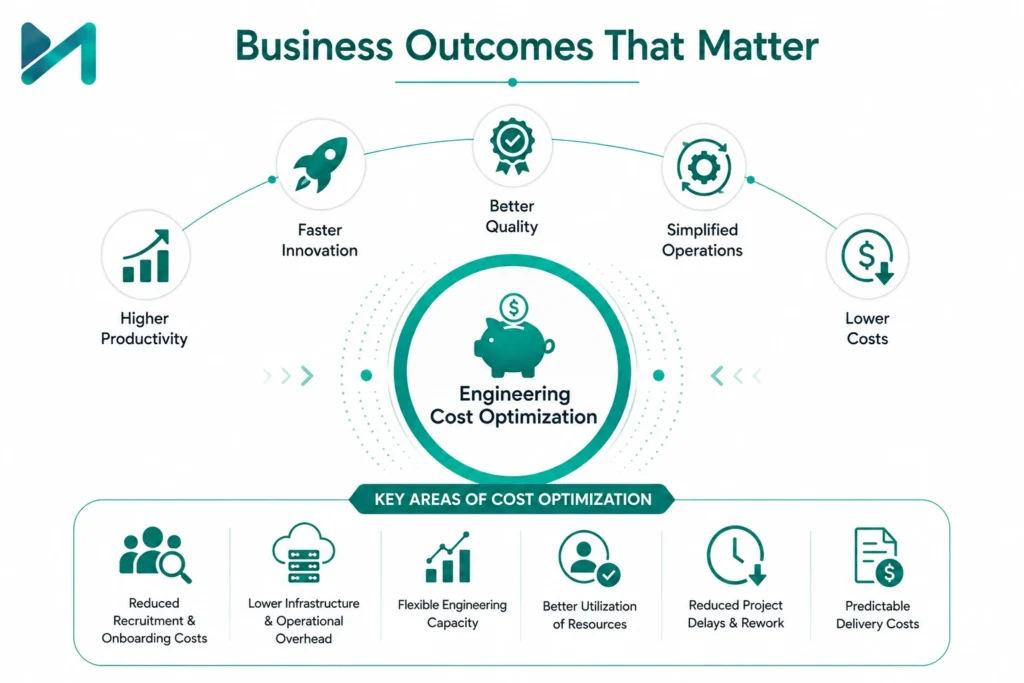
Engineering leaders today are measured not only by the quality of the products they deliver but also by how efficiently they utilize resources, accelerate innovation, and contribute to overall business growth. As engineering organizations become larger and more distributed, improving operational efficiency has become just as important as adopting new technologies.
Managed Engineering Services provide organizations with more than additional engineering capacity—they create measurable business outcomes that improve productivity, reduce costs, simplify operations, and accelerate product delivery.
Instead of focusing solely on engineering activities, successful organizations evaluate engineering performance based on the value delivered to the business.
Engineering represents one of the largest investments for product-driven organizations. Recruiting specialists, maintaining infrastructure, licensing engineering tools, and supporting multiple engineering teams can significantly increase operational costs.
Managed Engineering Services help organizations optimize engineering investments without compromising innovation or quality.
Rather than maintaining oversized internal teams during periods of fluctuating demand, organizations can scale engineering capabilities as needed while maintaining cost efficiency.
In competitive markets, speed is often the difference between leading and following. Organizations that deliver products faster can respond more quickly to customer needs, capture new market opportunities, and maintain a competitive advantage.
Managed Engineering Services help accelerate product development by providing experienced engineering teams, standardized delivery processes, and scalable engineering capacity.
By combining engineering expertise with proven delivery frameworks, organizations reduce bottlenecks and accelerate every stage of product development.
Many organizations work with multiple engineering vendors, each responsible for different technologies, products, or services. While this may address immediate resource needs, managing multiple suppliers often introduces unnecessary complexity.
Common challenges include:
Consolidating engineering capabilities under a strategic Managed Engineering Services partner creates a more connected and efficient operating model.
With fewer vendors and clearer ownership, organizations can focus more on innovation and less on operational coordination.
Productivity is no longer measured only by the number of engineers on a project. Modern engineering organizations focus on how effectively teams deliver value, collaborate, and respond to changing business priorities.
Managed Engineering Services improve productivity by combining skilled professionals, standardized processes, automation, and continuous improvement initiatives.
KPI | Business Value |
Lead Time | Faster feature delivery |
Cycle Time | Improved development efficiency |
Deployment Frequency | Increased release velocity |
Defect Rate | Better software quality |
Resource Utilisation | Optimized engineering capacity |
Customer Satisfaction | Better product experience |
Organizations that continuously monitor engineering performance are better positioned to identify improvement opportunities and make informed business decisions.
While technical excellence remains essential, modern engineering organizations also evaluate success through broader business outcomes.
By focusing on measurable business outcomes rather than simply increasing engineering capacity, organizations create a scalable foundation for long-term innovation and digital transformation.
Engineering is no longer viewed as a support function—it has become a strategic driver of business success. Organizations that invest in efficient engineering delivery models gain a competitive advantage by bringing products to market faster, responding more effectively to customer needs, and optimizing the return on every engineering investment.
Managed Engineering Services provide the governance, expertise, and flexibility needed to achieve these outcomes while allowing internal teams to focus on innovation and strategic priorities.
In the next section, we’ll explore how Sweden and the Nordic region are responding to engineering talent shortages, why businesses are adopting distributed engineering models, and how Managed Engineering Services help organizations build resilient engineering capabilities across global teams.
The Nordic region is recognized globally for engineering excellence, innovation, and advanced manufacturing. Countries such as Sweden, Norway, Denmark, and Finland are home to some of the world’s most respected automotive manufacturers, industrial technology companies, telecommunications leaders, medical device innovators, and software-driven enterprises.
However, as products become increasingly digital and software-centric, engineering organizations across the Nordics face growing challenges in scaling their engineering capabilities while maintaining quality, innovation, and operational efficiency.
Managed Engineering Services have emerged as a strategic solution that enables organizations to access global engineering expertise, accelerate product development, and build resilient engineering organizations without compromising local business knowledge or customer collaboration.
Rather than replacing internal engineering teams, Managed Engineering Services complement existing capabilities, allowing businesses to scale faster, access specialized skills, and focus internal resources on strategic innovation.
Sweden has long been recognized as one of Europe’s leading technology and innovation hubs. The country is home to globally recognized companies in automotive, telecommunications, industrial automation, fintech, gaming, and life sciences.
As digital transformation accelerates, Swedish organizations are increasingly combining local engineering leadership with global software development capabilities to improve agility and respond more quickly to market demands.
Software development outsourcing has evolved significantly over the past decade. Organizations are no longer seeking low-cost development resources—they are looking for strategic engineering partners that can contribute technical expertise, engineering governance, and long-term product innovation.
By partnering with experienced engineering providers, Swedish businesses can maintain local product ownership while extending development capacity through dedicated engineering teams.
The demand for highly skilled engineers continues to grow across Sweden and the broader Nordic region. Organizations are investing heavily in software development, cloud computing, artificial intelligence, cybersecurity, embedded systems, and digital engineering to remain competitive.
However, the availability of experienced engineering professionals has not kept pace with this demand.
These challenges can delay projects, increase development costs, and reduce an organization’s ability to respond quickly to new business opportunities.
Managed Engineering Services help organizations overcome these challenges by providing immediate access to multidisciplinary engineering teams with expertise across a wide range of technologies and industries
Rather than competing in an increasingly constrained talent market, organizations can build long-term engineering partnerships that provide consistent access to the skills required for future growth.
Distributed engineering has become the standard operating model for many organizations across Europe. Advances in cloud collaboration, Agile methodologies, DevOps practices, and secure engineering platforms have made it possible for globally distributed teams to work together efficiently while maintaining high engineering standards.
For Nordic companies, the most successful distributed teams operate as integrated engineering organizations rather than separate internal and external groups.
When engineering teams operate with common goals and standardized workflows, geographical location becomes less important than collaboration and execution.
Organizations that successfully build distributed engineering teams benefit from greater flexibility, improved resilience, and the ability to scale engineering capabilities without sacrificing quality or collaboration.
Engineering organizations throughout Sweden and the Nordic region are increasingly adopting Managed Engineering Services because they provide a sustainable way to address talent shortages, accelerate innovation, and improve operational efficiency.
Managed Engineering Services allow organizations to build scalable engineering capabilities while maintaining strategic control over product vision, customer relationships, and business priorities.
By combining local engineering leadership with global engineering expertise, Nordic companies can create resilient development organizations that are prepared for future innovation.
The most successful engineering partnerships are built on collaboration, transparency, and shared objectives—not simply resource supply.
For organizations across Sweden and the Nordic region, Managed Engineering Services provide access to specialized expertise, scalable delivery models, and engineering best practices that enable sustainable business growth.
Whether developing next-generation industrial systems, connected products, enterprise software, or digital platforms, businesses benefit from engineering teams that can adapt quickly, collaborate effectively, and deliver measurable outcomes.
In the final section, we’ll explore how MicroGenesis Sweden helps organizations build high-performing engineering teams through flexible engagement models, deep technical expertise, and a commitment to long-term engineering excellence.
Building successful products requires more than technical expertise. It demands the ability to scale engineering teams, integrate modern technologies, maintain engineering quality, and continuously innovate in a rapidly changing business environment.
At MicroGenesis Sweden, we partner with organizations to deliver outcome-driven Managed Engineering Services that combine engineering excellence, flexible delivery models, and deep industry expertise. Our goal is to help businesses accelerate product development, optimize engineering operations, and build scalable engineering organizations that are prepared for future growth.
Whether you’re expanding software development capabilities, modernizing engineering operations, or building distributed engineering teams, we provide the people, processes, and technology needed to deliver measurable business outcomes.
We offer end-to-end engineering services that support every stage of the product development lifecycle, enabling organizations to innovate faster while maintaining quality, security, and operational efficiency.
Our multidisciplinary engineering teams work closely with your organization to ensure seamless collaboration, transparent communication, and consistent delivery.
Every engineering organization has unique business objectives and resource requirements. That’s why we offer flexible engagement models designed to align with your product strategy, project complexity, and growth plans.
A dedicated engineering team works exclusively on your projects, integrating with your internal organization and following your engineering processes and delivery standards.
Ideal for:
Our Managed Engineering Services model provides complete ownership of engineering delivery, including project management, quality assurance, governance, reporting, and continuous improvement.
Organizations benefit from:
We combine onsite collaboration with nearshore and offshore engineering capabilities to create flexible delivery models that balance speed, quality, and cost efficiency.
Benefits include:
Our engineering professionals support organizations across a wide range of industries, helping them solve complex engineering challenges while accelerating innovation.
With experience across highly regulated industries, we understand the importance of engineering governance, quality management, traceability, and compliance.
Engineering excellence depends on combining the right people with the right technologies. Our teams bring expertise across modern engineering platforms, software development practices, and digital engineering methodologies.
We continuously invest in emerging technologies to help clients remain competitive in an increasingly digital marketplace.
Successful engineering partnerships require more than technical capability—they require transparency, collaboration, and measurable outcomes.
Our delivery approach focuses on:
This structured approach enables organizations to maintain visibility throughout every stage of product development while reducing delivery risk.
Businesses choose MicroGenesis Sweden because we combine local customer engagement with global engineering capabilities, enabling organizations to scale efficiently while maintaining engineering excellence.
Our goal is not simply to provide engineering resources but to become a trusted extension of your engineering organization.
Whether you’re developing next-generation software products, modernizing engineering operations, or expanding your engineering capacity, MicroGenesis Sweden provides the expertise, flexibility, and delivery capabilities needed to help you succeed.
Our experts can help you:
Contact MicroGenesis Sweden today to discuss how our Managed Engineering Services can help you build scalable engineering capabilities and deliver innovative products faster.
Managed Engineering Services are outcome-based engineering solutions where a specialized partner takes responsibility for delivering engineering capabilities, projects, or functions. Unlike traditional outsourcing or staff augmentation, managed engineering services include governance, delivery management, quality assurance, continuous improvement, and scalable engineering teams aligned with business objectives.
Staff augmentation provides individual engineers who work under your management, while Managed Engineering Services deliver dedicated teams responsible for achieving agreed business outcomes. Managed services include project governance, delivery ownership, quality management, and continuous performance improvement.
Related Reading: Staff Augmentation vs Managed Services
Managed Engineering Services support organizations across multiple industries, including:
These industries benefit from scalable engineering expertise, faster product development, and improved engineering governance.
Dedicated Development Teams are engineering professionals who work exclusively on your products and projects while integrating with your internal teams, processes, and delivery methodologies. This model is ideal for long-term product development and digital transformation initiatives.
Related Reading: Dedicated Development Teams
Organizations should consider Managed Engineering Services when they need to:
Nearshore development uses engineering teams in nearby regions with similar time zones, while offshore development provides access to global engineering talent and greater scalability. Many organizations adopt hybrid delivery models to combine the benefits of both approaches.
Related Reading: Nearshore vs Offshore Development
Managed Engineering Services improve productivity by introducing standardized engineering processes, Agile delivery, automation, DevOps, engineering governance, and dedicated engineering teams focused on measurable business outcomes.
Related Reading: Improving Engineering Productivity
Organizations reduce engineering costs through:
Related Reading: Engineering Cost Optimisation
Yes. Managed Engineering Services play an important role in digital transformation by providing expertise in cloud engineering, DevOps, AI, automation, software modernization, Engineering Lifecycle Management (ELM), and Digital Engineering.
Engineering teams typically support technologies including:
Organizations can rapidly scale engineering teams through Dedicated Development Teams, Managed Engineering Services, or Hybrid Delivery Models, enabling access to experienced engineers without lengthy recruitment cycles.
Related Reading: Scaling Engineering Teams
A Hybrid Delivery Model combines onsite, nearshore, and offshore engineering capabilities to improve collaboration, optimize costs, and provide access to global engineering expertise.
Related Reading: Hybrid Delivery Models
Companies across Sweden and the Nordic region increasingly use Managed Engineering Services to address engineering talent shortages, accelerate software development, improve productivity, and support long-term digital transformation initiatives.
Related Reading: Engineering Talent Challenges in Nordic Markets
Managed Engineering Services support the complete product lifecycle, including:
This enables faster delivery while maintaining engineering quality and governance.
MicroGenesis Sweden combines deep engineering expertise, flexible engagement models, and global delivery capabilities to help organizations scale engineering teams, accelerate innovation, and achieve measurable business outcomes. Our collaborative approach, industry experience, and commitment to engineering excellence make us a trusted partner for businesses across Sweden and Europe.
Engineering is evolving rapidly as organizations embrace software-defined products, cloud-native platforms, artificial intelligence, and connected digital ecosystems. Success in this environment requires more than skilled engineers—it requires scalable delivery models, engineering governance, modern development practices, and the ability to adapt quickly to changing business needs.
Managed Engineering Services provide the flexibility and expertise needed to meet these challenges. By combining dedicated engineering teams, structured delivery frameworks, and outcome-based engagement models, organizations can accelerate product development, improve engineering productivity, optimize costs, and build resilient engineering capabilities.
Whether you’re expanding engineering capacity, modernizing legacy systems, launching new digital products, or supporting long-term innovation programs, choosing the right engineering partner can have a lasting impact on your business performance.
At MicroGenesis Sweden, we help organizations transform engineering operations through flexible delivery models, dedicated engineering teams, managed software development, and digital engineering expertise. We work as an extension of your organization, delivering engineering excellence that supports innovation, growth, and long-term business success.
Partner with MicroGenesis SwedenAB to build high-performing engineering teams, accelerate product development, and create a scalable engineering organization prepared for the future.
Talk to our engineering experts today and discover how Managed Engineering Services can help your business innovate faster and deliver better products