As enterprises grow increasingly digital, they depend on a complex ecosystem of service providers—cloud vendors, application developers, network operators, cybersecurity partners, and more. While outsourcing and multi-sourcing offer flexibility and cost efficiency, they also introduce significant challenges: fragmented accountability, inconsistent performance, and blurred ownership of outcomes.
In this environment, Service Integration and Management (SIAM) has emerged as a structured approach to orchestrate and govern diverse providers. SIAM ensures that the organization retains end-to-end control, visibility, and accountability while leveraging specialized expertise from multiple suppliers.
In simple terms, SIAM enables organizations to “act as one” across multiple vendors. It integrates services, processes, tools, and governance frameworks to deliver seamless, high-quality business services to end users.
This comprehensive guide explores what SIAM is, why it matters, how it works, and how organizations can successfully implement it to drive transformation, agility, and business value.
Service Integration and Management (SIAM) is a management methodology and operating model that coordinates multiple service providers to deliver a unified set of business-aligned IT services.
Unlike traditional vendor management, which focuses on contracts and SLAs at the provider level, SIAM ensures end-to-end accountability, meaning the business receives a complete service experience without worrying about which vendor provides which part.
In short:
SIAM = IT Service Management + Multi-Vendor Coordination + Governance
Successfully implementing Service Integration and Management (SIAM) requires adherence to several foundational principles that guide governance, process design, and provider collaboration. These principles ensure that multi-vendor environments operate as a single, cohesive ecosystem rather than a set of disconnected services.
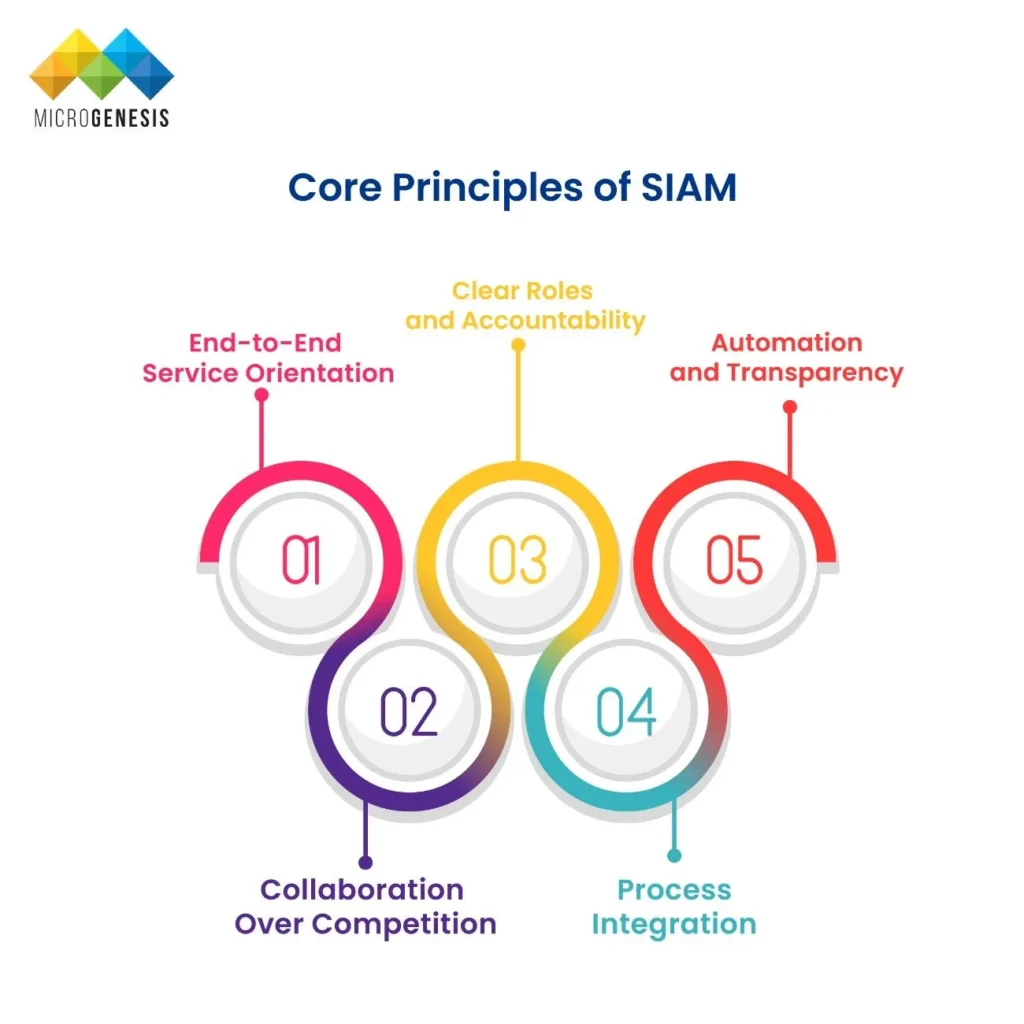
SIAM emphasizes delivering outcomes that matter to the business, rather than focusing on the performance of individual providers.
This principle shifts the focus from “local optimization” to “overall service success”, reducing silos and misaligned priorities.
SIAM fosters a culture where providers work together instead of competing internally.
Collaboration ensures seamless service delivery and builds trust across the ecosystem, preventing the common “blame game” scenario.
Defining who is responsible for what at every layer is essential in multi-vendor environments.
Clear role definition prevents ambiguity, reduces conflicts, and enhances operational efficiency.
SIAM requires the harmonization of ITSM processes across all providers.
Process integration ensures predictability, repeatability, and reliability in service delivery.
Automation and visibility are critical enablers in complex multi-provider environments.
Together, automation and transparency increase efficiency, reduce errors, and provide stakeholders with a clear understanding of service performance at any moment
The rise of multi-sourcing, cloud adoption, and digital transformation has made SIAM a strategic necessity.
Organizations today manage dozens of services—cloud hosting, SaaS apps, managed security, DevOps pipelines, and more. Each vendor operates independently, often using different tools, contracts, and SLAs. The result?
Different organizations adopt SIAM in different ways, depending on internal maturity, governance preferences, and sourcing strategy. Below are the four common models:
The organization itself acts as the integrator.
Use Case: Enterprises with mature IT functions or a desire to retain full control.
An independent third-party acts as the integrator, coordinating vendors on behalf of the organization.
Use Case: Organizations without internal integration maturity or capacity.
A collaborative approach where integration responsibilities are shared between the organization and an external partner.
Use Case: Large enterprises balancing internal control and external expertise.
One vendor is appointed as the lead integrator, managing other providers.
Use Case: Scenarios with one dominant supplier or tightly coupled ecosystems.
A mature SIAM framework operates through four interdependent layers, each serving a unique role in governance and delivery:
The heart of SIAM — this layer manages:
The integrator ensures that the ecosystem runs as one cohesive unit.
Each supplier delivers services under defined SLAs. Providers are accountable for their own deliverables while collaborating with others through shared processes.
Covers unified ITSM processes like incident, change, problem, release, and configuration management. These are standardized across providers to ensure consistent workflows.
A multi-tier governance framework ensures oversight:
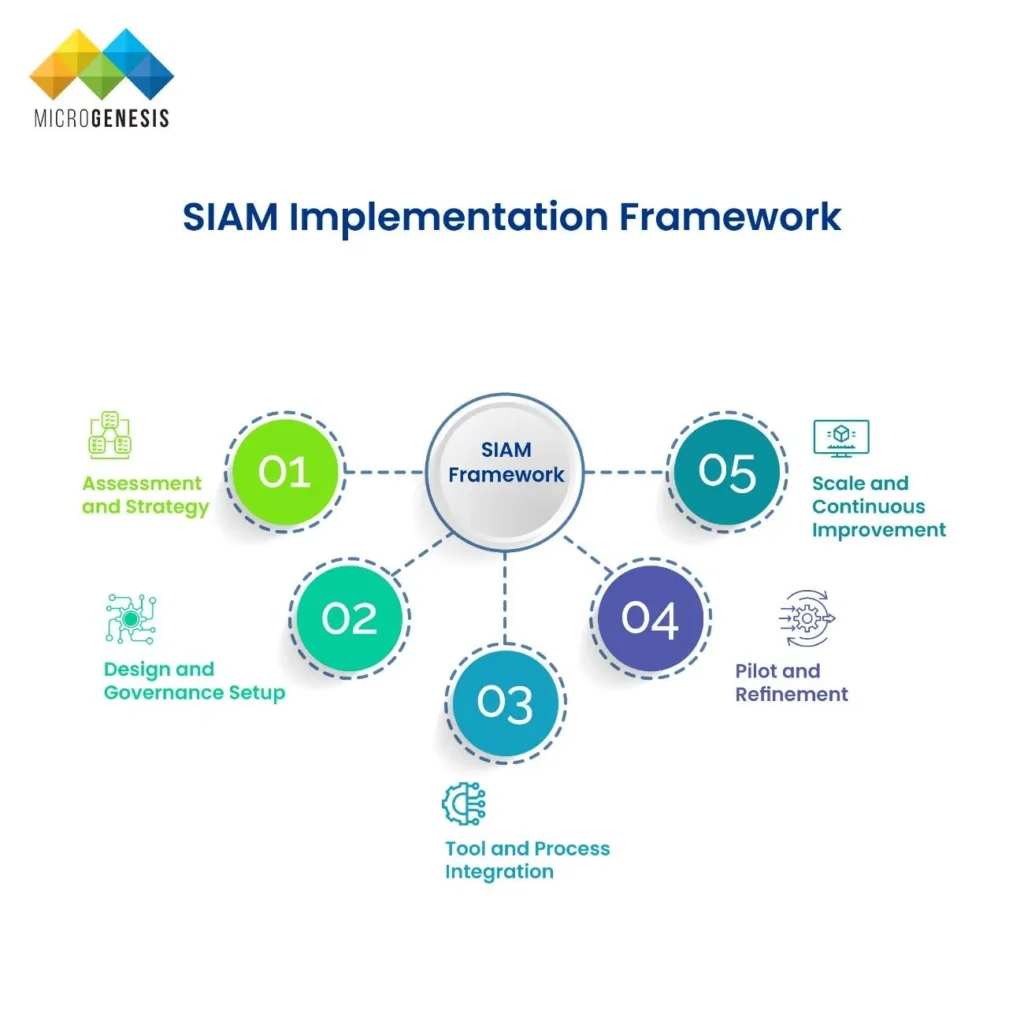
Implementing SIAM is a transformational journey that touches technology, process, people, and culture. Below is a phased roadmap:
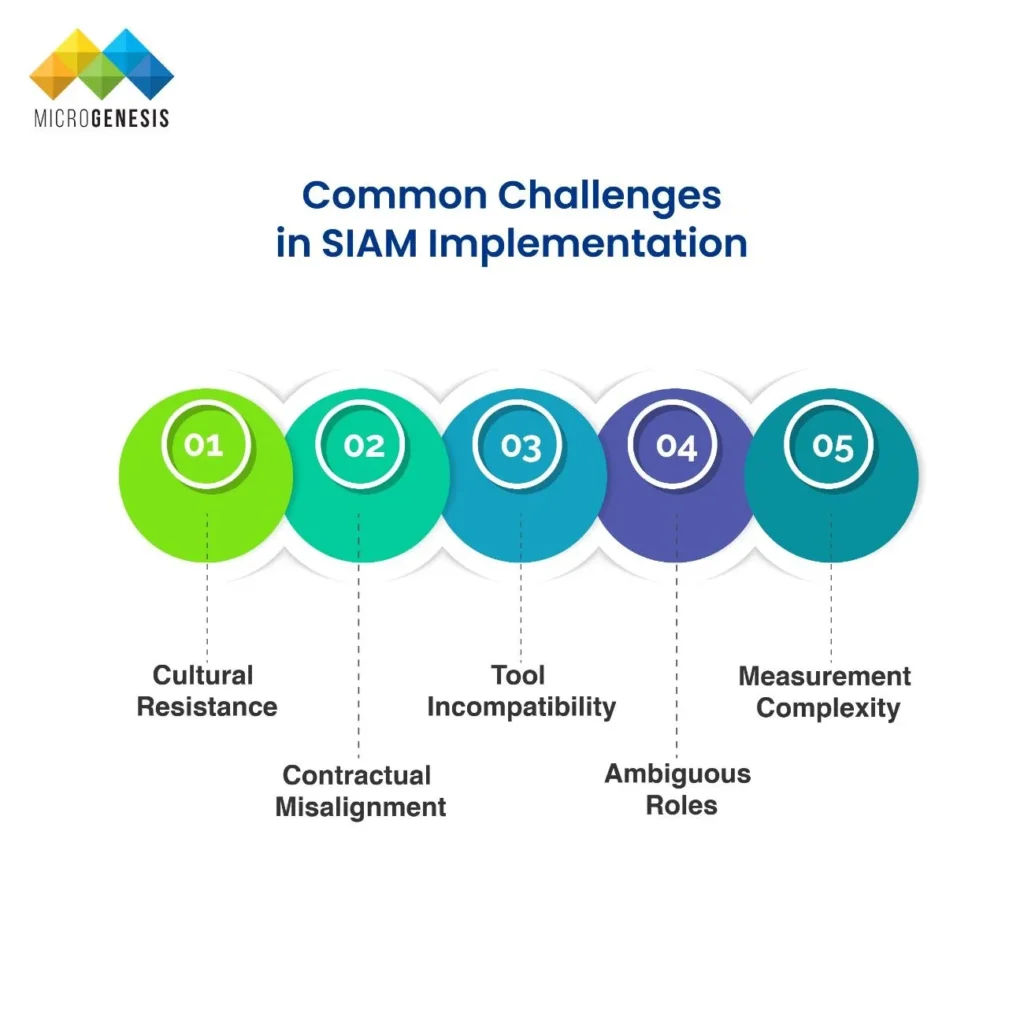
Teams and vendors may fear losing autonomy.
Solution: Transparent communication, leadership support, and change champions.
SLAs across vendors often conflict.
Solution: Harmonize contracts and include joint KPIs that measure collective outcomes.
Different ITSM systems create integration silos.
Solution: Use middleware, APIs, or unified platforms to enable cross-provider visibility.
Without clarity, accountability breaks down.
Solution: Define clear RACI matrices and governance protocols.
It’s hard to measure performance spanning multiple providers.
Solution: Focus on end-to-end service KPIs (availability, resolution time, business impact).
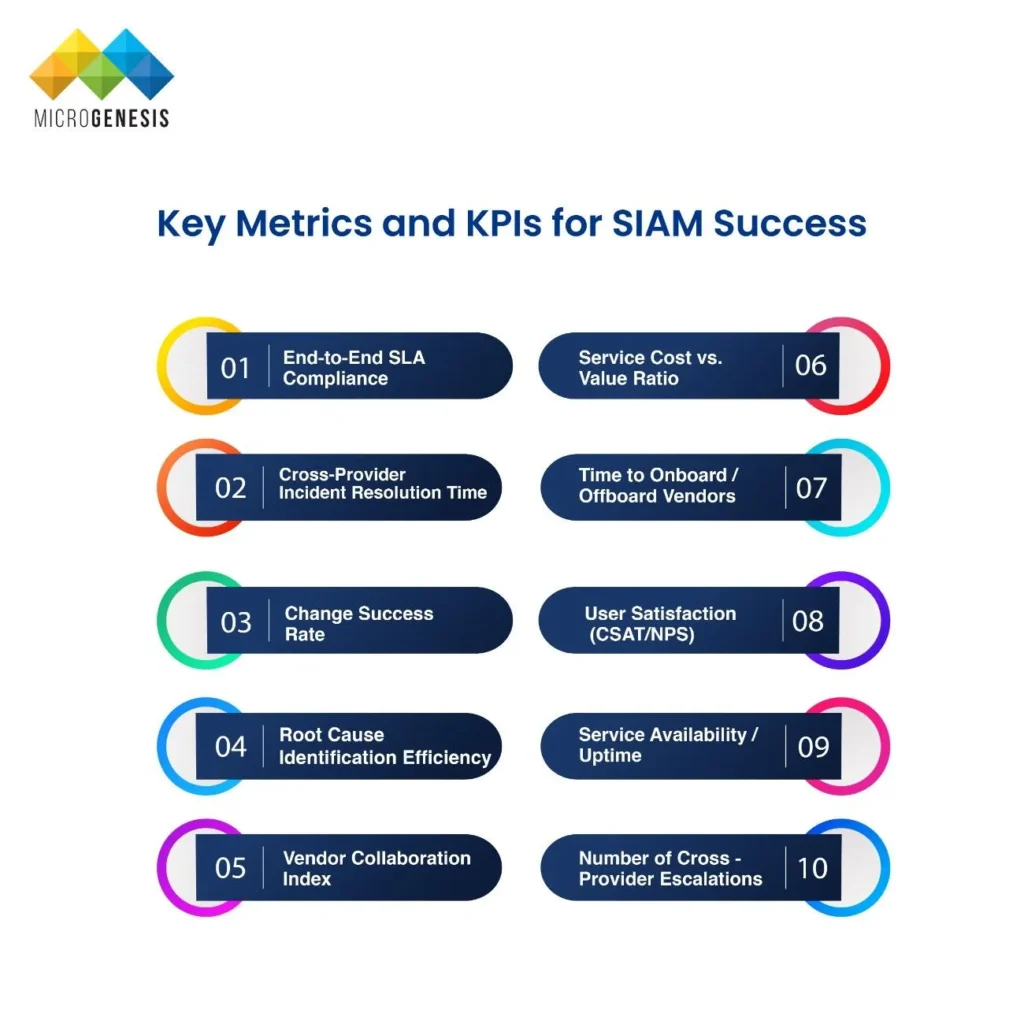
To measure SIAM success, organizations need to focus on end-to-end service outcomes rather than isolated vendor performance. Key metrics include:
Measures whether the overall service meets agreed SLAs, ensuring that all providers collectively deliver a seamless experience.
Tracks the average time to resolve incidents that span multiple vendors, reflecting coordination and escalation efficiency.
Percentage of changes implemented without causing incidents across all providers, indicating process alignment and reliable workflows.
Measures how quickly multi-vendor incidents are diagnosed, minimizing repeated disruptions and downtime.
A qualitative measure of how effectively vendors work together, helping identify communication or process gaps.
Compares the total service delivery cost with business value, highlighting opportunities for optimization without compromising quality.
Tracks the efficiency of integrating or retiring vendors, reflecting SIAM maturity and agility.
Captures end-user perception of service quality, supplementing technical KPIs with business-relevant feedback.
Monitors overall service uptime across providers, ensuring critical business functions remain operational.
Measures how often incidents require intervention from multiple vendors, highlighting integration or governance issues.
Dig Deeper: Top SIAM Metrics and KPIs for Multi-Vendor Success
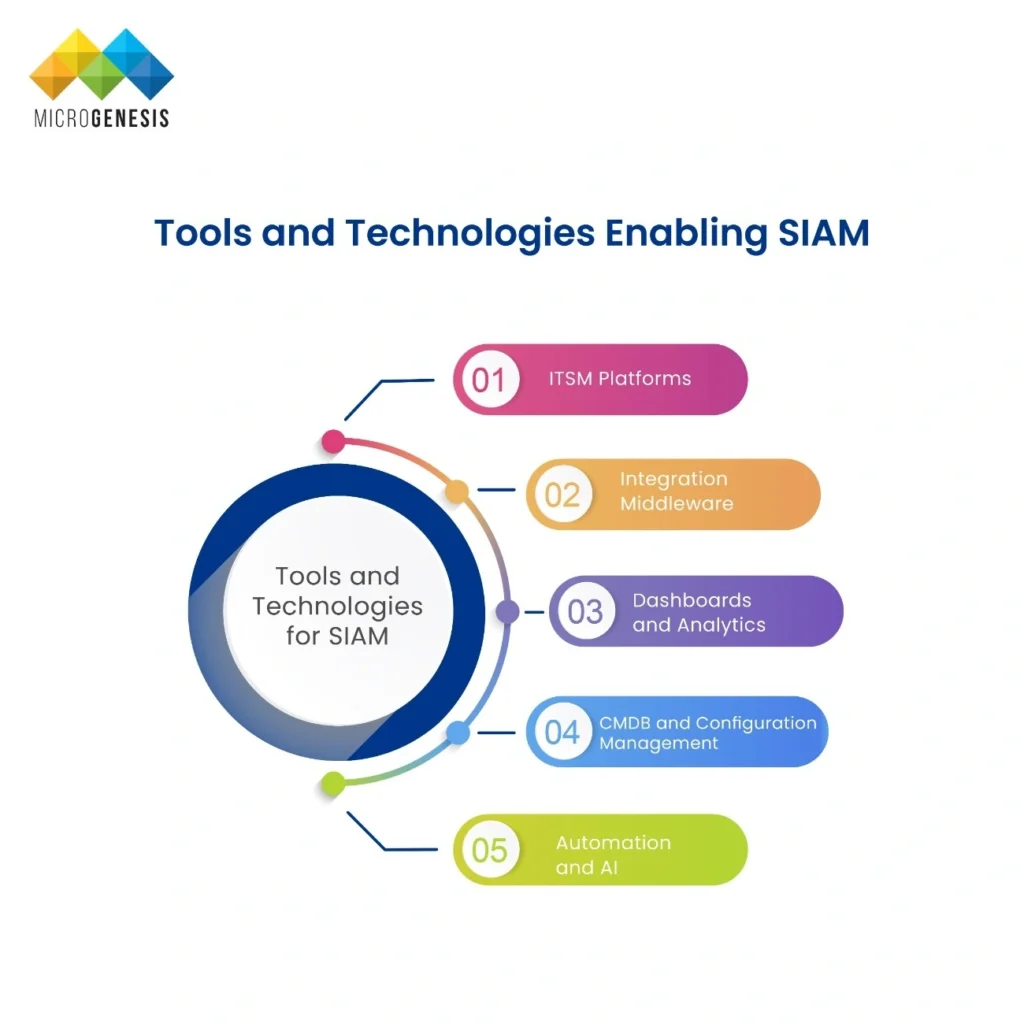
Tools like ServiceNow, Jira Service Management, and BMC Helix support process harmonization and SLA tracking.
Platforms such as ONEiO or Zapier Enterprise connect disparate vendor systems via APIs, enabling real-time data exchange.
Unified dashboards (e.g., Power BI, Grafana) offer visibility into end-to-end performance.
A shared Configuration Management Database provides a single source of truth across services, assets, and dependencies.
AI-driven workflows can auto-route incidents, identify bottlenecks, and predict service degradation before it occurs.
Learn: Top 9 Future Trends in Service Integration and Management
Successfully implementing SIAM requires not only a structured framework but also adherence to proven best practices. These practices ensure that multi-vendor ecosystems operate efficiently, deliver consistent value, and continuously improve over time.
Also Read: Benefits of SIAM for Multi-Vendor Management in Europe
A global telecom company managed over 15 service providers for infrastructure, customer support, and cloud operations. Service disruptions often led to blame games and missed SLAs.
Pro Tip: SIAM Best Practices | Lessons from Leading Enterprises
Modern enterprises operate in increasingly complex, hybrid IT environments, combining on-premises infrastructure, public and private clouds, and SaaS applications. This complexity, coupled with the need for speed and agility, requires SIAM to evolve beyond traditional multi-vendor coordination.
Read more: How SIAM Supports Cloud, Agile, and DevOps Transformation
Service Integration and Management (SIAM) represents the next evolution of IT service governance. In a world defined by digital ecosystems and vendor diversity, SIAM provides the framework for accountability, agility, and alignment.
By mastering SIAM, organizations transform fragmented supplier networks into cohesive, value-driven ecosystems — improving performance, reducing risk, and enabling innovation.
When implemented strategically, SIAM is not merely a process framework; it is a competitive differentiator that empowers organizations to deliver consistent, customer-centric, and high-performing digital services.
MicroGenesis Sweden AB helps organizations successfully implement and optimize SIAM by aligning multi-vendor ecosystems with business goals, ensuring seamless service integration and governance.
Key capabilities include:
Service Integration and Management (SIAM) is a framework that coordinates multiple IT service providers to deliver a single, unified business service. It ensures end-to-end accountability, governance, and seamless collaboration across vendors.
SIAM works by introducing a service integrator that manages processes, tools, and communication across all vendors. It standardizes workflows, aligns SLAs, and ensures services are delivered as a cohesive system rather than isolated components.
The main goal of SIAM is to provide end-to-end service accountability, ensuring that business outcomes are achieved regardless of how many vendors are involved.
ITSM focuses on managing IT services within an organization, while SIAM extends ITSM to coordinate multiple external and internal service providers, ensuring unified service delivery across vendors.
SIAM is important because modern organizations rely on multiple vendors. It eliminates silos, improves collaboration, enhances visibility, and ensures consistent service quality across the entire ecosystem.
SIAM implementation includes:
Assessing current vendors and processes
Defining strategy and governance
Integrating tools and workflows
Running pilot programs
Scaling and continuous improvement
Common challenges include cultural resistance, tool incompatibility, unclear roles, misaligned contracts, and difficulty measuring cross-provider performance.
The best SIAM model depends on organizational maturity:
Internal model → high control
External model → expertise-driven
Hybrid model → balanced approach
Lead supplier → simple but risk of bias
SIAM implementation typically takes 3 to 12 months, depending on the number of vendors, organizational complexity, and existing ITSM maturity.
Common SIAM tools include:
ITSM platforms like ServiceNow and Jira Service Management
Integration middleware like ONEiO
Analytics tools like Power BI
CMDB systems for configuration management
SIAM improves service quality, enhances vendor collaboration, reduces costs, increases operational efficiency, and ensures better alignment between IT services and business goals.
Yes, SIAM reduces costs by eliminating duplicated efforts, improving vendor efficiency, optimizing processes, and enabling better resource utilization across providers.
SIAM improves service quality by standardizing processes, aligning SLAs, enabling real-time monitoring, and ensuring accountability across all service providers.
Yes, SIAM can be adapted for small businesses, especially those using multiple SaaS or cloud providers, though it is most beneficial for medium to large enterprises.
SIAM supports digital transformation by integrating cloud, DevOps, and multi-vendor services into a unified ecosystem, enabling agility, scalability, and faster innovation.
SIAM aligns DevOps and Agile practices across vendors by coordinating release cycles, automating workflows, and ensuring continuous integration and delivery across multiple providers.
Key SIAM KPIs include:
End-to-end SLA compliance
Incident resolution time
Change success rate
Service availability
Customer satisfaction (CSAT/NPS)
A SIAM operating model defines how services are structured across business, integration, provider, and governance layers to ensure seamless service delivery.
The service integrator is responsible for coordinating vendors, managing processes, ensuring SLA compliance, resolving conflicts, and maintaining end-to-end service performance.
Yes, SIAM is considered the future of IT service management in multi-vendor environments, as it enables organizations to manage complex ecosystems efficiently.