

Modern engineering organizations are under constant pressure to deliver products faster, access specialized skills, control development costs, and scale engineering capacity without compromising quality.
For companies in Sweden and across the Nordic region, this challenge can be particularly difficult. Building an experienced in-house engineering team takes time, while demand for skills in cloud engineering, DevOps, embedded systems, cybersecurity, AI, and software development continues to grow.
Hiring internally is not always the answer.
For a long-term product initiative, digital transformation program, or engineering modernization project, organizations increasingly consider dedicated development teams as a way to extend their existing capabilities without building an entirely new department.
A dedicated development team works as an extension of your organization. The team aligns with your product roadmap, engineering practices, tools, and business objectives while providing the flexibility to scale as requirements change.
Looking to extend your engineering capacity without going through a lengthy hiring cycle?
Explore Managed Engineering Services to see how an extended engineering model can support long-term product development.
In this guide, we’ll explain what dedicated development teams are, how they compare with staff augmentation and project outsourcing, when they make sense, how to manage them effectively, and what Nordic organizations should consider before choosing a delivery partner.
What Is a Dedicated Development Team?
A dedicated development team is a long-term engineering engagement in which a group of specialists works exclusively or primarily on a client’s products, platforms, or engineering initiatives.
Instead of hiring every specialist internally, an organization can build a team around its specific requirements.
A dedicated team may include:
- Software developers
- Technical leads
- Solution architects
- UI/UX designers
- DevOps engineers
- QA engineers
- Scrum Masters
- Product specialists
- Engineering managers
- Cloud engineers
- Embedded systems engineers
- Data and AI specialists
- Cybersecurity engineers
The exact composition depends on the organization’s product roadmap and technical requirements.
The important distinction is that a dedicated team is not simply a collection of temporary resources.
The objective is to create a stable engineering capability that develops product knowledge, follows agreed delivery processes, and works closely with the customer’s internal organization.
How a Dedicated Development Team Typically Works
A typical engagement may look like this:
Business goals → Engineering roadmap → Team composition → Onboarding → Agile delivery → Performance measurement → Continuous scaling
This creates a more predictable model for organizations that need engineering capacity over an extended period.
Why Are Dedicated Development Teams Becoming More Popular?
Building an engineering organization internally can involve significant time and management effort.
Recruitment is only the beginning. Organizations also need to handle onboarding, technical leadership, infrastructure, training, retention, and workforce planning.
For companies dealing with changing product requirements, this can make traditional hiring difficult to scale.
Dedicated teams provide another option.
Organizations can bring together the engineering skills they need while retaining control over:
- Product strategy
- Technical direction
- Priorities
- Architecture decisions
- Product ownership
- Engineering standards
- Delivery expectations
This makes the model particularly relevant for companies undertaking digital transformation, cloud modernization, product engineering, and software development initiatives.
Common Business Drivers
Organizations typically consider dedicated development teams when they need to:
- Address engineering talent shortages
- Accelerate product development
- Expand development capacity
- Access specialized engineering skills
- Modernize legacy applications
- Develop cloud-native platforms
- Support long-term product development
- Reduce recruitment pressure
- Launch new digital products
- Support multiple engineering workstreams
If your organization is already struggling to recruit or retain the specialists required for a growing roadmap, an extended engineering model can provide additional capacity without forcing you to redesign your entire internal organization.
Key Benefits of Dedicated Development Teams
1. Access to Specialized Engineering Talent
Modern products often require expertise across several technical disciplines.
One project may require cloud architects, DevOps engineers, QA specialists, cybersecurity professionals, software developers, and embedded engineers.
Building all these capabilities internally can take considerable time.
A dedicated development team gives organizations access to a broader engineering skill set while allowing them to choose the team composition around the product’s needs.
Potential benefits include:
- Access to niche technical expertise
- Faster team formation
- Reduced recruitment dependency
- Greater engineering flexibility
- Access to specialized roles
- Easier capability expansion
2. Faster Product Development
A dedicated team is focused on defined engineering objectives rather than moving between unrelated client projects.
Once the team understands the product, architecture, tools, and delivery model, it can contribute more effectively to ongoing development.
This can support:
- Faster onboarding
- Shorter development cycles
- Continuous product improvements
- More consistent delivery
- Faster response to changing priorities
For organizations with a growing product roadmap, the ability to add capacity without restarting the recruitment process can be particularly valuable.
Need additional engineering capacity for a product or transformation initiative?
See how Engineering Augmentation Services can help you add the right technical capabilities without unnecessarily expanding your internal hiring workload.
3. Better Product Knowledge and Continuity
One of the weaknesses of short-term outsourcing is knowledge loss.
Teams may change when a project phase ends, taking valuable product and technical knowledge with them.
A dedicated team is designed for longer-term collaboration.
As engineers remain involved with the product, they develop a deeper understanding of:
- Product architecture
- Business requirements
- Customer expectations
- Technical dependencies
- Development processes
- Quality standards
- Engineering priorities
This accumulated knowledge can become a significant advantage as the product evolves.
4. Flexible Engineering Team Scaling
Engineering requirements rarely remain constant.
A product may require five developers during one phase and additional DevOps, QA, cloud, or cybersecurity specialists during another.
A dedicated development model allows organizations to adjust team composition as priorities change.
You may be able to:
- Add engineers
- Introduce specialist roles
- Expand delivery capacity
- Support multiple products
- Reduce capacity when appropriate
- Create new engineering capabilities
The goal is not simply to make the team larger. It is to make the engineering capability more adaptable.
5. More Predictable Engineering Costs
Hiring internally involves more than salary.
Organizations also need to consider recruitment, benefits, infrastructure, training, management, employee turnover, and other operational costs.
A dedicated team model can provide a more predictable way to plan engineering capacity.
However, cost should not be the only evaluation criteria.
A lower-cost team that requires significant management intervention or produces inconsistent quality may ultimately cost more.
For decision-makers, the more useful question is:
What engineering capability am I getting for the total investment?
Dedicated Development Team vs Staff Augmentation
These two models are often confused, but they solve different problems.
| Factor | Dedicated Development Team | Staff Augmentation |
|---|---|---|
| Engagement | Long-term | Often short or medium-term |
| Structure | Complete team | Individual specialists |
| Product knowledge | Builds over time | Depends on individual |
| Team management | Shared/structured | Usually customer-led |
| Scaling | Team-level | Role/resource-level |
| Best suited for | Long-term product development | Filling specific skill gaps |
| Strategic involvement | Higher | Usually tactical |
When Should You Choose Staff Augmentation?
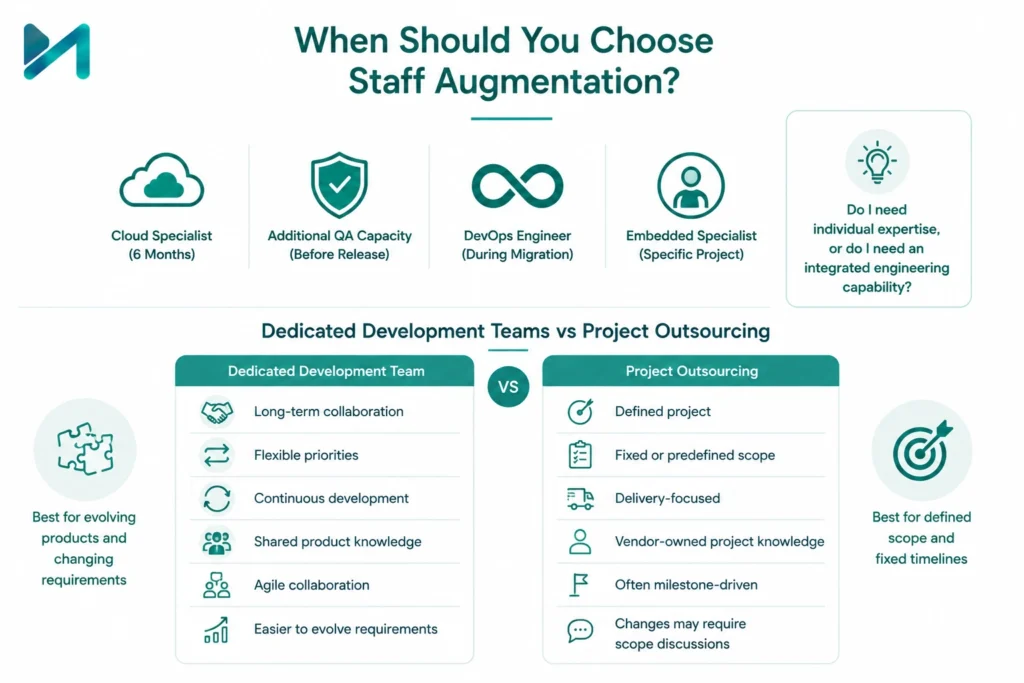
Staff augmentation can make sense when you already have a strong internal engineering organization but need one or two specific skills.
For example, you may need:
- A cloud specialist for six months
- Additional QA capacity before a release
- A DevOps engineer during migration
- An embedded specialist for a particular project
A dedicated development team is generally more suitable when you need multiple roles working together toward a long-term engineering objective.
If you’re comparing the two models, don’t ask only which one is cheaper.
Ask:
Do I need individual expertise, or do I need an integrated engineering capability?
Dedicated Development Teams vs Project Outsourcing
Project outsourcing typically focuses on delivering a defined scope.
For example:
“Build this application within six months.”
A dedicated team is different.
The relationship is usually structured around an ongoing product or engineering capability.
| Dedicated Development Team | Project Outsourcing |
|---|---|
| Long-term collaboration | Defined project |
| Flexible priorities | Fixed or predefined scope |
| Continuous development | Delivery-focused |
| Shared product knowledge | Vendor-owned project knowledge |
| Agile collaboration | Often milestone-driven |
| Easier to evolve requirements | Changes may require scope discussions |
For products where requirements are expected to change, dedicated teams can provide greater flexibility.
Dedicated Development Teams vs Managed Engineering Services
There is another important distinction that decision-makers should consider.
A dedicated development team generally extends your engineering organization with a team aligned to your product.
Managed engineering services, on the other hand, can provide a broader delivery responsibility where the service provider takes greater ownership for engineering operations, delivery processes, governance, and outcomes.
The right model depends on how much control and operational responsibility you want to retain internally.
Choose a Dedicated Development Team When:
- You want direct involvement in product decisions
- Your internal team owns product strategy
- You need additional engineering capacity
- You want a long-term engineering extension
- Your priorities are likely to evolve
Consider Managed Engineering Services When:
- You want greater delivery ownership
- You need structured engineering operations
- You want to improve engineering governance
- You need support across multiple engineering capabilities
- You want to scale engineering without managing every operational detail
For organizations evaluating these models, understanding the difference early can prevent expensive changes later.
Explore our Managed Engineering Services to understand how a managed model can complement your internal engineering organization.
When Should You Choose a Dedicated Development Team?
A dedicated team can be a strong option when your organization is facing one or more of the following situations.
You’re Building a New Product
You need a multidisciplinary engineering team but don’t yet have all the required capabilities internally.
You’re Modernizing Legacy Applications
Modernization often requires a combination of software development, cloud, DevOps, architecture, testing, and security skills.
You’re Scaling an Existing Product
Your product is growing faster than your internal engineering capacity.
You’re Entering a New Technology Area
Your organization needs capabilities in areas such as AI, cloud-native development, embedded systems, cybersecurity, or data engineering.
You’re Facing Engineering Talent Constraints
Recruitment is taking too long or the local market does not provide enough specialized talent.
You Need Long-Term Engineering Continuity
Your initiative will continue for several years and requires product knowledge to remain within the engineering team.
How to Build the Right Dedicated Development Team
Choosing the right team structure is just as important as choosing the engagement model.
Start with your business objectives, not job titles.
Instead of saying:
“We need five developers.”
Start with:
“We need to deliver this product capability within the next 12 months.”
Then determine the capabilities required to achieve that objective.
Step 1: Define Your Engineering Objectives
Clarify:
- What are you building?
- What problem does it solve?
- What is the expected timeline?
- What technical capabilities are required?
- What does your internal team already handle?
Step 2: Identify Capability Gaps
Map the skills you already have against the skills you need.
For example:
| Capability | Internal Team | Additional Need |
|---|---|---|
| Product Management | ✓ | |
| Software Development | ✓ | ✓ |
| Cloud Engineering | ✓ | |
| DevOps | ✓ | |
| QA | ✓ | ✓ |
| Cybersecurity | ✓ |
This creates a more practical foundation for defining the team.
Step 3: Establish Technical Leadership
A dedicated team needs clear technical ownership.
Define who is responsible for:
- Architecture
- Technical decisions
- Code quality
- Engineering standards
- Delivery priorities
- Risk management
Step 4: Define Collaboration and Governance
Before development starts, agree on:
- Communication channels
- Agile ceremonies
- Reporting
- KPIs
- Escalation processes
- Documentation standards
- Security requirements
- Decision-making responsibilities
Step 5: Start With the Right Team Size
Avoid creating a large team simply because more resources appear attractive.
Start with the capabilities required for the immediate roadmap and scale as the product evolves.
Best Practices for Managing Dedicated Development Teams
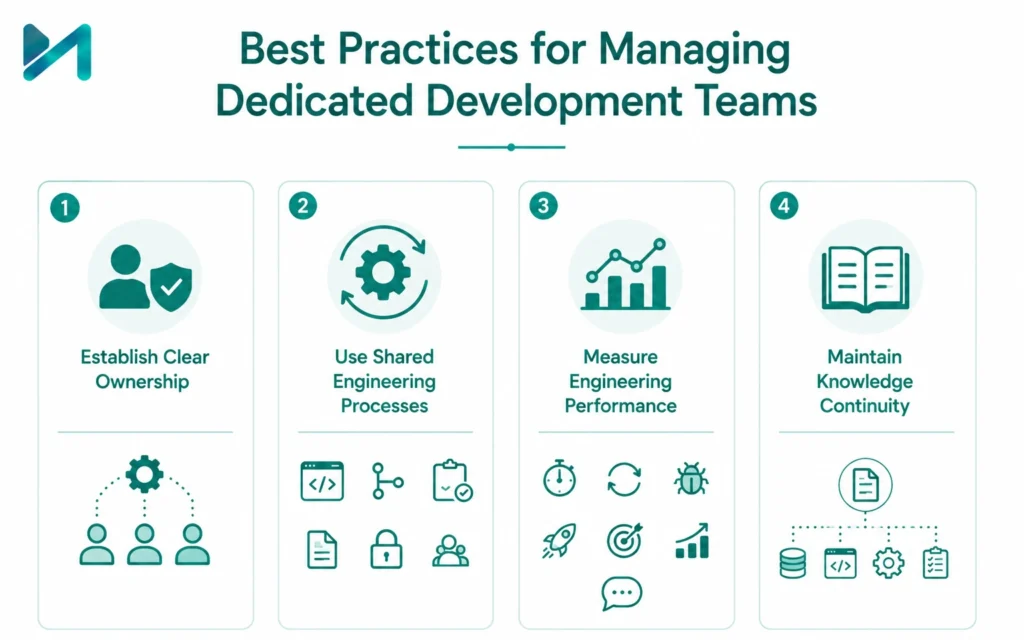
A successful partnership requires more than hiring technically capable engineers.
The operating model matters just as much.
Establish Clear Ownership
Every major engineering area should have a clearly defined owner.
Ambiguous ownership can lead to duplicated work, delayed decisions, and accountability gaps.
Use Shared Engineering Processes
Where possible, internal and dedicated engineers should follow the same:
- Coding standards
- Development workflows
- Testing practices
- Documentation requirements
- Security processes
- Agile ceremonies
Measure Engineering Performance
Useful KPIs can include:
- Lead time
- Cycle time
- Defect rates
- Release frequency
- Sprint predictability
- Deployment frequency
- Customer-reported issues
Metrics should help identify improvement opportunities rather than become a mechanism for simply measuring individual productivity.
Maintain Knowledge Continuity
Document:
- Architecture decisions
- Technical standards
- Product requirements
- APIs
- Development processes
- Operational procedures
This reduces dependency on individual engineers.
Build One Team Culture
The strongest dedicated teams don’t feel like an “external team.”
They work alongside internal employees, participate in planning, share knowledge, and contribute toward the same product objectives.
Common Challenges of Dedicated Development Teams
Dedicated teams solve several engineering challenges, but they aren’t automatically successful.
Communication Across Distributed Teams
Different locations, communication styles, and working practices can create friction.
What helps:
- Regular stand-ups
- Sprint planning
- Reviews and retrospectives
- Shared documentation
- Defined escalation paths
- Clear communication channels
Knowledge Transfer
Without structured onboarding, external engineers may take longer to understand your product.
Create documentation and knowledge-sharing practices from the beginning.
Time Zone Differences
Global engineering teams may have limited working-hour overlap.
For Swedish and Nordic companies working with distributed teams, establishing overlapping collaboration hours and clear asynchronous communication practices can make a significant difference.
Governance
Without clear governance, organizations may struggle with inconsistent delivery, unclear ownership, or limited visibility.
Define responsibilities and KPIs before the engagement becomes complex.
Maintaining Team Culture
Treating dedicated engineers as separate from the internal organization can create communication gaps.
The better approach is to create a shared engineering culture and shared accountability.
Dedicated Development Teams for Swedish and Nordic Companies
For organizations in Sweden and across the Nordic region, dedicated engineering teams can provide a practical way to expand technical capacity while maintaining local ownership of product strategy.
A Nordic company may, for example, keep:
- Product leadership in Sweden
- Business stakeholders locally
- Product ownership internally
while extending its engineering capacity through a distributed dedicated team.
This model can be particularly useful for companies working on:
- Industrial software
- Automotive technology
- MedTech
- Manufacturing platforms
- SaaS products
- Enterprise applications
- Embedded systems
- Cloud platforms
- AI and data solutions
- Digital transformation initiatives
The objective is not to replace the internal engineering organization.
It is to extend what the organization can accomplish.
Building an engineering team in Sweden but struggling to find the right mix of skills?
Our Engineering Augmentation Services can help you extend your existing capabilities with specialized engineering expertise.
What Should You Look for in a Dedicated Development Team Partner?
Choosing a partner should involve more than checking the number of developers available.
Decision-makers should evaluate the provider across several areas.
Engineering Capability
Does the partner have experience across the technologies and engineering disciplines your product requires?
Delivery Experience
Can they demonstrate experience managing long-term engineering engagements rather than only delivering short projects?
Governance
How will performance, quality, communication, security, and delivery be managed?
Scalability
Can the team grow when your roadmap expands?
Cultural Fit
Will the engineering team work effectively with your internal organization?
Knowledge Retention
What processes are used to document knowledge and maintain continuity?
Transparency
Do you have clear visibility into team performance, delivery progress, and engineering risks?
Nordic Collaboration
For Swedish organizations, consider practical factors such as working-hour overlap, communication, proximity, and understanding of Nordic business expectations.
Dedicated Development Team Cost: What Should You Consider?
There is no single price for a dedicated development team because the cost depends on factors such as:
- Team size
- Engineering roles
- Technology stack
- Seniority
- Engagement duration
- Location
- Delivery responsibilities
- Security requirements
- Governance model
Instead of comparing hourly rates alone, evaluate the total cost of achieving the required engineering outcome.
A team that costs slightly more but provides stronger technical leadership, faster onboarding, better continuity, and lower management overhead may deliver greater business value.
Dedicated Development Team vs Hiring In-House
For decision-makers, the comparison is often not simply outsourcing vs internal hiring.
It is about determining which model provides the right balance of:
Control + capability + speed + cost + scalability.
| Consideration | In-House Hiring | Dedicated Development Team |
|---|---|---|
| Recruitment effort | Higher | Lower |
| Speed to build team | Slower | Faster |
| Organizational control | High | High collaboration |
| Scalability | Can be slower | More flexible |
| Long-term product knowledge | High | Can become high |
| Access to niche skills | Depends on hiring market | Broader access |
| Management responsibility | Internal | Shared/structured |
For companies with a long-term engineering roadmap, the answer may also be a hybrid model retaining core product ownership internally while extending engineering capacity through an external team.
How to Get Started With a Dedicated Development Team
A successful engagement usually begins with a structured discovery process.
1. Define Your Business Objective
Identify what you want the team to achieve.
2. Map Your Existing Engineering Capability
Understand where your internal team is strong and where gaps exist.
3. Define Required Roles
Determine the capabilities rather than simply requesting a number of developers.
4. Select the Engagement Model
Decide whether you need:
- Dedicated development
- Engineering augmentation
- Managed engineering services
- A hybrid model
5. Establish Governance
Agree on ownership, communication, KPIs, security, and reporting.
6. Start and Scale
Build the initial team, measure outcomes, and adjust team composition as your roadmap changes.
For a broader understanding of how organizations can structure and scale external engineering capabilities, explore our Managed Engineering Services Guide.
Why MicroGenesis Sweden?
At MicroGenesis Sweden, we help organizations extend their engineering capabilities through flexible delivery models designed around long-term business and technology objectives.
Our engineering capabilities include:
- Software Engineering
- Product Engineering
- Cloud Engineering
- DevOps
- Embedded Systems
- Quality Engineering
- AI & Data Engineering
- Platform Engineering
Our approach focuses on building engineering capabilities that work as an extension of your organization rather than operating as a disconnected external team.
What Organizations Can Expect
- Flexible engineering capacity
- Structured delivery governance
- Agile collaboration
- Access to specialized skills
- Transparent communication
- Scalable team models
- Long-term engineering continuity
Whether you’re building a new product, modernizing an existing platform, or expanding an established engineering organization, the right team structure can make a significant difference to delivery speed and long-term product outcomes.
Not sure whether a dedicated team, engineering augmentation, or managed engineering model is right for your organization?
Speak with our team to discuss your engineering requirements and identify the most suitable delivery model.
Frequently Asked Questions About Dedicated Development Teams
What is a dedicated development team?
A dedicated development team is a group of engineering professionals working on a client’s product or engineering initiatives over an extended period. The team operates as an extension of the client’s organization and can include developers, architects, DevOps engineers, QA specialists, and other technical roles.
How is a dedicated development team different from staff augmentation?
Staff augmentation generally provides individual specialists to fill specific skill gaps. A dedicated development team provides a coordinated group of professionals working toward shared product or engineering objectives.
Are dedicated development teams suitable for Swedish companies?
Yes. Dedicated teams can be useful for Swedish and Nordic organizations that need additional engineering capacity, specialized skills, or scalable product development capabilities while retaining internal ownership of product strategy.
Can a dedicated development team work with our existing engineers?
Yes. A dedicated team can operate alongside an internal engineering organization, using agreed tools, processes, Agile ceremonies, development standards, and governance practices.
How quickly can a dedicated engineering team be scaled?
The timeline depends on the required roles, seniority, technology stack, and team size. A structured onboarding and team-building process can help organizations add capabilities faster than traditional recruitment for every role.
Should I choose a dedicated team or managed engineering services?
It depends on the level of responsibility you want the external partner to assume. Dedicated teams are suitable when you want an extended engineering capability closely aligned with your internal organization. Managed engineering services may be more appropriate when you want greater delivery and operational ownership from the partner.
What industries can use dedicated development teams?
Dedicated engineering teams can support organizations across industries such as automotive, manufacturing, MedTech, healthcare, transportation, logistics, SaaS, financial services, and industrial technology.
Final Thoughts
A dedicated development team is not simply a way to add more developers.
When structured properly, it becomes an extension of your engineering organization bringing additional expertise, capacity, and flexibility while allowing your internal leadership to retain control over product strategy.
For Swedish and Nordic companies, this can be especially valuable when engineering talent is difficult to find locally or when product development needs to scale faster than internal hiring can support.
The right model depends on your situation.
If you need a few specialists, engineering augmentation may be appropriate. If you need an integrated team working on a long-term product, a dedicated development model may make more sense. And if you want a partner to take greater responsibility for engineering operations and delivery, managed engineering services may be the better option.
The important thing is to choose the model around your business objectives—not simply the number of resources you need.
Looking to build or extend your engineering team in Sweden?
Explore Managed Engineering Services →
Or, if you’re still evaluating the right approach: