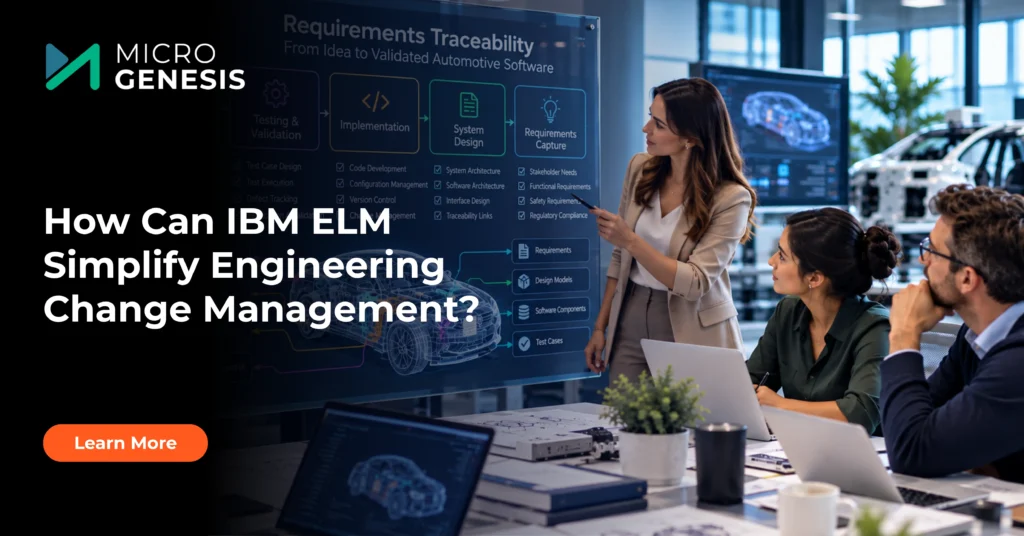

Swedish engineering companies in automotive, industrial manufacturing, embedded systems, and technology increasingly need connected engineering workflows to manage complex product development. When requirements, development activities, and testing operate in separate tools, teams face fragmented information, incomplete traceability, duplicated work, and delays in validating engineering changes.
IBM Engineering Lifecycle Management (ELM) helps organizations connect requirements management, systems engineering, development workflows, and testing. With the right implementation strategy, Swedish companies can improve engineering visibility, coordinate distributed teams, and establish a more consistent product development lifecycle.
For organizations evaluating IBM ELM implementation in Sweden, the priority should be to connect the tools and processes that address their actual engineering challenges.
Why Swedish Engineering Companies Need Integrated Engineering Workflows
Engineering teams often use separate systems for requirements, architecture, software development, defect management, and testing. Although each tool may serve its purpose, disconnected workflows make it difficult to understand how a change in one area affects the rest of the product.
Consider an automotive engineering team updating a software requirement. The change may affect system architecture, software implementation, test cases, and verification results. Without connected information, engineers may need to identify these dependencies manually.
Common challenges include:
Requirements maintained in documents or disconnected systems.
Development tasks without clear links to approved requirements.
Test cases that are not consistently associated with requirements.
Engineering changes that require manual impact analysis.
Limited visibility into verification coverage and outstanding defects.
Coordination difficulties across distributed R&D teams and suppliers.
These challenges can increase engineering effort and make it harder to maintain consistent product information.
Integrating requirements, development and testing with IBM ELM provides a structured way to address these issues by connecting engineering artifacts and supporting traceability across the development lifecycle.
Before implementing a solution, organizations should also understand how to assess technical capabilities, delivery experience, and long-term support. Choosing an IBM ELM implementation partner in Sweden requires evaluating integration expertise, migration capabilities, industry knowledge, and the ability to align the platform with existing engineering processes.
What Is IBM Engineering Lifecycle Management?
IBM Engineering Lifecycle Management is a collection of tools that supports requirements management, systems and software engineering, development workflow coordination, and test management.
Depending on the organization’s needs, an IBM ELM implementation may involve:
IBM Engineering Requirements Management DOORS Next: Managing requirements, reviews, relationships, and traceability.
IBM Engineering Systems Design Rhapsody: Supporting model-based systems engineering and systems design.
IBM Engineering Workflow Management (EWM): Coordinating development work items, change requests, and team workflows.
IBM Engineering Test Management (ETM): Managing test planning, test cases, execution, and verification results.
These capabilities can be configured and integrated according to existing engineering processes and technical requirements. Organizations do not necessarily need to implement every tool at once.
For Swedish businesses, a well-planned implementation should prioritize the workflows that deliver the greatest operational value.
Explore IBM ELM consulting and implementation services in Sweden to understand how the platform can be aligned with your engineering environment.
1. Connect Requirements Management with IBM DOORS Next
Requirements are the foundation of product development. They define system behaviour, technical constraints, functional expectations, and verification criteria.
When requirements are spread across documents and separate systems, teams may struggle to maintain consistent versions and establish reliable relationships with downstream engineering activities.
IBM DOORS Next helps organizations structure requirements, manage reviews, maintain relationships, and control requirement changes.
Establish consistent requirements management
An implementation partner can help define requirement structures, attributes, naming conventions, review states, ownership, and approval workflows.
These practices help engineers understand which requirements are current, who is responsible for them, and how they relate to the broader product.
Maintain requirements traceability
Requirements should be connected to the relevant design elements, development work, and test cases wherever the engineering workflow requires those relationships.
For example, a requirement for an industrial controller can be associated with the relevant software implementation task and verification test. When the requirement changes, engineers can investigate the associated activities.
For Swedish automotive and embedded engineering companies, this improves visibility into requirements coverage and supports more structured change-impact analysis.
MicroGenesis provides IBM DOORS Next services to support requirements management, configuration, traceability, and lifecycle workflows.
Improving requirements traceability across automotive and embedded software development can help teams identify coverage gaps, understand change impacts, and maintain visibility from requirements to verification.
2. Connect Systems Engineering with IBM Rhapsody
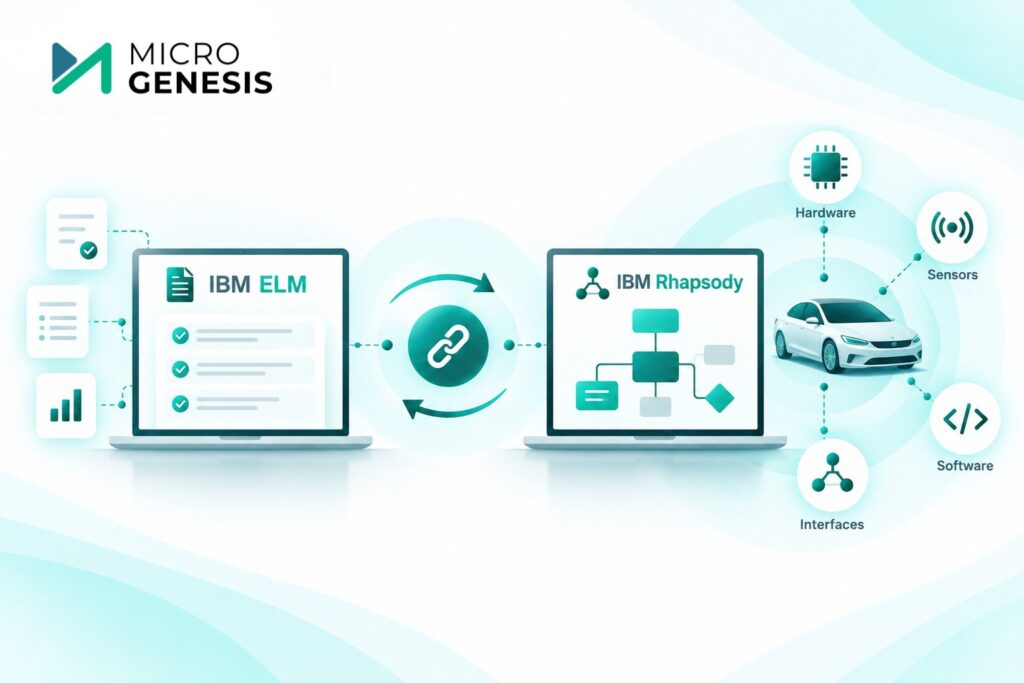
Complex engineering products involve interactions between hardware, software, system components, and external interfaces. Requirements alone may not provide enough context to understand how these elements work together.
IBM Rhapsody supports model-based systems engineering and software design. Depending on the architecture and implementation, it can help teams represent system structures, behaviours, and relationships between engineering elements.
Improve visibility between requirements and system design
Consider an embedded automotive system containing controllers, sensors, communication interfaces, and software components. A change to one requirement may affect several elements of the system.
Linking requirements to relevant models and design information can help engineers investigate these dependencies and maintain consistency between requirements and system architecture.
Support multidisciplinary engineering
Swedish automotive and industrial companies may coordinate systems engineers, embedded software developers, hardware specialists, and verification teams.
A connected engineering environment helps these teams work with shared information and understand how design decisions relate to requirements and downstream activities.
MicroGenesis offers IBM Rhapsody services for organizations seeking support with systems engineering and model-based engineering workflows.
The required integration should be designed around the organization’s architecture, engineering methods, and existing tools.
3. Connect Development Activities with IBM Engineering Workflow Management
After requirements and design decisions are established, development teams need to plan, assign, track, and complete implementation work.
When development activities are managed separately from requirements, teams may lack visibility into why work is required, which requirement it supports, and what could be affected by a change.
IBM Engineering Workflow Management supports work item management, change tracking, and development coordination.
Link development work to requirements
Where appropriate, development work items can be associated with requirements and other engineering artifacts.
This allows teams to understand the purpose of a task and identify related work when requirements or design decisions change.
Improve engineering change management
A structured workflow can define how change requests are submitted, reviewed, approved, assigned, and completed.
For example, when a software requirement changes, the engineering team can record the request, identify affected activities, assign responsibilities, and monitor implementation progress.
Simplifying engineering change management with IBM ELM helps organizations understand how changes can be coordinated across connected engineering activities.
For Swedish companies managing multiple product lines or distributed development teams, these workflows can improve accountability and reduce reliance on manual coordination.
Explore IBM Engineering Workflow Management services for development workflow configuration and change management support.
4. Connect Testing and Verification with IBM Engineering Test Management
Testing establishes whether the implemented product satisfies its requirements. However, test results are more useful when they can be traced to the requirements and development activities they validate.
IBM Engineering Test Management supports test planning, test case management, test execution, and verification information.
Establish requirements-based testing
Test cases should be linked to the requirements they are intended to verify. This helps engineering teams understand whether requirements have appropriate verification coverage.
For example, a requirement describing how an industrial controller responds to an input condition should have corresponding verification activities that evaluate the specified behaviour.
Improve test visibility
Connected test information helps teams identify tests that have passed, failed, or remain incomplete. When test cases are linked to requirements and development activities, engineers can investigate failures in the context of the affected functionality.
Support regression testing
Engineering changes can affect previously validated functionality. Traceability can help teams identify relevant test cases and plan regression testing based on the scope and risk of the change.
MicroGenesis provides IBM Engineering Test Management services to support test management and verification workflows.
For Swedish MedTech organizations, strengthening requirements traceability and verification in MedTech is particularly relevant when establishing relationships between requirements, test activities, and engineering evidence. IBM ELM can support these workflows, but regulatory compliance depends on the organization’s broader quality processes and validation activities.
5. Establish End-to-End Traceability Across the Engineering Lifecycle
One of the main benefits of connecting requirements, development, and testing is improved lifecycle traceability.
A typical relationship may look like this:
Requirement → System Design → Development Work Item → Test Case → Test Result
The exact relationships depend on the engineering process and implementation.
A connected lifecycle helps teams investigate questions such as:
Has each requirement been addressed?
Which tests verify a particular requirement?
What engineering activities may be affected by a change?
Which requirements have failed verification?
Are any requirements missing test coverage?
What evidence supports a release decision?
These relationships should be maintained through defined processes and appropriate tool configuration. Merely deploying IBM ELM does not guarantee complete or accurate traceability.
For automotive and embedded software companies, improving requirements traceability across automotive and embedded software development can help establish better visibility from requirements through implementation and verification.
For MedTech engineering teams, traceability can also support the organization of verification records and change documentation.
6. Reduce Engineering Data Silos Across Distributed R&D Teams
Swedish engineering companies may work with multiple offices, external suppliers, development partners, and specialist teams. When engineering information is fragmented across systems, collaboration becomes more difficult.
Common symptoms include inconsistent requirement versions, duplicated records, manual status updates, and limited visibility into development progress.
IBM ELM can help connect engineering information, provided the required integrations, permissions, and processes are designed appropriately.
Improve access to consistent information
Teams should understand where authoritative engineering information is maintained and how related information is accessed across the lifecycle.
Reduce manual coordination
Connected workflows can reduce the need to copy information between tools or request status updates manually. They can also help teams identify dependencies and follow up on unresolved activities.
Support distributed collaboration
Clearly defined responsibilities, shared workflows, and documented relationships help engineering teams coordinate work across locations.
Reducing engineering data silos across distributed R&D teams is therefore an important consideration when planning an IBM ELM implementation.
The objective is not to connect every available tool indiscriminately. It is to prioritize integrations that improve engineering continuity, information accuracy, and decision-making.
7. How to Implement IBM ELM Successfully
A successful IBM ELM implementation should begin with the organization’s engineering challenges rather than a predetermined tool configuration.
A structured approach typically includes:
Assess the current environment: Review requirements tools, development workflows, test management, integrations, and existing data.
Define business objectives: Identify the problems to solve, such as incomplete traceability, duplicated work, or limited verification visibility.
Design the solution: Determine which IBM ELM capabilities and integrations are required.
Configure workflows: Establish requirements structures, work items, test relationships, roles, and permissions.
Migrate and integrate data: Transfer required information and connect relevant systems.
Validate the implementation: Test workflows, integrations, access controls, and critical traceability relationships.
Train engineering teams: Explain the new workflows and responsibilities.
Improve continuously: Review adoption, identify gaps, and refine the environment as requirements evolve.
A pilot implementation may be appropriate when the organization needs to validate the approach before expanding it across multiple teams.
The scope and timeline should reflect the number of systems involved, migration complexity, integration requirements, and organizational readiness.
Why Choose MicroGenesis for IBM ELM Services in Sweden?
MicroGenesis supports engineering organizations with IBM ELM consulting, implementation, integration, migration, configuration, and ongoing lifecycle management services.
With 25+ years of experience and 400+ clients globally, MicroGenesis helps organizations address engineering lifecycle challenges and improve connections between requirements, development, and testing.
Support can include:
IBM ELM implementation planning and consulting.
IBM DOORS Next requirements management and traceability.
IBM Rhapsody systems engineering workflows.
IBM Engineering Workflow Management configuration.
IBM Engineering Test Management implementation and verification workflows.
Engineering tool integration and legacy data migration.
Post-implementation optimization and support.
The appropriate engagement depends on your current toolchain, engineering processes, and business objectives. An initial assessment can help identify the gaps, integrations, and implementation priorities that matter most.
Frequently Asked Questions
Can IBM ELM integrate requirements, development, and testing?
Yes. Depending on the selected tools, configuration, and integration design, IBM ELM can connect requirements, development activities, test cases, and verification results.
Is IBM DOORS Next enough for complete engineering lifecycle management?
DOORS Next supports requirements management. Organizations that need broader development workflow, systems engineering, and test management capabilities may also consider EWM, Rhapsody, and ETM according to their requirements.
How can Swedish companies improve requirements traceability?
Organizations can define consistent requirements structures, establish relationships with design and development artifacts, link requirements to verification activities, and maintain these relationships through controlled change management processes.
Does IBM ELM automatically ensure regulatory compliance?
No. IBM ELM can support traceability and controlled engineering workflows, but compliance also depends on the organization’s processes, documentation, validation, and applicable standards.
Conclusion
Integrating requirements, development, and testing helps Swedish engineering companies improve lifecycle visibility, manage changes, and maintain relationships between engineering artifacts.
IBM ELM provides capabilities for requirements management, systems engineering, development workflows, and test management. However, the results depend on choosing the right implementation scope, configuring workflows appropriately, integrating relevant tools, and maintaining traceability over time.
MicroGenesis supports organizations with IBM ELM consulting and implementation services, including DOORS Next, Rhapsody, Engineering Workflow Management, and Engineering Test Management.
For Swedish engineering teams looking to reduce disconnected workflows and improve engineering lifecycle control, a structured IBM ELM implementation can provide a foundation for more connected and maintainable product development.