

Swedish engineering companies increasingly depend on collaboration between systems engineers, software developers, hardware specialists, verification teams, suppliers, and geographically distributed R&D units. As product complexity grows, these teams need consistent access to requirements, architecture models, development tasks, test results, and engineering decisions.
However, engineering information is often spread across disconnected tools and departmental workflows. Requirements may be managed in one system, design models in another, development activities in a separate platform, and verification results in yet another environment. This fragmentation creates engineering data silos that make collaboration, traceability, and change management more difficult.
For organizations developing automotive systems, embedded software, industrial equipment, and complex products, disconnected engineering data can increase manual effort and make it harder to understand the full product lifecycle.
IBM Engineering Lifecycle Management (ELM) provides capabilities that can help connect requirements management, systems engineering, development, and testing. With an appropriate integration strategy, Swedish R&D organizations can improve engineering visibility, establish stronger relationships between technical artifacts, and support more consistent collaboration across distributed teams.
Why Engineering Data Silos Are a Challenge for Swedish R&D Teams
Engineering data silos occur when information is maintained in separate systems or teams without reliable relationships, shared workflows, or suitable integration.
These silos do not necessarily mean that every team must use the same tool. Different engineering disciplines often need specialized applications. The challenge is ensuring that information can be connected and accessed when required.
For Swedish organizations working with distributed product development teams, suppliers, and international engineering partners, several problems can emerge.
1. Requirements and design information are disconnected
Requirements engineers may maintain specifications in a requirements management platform, while systems engineers develop architecture models separately.
Without maintained relationships between these artifacts, it becomes difficult to determine how a requirement is reflected in the system design or which design elements may be affected by a change.
2. Development teams lack end-to-end visibility
Software developers may track work items and defects in a development management tool without having a clear connection to the requirements that initiated the work.
Engineering managers may therefore need to gather information manually to understand implementation progress or investigate the status of a requirement.
3. Testing information is separated from engineering decisions
Test cases, execution records, and verification results may be maintained independently of requirements and development activities.
This makes it harder to assess test coverage, identify outstanding verification activities, and understand the implications of a requirement or design change.
4. Teams duplicate information across systems
When engineering tools do not exchange information effectively, employees may copy requirements, update spreadsheets, or maintain parallel status reports.
Duplicate records can become inconsistent when information changes in one location but not another.
5. Distributed R&D teams struggle with collaboration
Different engineering sites and suppliers may use different workflows, terminology, and reporting methods.
Without agreed information structures and integration rules, teams can struggle to identify the latest approved information, understand dependencies, and coordinate engineering decisions.
These challenges can increase coordination effort and reduce confidence in the completeness of engineering information.
What Is Engineering Lifecycle Data Integration?
Engineering lifecycle data integration is the process of connecting relevant engineering information across the tools and workflows used to develop, test, and maintain a product.
Rather than requiring every discipline to work in one application, integration establishes relationships between the artifacts managed by different systems.
A connected engineering environment may link:
Requirements → System Architecture → Development Work Items → Test Cases → Test Results
Depending on the product and engineering process, it may also connect defects, change requests, configuration information, and release activities.
For example, an embedded software requirement may be linked to a design element, an implementation task, and the test cases used to verify the expected behaviour.
When that requirement changes, engineers can investigate the related artifacts instead of manually searching across multiple systems.
The objective is not to eliminate specialized engineering tools. It is to make the information they manage more useful across the product lifecycle.
How IBM ELM Helps Connect Engineering Information
IBM ELM includes capabilities for requirements management, systems engineering, development workflow management, and test management. Organizations can configure and integrate these capabilities to establish relationships between engineering artifacts.
The appropriate implementation depends on the existing toolchain, data structures, workflow requirements, and integration architecture.
1. Connect requirements with IBM DOORS Next
Requirements are a key source of engineering information. They describe what a product or system must achieve and provide a reference point for design, implementation, and verification.
IBM Engineering Requirements Management DOORS Next supports structured requirements management and relationships between requirements and other engineering artifacts.
By establishing consistent requirements structures and maintaining relevant relationships, organizations can improve visibility into requirements across engineering disciplines.
For example, a Swedish automotive engineering team may need to connect system requirements with software requirements and associated verification activities. Maintaining these relationships helps engineers investigate dependencies when specifications change.
IBM DOORS Next can support activities such as:
Managing structured requirements and their attributes.
Maintaining relationships between requirements.
Supporting requirements reviews and change management.
Improving visibility into requirements and associated engineering information.
Supporting traceability across connected lifecycle workflows.
MicroGenesis provides IBM DOORS Next services to support requirements management, configuration, and lifecycle traceability.
2. Connect systems engineering and design with IBM Rhapsody
Systems engineering teams need to understand how requirements relate to system architecture, components, interfaces, and software design.
IBM Engineering Systems Design Rhapsody supports model-based systems engineering and software design. Where appropriate relationships are configured, organizations can connect requirements with relevant model elements.
This can help teams understand how system-level decisions relate to detailed engineering work.
For instance, changing an interface requirement in an embedded product may affect multiple components or interactions. Connections between requirements and design models can help engineers identify areas that require further investigation.
Potential benefits include:
Better visibility into requirements and architecture relationships.
Improved coordination between systems and software engineering.
Easier investigation of potential design impacts.
More consistent access to relevant engineering context.
Explore IBM Rhapsody services for support with systems engineering and model-based engineering workflows.
3. Link development activities through IBM Engineering Workflow Management
Engineering teams need to translate requirements and design decisions into implementation activities.
IBM Engineering Workflow Management (EWM) supports work item management, development coordination, and change tracking. It can help teams organize engineering tasks and maintain information about responsibilities, status, and dependencies.
When development work items are linked to relevant requirements and other engineering artifacts, teams can improve visibility into implementation progress.
For example, a software change may require updates to several components. Connected work items can help engineers coordinate those tasks and identify outstanding dependencies.
EWM can support:
Structured work item workflows.
Assignment and tracking of engineering activities.
Change-related coordination.
Visibility into work status and dependencies.
Connections with relevant engineering information, where supported by the configured environment.
MicroGenesis offers IBM Engineering Workflow Management services to help organizations configure and improve development workflows.
4. Connect testing and verification with IBM Engineering Test Management
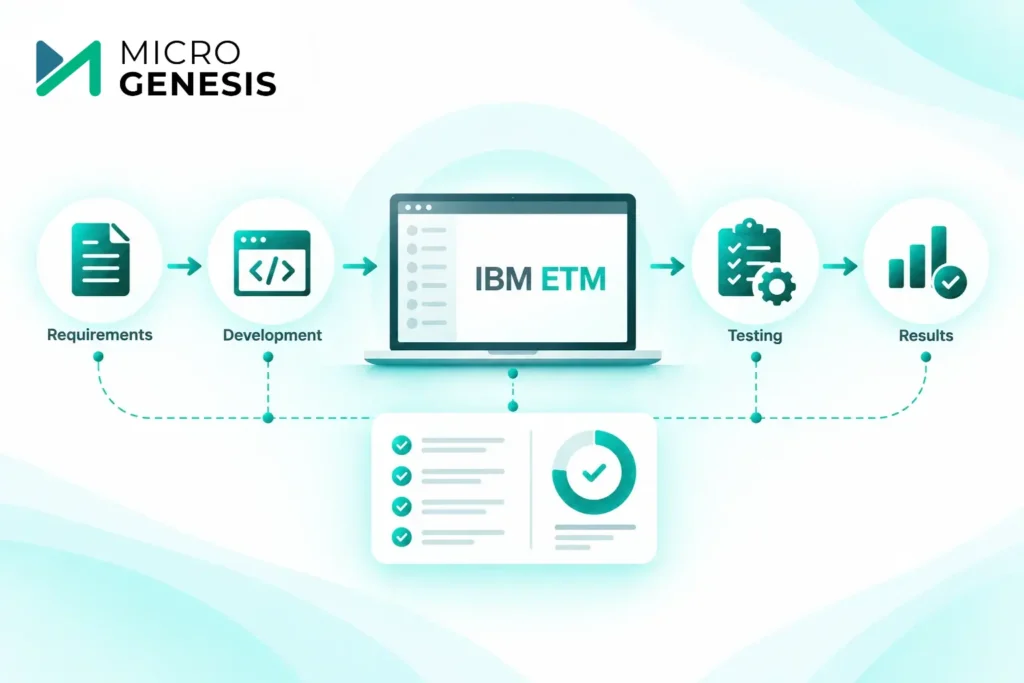
Engineering data silos can also affect testing teams. When test cases and results are disconnected from requirements, development activities, and change records, it becomes difficult to understand verification coverage.
IBM Engineering Test Management (ETM) supports test planning, test case management, execution, and verification activities.
By connecting relevant requirements and test information, organizations can improve visibility into which requirements have associated tests and which verification activities remain outstanding.
For distributed R&D teams, this can help establish a more consistent view of testing progress across projects and engineering locations.
ETM can support:
Test planning and test case management.
Tracking test execution and results.
Requirements-based verification workflows.
Visibility into test coverage and outstanding activities.
Relationships between testing information and other lifecycle artifacts.
Learn more about IBM Engineering Test Management services.
How to Reduce Engineering Data Silos Across Distributed Teams
Implementing connected engineering tools requires a clear strategy. Organizations should first understand how information is created and used, then determine which relationships and integrations will deliver the most value.
Step 1: Map the existing engineering toolchain
Start by documenting the tools used across requirements management, systems engineering, development, testing, and release management.
Identify which teams own each system, what information it contains, and how data moves between applications.
The assessment should highlight:
Duplicate information and manual data transfers.
Missing relationships between engineering artifacts.
Disconnected approval and change workflows.
Inconsistent identifiers or data structures.
Reporting gaps across engineering teams.
Integration limitations and maintenance requirements.
This creates a baseline for prioritizing improvements.
Step 2: Identify critical engineering relationships
Not every engineering artifact needs to be linked to every other artifact.
Focus on relationships that support real engineering decisions. For example, an organization may prioritize links between requirements, design elements, development work items, and test cases.
These relationships can help teams investigate changes, understand implementation status, and identify verification activities that require attention.
Define the purpose of each relationship and assign responsibility for maintaining it.
Step 3: Standardize data structures and terminology
Different teams may use different names for similar concepts, status values, identifiers, and approval stages.
Before integrating systems, establish common definitions where necessary.
Standardization may include:
Requirement identifiers and attributes.
Work item categories and statuses.
Change request classifications.
Product and component naming conventions.
Ownership and approval responsibilities.
Verification status definitions.
The objective is to establish enough consistency for information to be interpreted correctly across teams without removing legitimate differences between engineering disciplines.
Step 4: Define an integration architecture
Choose the appropriate integration approach based on the systems involved and the required information flow.
Some environments may use supported connectors or application integrations. Others may require APIs or tailored integration solutions.
The design should specify:
Which system owns each data element.
Which information must be synchronized.
How relationships and identifiers are maintained.
How conflicting updates are handled.
How errors and failed synchronization are detected.
Which access controls apply.
Who is responsible for integration maintenance.
Integration should be validated against realistic engineering scenarios rather than only simple data-transfer tests.
Step 5: Establish change-impact workflows
A connected toolchain becomes more valuable when teams can use it to investigate changes.
Define a repeatable process for determining which requirements, design elements, work items, and tests may be affected by a proposed change.
For example, when a system requirement changes, the responsible engineers should be able to identify relevant downstream artifacts, assess the impact, and assign the necessary updates.
Tool-supported relationships can help identify potential dependencies, but engineering teams must validate the results and determine the appropriate response.
This approach is closely connected to simplifying engineering change management with IBM ELM, especially for products with complex hardware-software dependencies.
Step 6: Create consistent reporting and dashboards
Distributed teams need a shared understanding of engineering progress.
Useful reporting views may include:
Requirements without associated verification activities.
Changes awaiting approval.
Development work items linked to open changes.
Test cases requiring review after a change.
Failed or incomplete synchronization activities.
Outstanding engineering dependencies.
Reports should help users make decisions and identify bottlenecks. Avoid creating dashboards that simply display large volumes of information without a clear operational purpose.
Step 7: Improve access, governance, and security
Connecting engineering information across locations and teams requires appropriate governance.
Define who can view, edit, approve, and share engineering artifacts. Consider supplier access, project confidentiality, information ownership, and the organization’s security policies.
Integration should preserve the intended access controls and avoid exposing information to users who do not have permission to access it.
Step 8: Pilot, validate, and expand
A phased implementation helps organizations validate the proposed architecture before applying it across a large engineering environment.
Start with a project or workflow that has a clear business need. Test the integration, traceability relationships, reporting, and user experience.
Collect feedback from requirements engineers, developers, systems engineers, and testers. Refine the configuration before expanding it to additional teams.
Benefits for Swedish Automotive and Embedded Engineering Companies
A well-designed engineering data integration strategy can improve several aspects of product development.
Better end-to-end engineering visibility
Connecting requirements, design, development, and testing information helps teams understand how individual activities relate to product objectives.
More effective collaboration across locations
Distributed engineering teams can work with more consistent information and reduce reliance on manually prepared status reports.
Reduced duplicate data entry
Appropriate integrations can reduce repeated information entry and the inconsistencies associated with maintaining parallel records.
More efficient change-impact assessment
Maintained relationships help engineers investigate affected artifacts and identify work that may require review or modification.
Improved verification visibility
Connecting requirements with test cases and results helps teams assess verification coverage and identify outstanding activities.
More consistent engineering governance
Defined data ownership, workflow rules, and access controls help organizations maintain more predictable processes across engineering teams.
The scale of these benefits depends on the quality of existing data, integration coverage, process maturity, and user adoption. Integrating tools alone does not resolve inconsistent processes or incomplete engineering information.
Common Mistakes to Avoid When Integrating Engineering Tools
Organizations should avoid several common implementation problems.
Integrating everything at once: Start with the relationships and workflows that solve the most important engineering problems.
Ignoring existing data quality: Incomplete identifiers, duplicate records, and outdated relationships can reduce the usefulness of integration.
Creating unnecessary data duplication: Define the authoritative source for each data element and determine whether information should be referenced, synchronized, or replicated.
Overlooking integration maintenance: Connectors, APIs, data mappings, and workflows need monitoring and ongoing support.
Failing to involve end users: Requirements engineers, developers, systems engineers, and testers should help validate the proposed workflows.
Assuming integration guarantees compliance: Connected data can support traceability and evidence management, but compliance depends on applicable processes, controls, validation, and organizational responsibilities.
Why Choose MicroGenesis for IBM ELM Services in Sweden?
MicroGenesis supports engineering organizations with IBM ELM consulting, implementation, integration, migration, configuration, training, and ongoing support.
With 25+ years of experience and 400+ clients globally, MicroGenesis helps organizations address engineering lifecycle challenges and improve the way requirements, development, systems engineering, and testing activities are connected.
Depending on the existing environment and business requirements, support can include:
IBM ELM consulting and implementation: Assess current engineering processes and define an appropriate implementation strategy.
IBM DOORS Next services: Improve requirements structures, configuration, and traceability.
IBM Rhapsody services: Support systems engineering and model-based engineering workflows.
IBM Engineering Workflow Management services: Configure development coordination and change management workflows.
IBM Engineering Test Management services: Support test management and verification traceability.
Engineering tool integration: Connect relevant systems and establish appropriate information flows.
Migration and ongoing support: Help transition existing environments and maintain engineering workflows.
The right approach depends on the organization’s current toolchain, data quality, integration requirements, and lifecycle objectives.
To understand how the services can support your environment, explore IBM ELM consulting and implementation services in Sweden.
Organizations evaluating implementation partners should also consider choosing an IBM ELM implementation partner in Sweden, with attention to integration experience, technical expertise, migration requirements, and long-term support.
Frequently Asked Questions
What are engineering data silos?
Engineering data silos occur when requirements, design information, development tasks, test results, and other product information are maintained in separate systems without reliable relationships or appropriate information sharing.
How can IBM ELM help reduce engineering data silos?
IBM ELM provides capabilities for requirements management, systems engineering, development workflow management, and testing. Appropriate configuration and integration can establish relationships between engineering artifacts and improve lifecycle visibility.
Do all engineering teams need to use the same tool?
No. Different engineering disciplines may need specialized tools. The objective is to connect relevant information and workflows while allowing teams to use suitable applications for their work.
Can IBM ELM support distributed R&D teams?
IBM ELM capabilities can support collaboration across engineering activities and locations when access, workflows, integrations, and data structures are configured appropriately. The implementation should account for organizational governance and security requirements.
How should a company start an engineering data integration project?
Begin by mapping the existing toolchain, identifying disconnected workflows, assessing data quality, and prioritizing the engineering relationships that matter most. A pilot implementation can validate the approach before wider deployment.
Does engineering tool integration eliminate manual work completely?
Not necessarily. Integration can reduce repetitive data entry and improve information flow, but some engineering reviews, decisions, and validation activities still require human involvement.
Conclusion
Engineering data silos can make it difficult for Swedish R&D teams to coordinate requirements, design, development, and testing across distributed locations. The solution is not necessarily to replace every engineering application, but to establish reliable relationships between the tools and information that support product development.
IBM ELM can help organizations connect key lifecycle activities through requirements management, systems engineering, development workflows, and test management. A successful implementation also requires consistent data structures, clear ownership, suitable integration architecture, and ongoing governance.
MicroGenesis supports organizations with IBM ELM consulting and implementation services to help build more connected engineering workflows.
For Swedish automotive, embedded software, and industrial engineering teams, a structured integration strategy can provide a practical foundation for improving collaboration, engineering visibility, and change-impact assessment.