

Engineering changes are a routine part of product development. Requirements evolve, designs are refined, software defects are discovered, and customer or supplier needs change. For Swedish product development teams working across automotive, embedded systems, industrial manufacturing, and other engineering-intensive sectors, managing these changes efficiently is essential to maintaining product quality and development timelines.
The challenge is not simply approving a change. Engineering teams must understand how it affects requirements, system architecture, software development, testing, documentation, and release activities. When this information is spread across disconnected tools, teams can struggle to identify dependencies, coordinate updates, and maintain a reliable record of engineering decisions.
IBM Engineering Lifecycle Management (ELM) can help organizations establish connected workflows for managing requirements, development activities, and verification. With appropriate configuration and integration, engineering teams can improve change visibility, coordinate decisions, and reduce the manual effort involved in assessing engineering impacts.
Why Engineering Change Management Is Challenging for Swedish Product Development Teams
Swedish engineering organizations often operate across multiple disciplines, suppliers, development sites, and product generations. A single change may affect several components and require coordination between systems engineers, software developers, hardware engineers, project managers, and verification teams.
Without a structured process, even a relatively small change can create significant downstream work.
1. Engineering information is distributed across tools
Requirements may be maintained in one system, architecture models in another, development tasks in a separate environment, and test results in a dedicated test management tool.
When these systems are not appropriately connected, engineers may need to search multiple locations to understand the full impact of a change.
2. Change impacts are difficult to identify
A change to a system requirement may affect software behaviour, interfaces, design elements, and test cases. If these relationships are not maintained, teams may overlook dependencies or spend considerable time investigating them manually.
3. Approvals and decisions lack consistent visibility
Changes may pass through several review stages before approval. Without clearly defined ownership, status tracking, and decision records, teams can struggle to determine whether a change is approved, pending, rejected, or ready for implementation.
4. Testing activities are not always aligned with changes
When a requirement or design element changes, associated test cases may need to be reviewed or updated. Without links between requirements and verification activities, teams can miss necessary regression testing or struggle to demonstrate test coverage.
5. Distributed teams face coordination challenges
Engineering teams and suppliers may work across different locations and use different processes. Maintaining a consistent view of change status, responsibilities, and dependencies becomes more difficult when information is fragmented.
These challenges make engineering change management a lifecycle concern rather than an isolated approval process.
What Is Engineering Change Management?
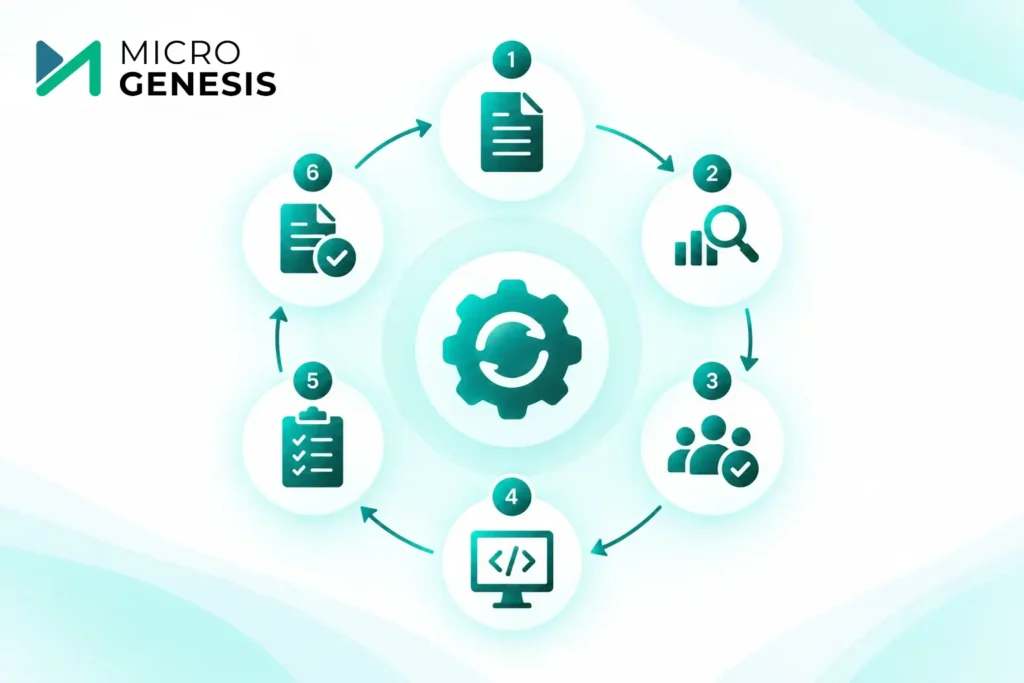
Engineering change management is the structured process of proposing, evaluating, approving, implementing, verifying, and documenting changes to engineering requirements, designs, software, and related product information.
A typical process includes:
Change request: Record the proposed change, its purpose, and the problem or opportunity it addresses.
Impact assessment: Identify affected requirements, design elements, development tasks, and verification activities.
Review and approval: Evaluate technical implications, risks, resources, and release considerations.
Implementation: Assign and track the required engineering work.
Verification: Confirm that the change has been implemented correctly and that relevant tests have been completed.
Closure: Record the outcome, update affected engineering artifacts, and retain the appropriate history.
The precise workflow depends on the organization’s engineering methodology, product complexity, and quality processes.
For effective change management, each stage should have clear ownership, defined entry and exit criteria, and visibility into the engineering artifacts affected by the decision.
How IBM ELM Supports Engineering Change Management
IBM ELM provides capabilities that can help connect requirements management, systems engineering, development workflows, and test management.
Rather than treating every engineering activity as a separate process, organizations can configure appropriate relationships between the artifacts involved in a change.
The value comes from establishing the right workflows and maintaining accurate relationships throughout the product lifecycle.
1. Manage requirements changes with IBM DOORS Next
Requirements are often the starting point for engineering changes. A revised functional requirement, interface specification, or performance target may affect several downstream activities.
IBM Engineering Requirements Management DOORS Next supports requirements management and relationships between requirements and other engineering information.
With an appropriate configuration, teams can:
- Record and manage requirement revisions.
- Maintain relationships between related requirements.
- Review changes and their associated information.
- Improve visibility into requirements affected by a proposed change.
- Connect requirements with relevant development and verification artifacts.
For example, if an automotive engineering team changes a communication requirement for an embedded controller, engineers can use established relationships to investigate the affected software requirements and verification activities.
MicroGenesis provides IBM DOORS Next services to support requirements management, configuration, and lifecycle traceability.
2. Connect design changes with IBM Rhapsody
Engineering changes often extend beyond requirements. A change to system behaviour may affect component architecture, interfaces, or model elements.
IBM Engineering Systems Design Rhapsody supports model-based systems engineering and software design workflows. Where the environment is configured appropriately, relationships between requirements and model elements can help teams understand how changes affect the system design.
This approach can help engineering teams:
- Investigate relationships between requirements and design.
- Review affected system components and interfaces.
- Coordinate changes across systems and software engineering.
- Maintain better visibility into design dependencies.
For Swedish automotive and embedded engineering organizations, these connections are particularly useful when a product includes multiple interacting hardware and software components.
Explore IBM Rhapsody services for support with systems engineering and model-based engineering workflows.
3. Coordinate implementation through IBM Engineering Workflow Management
Once a change has been assessed and approved, the required work must be assigned, tracked, and completed.
IBM Engineering Workflow Management (EWM) supports work item management, development coordination, and change tracking. It can help organizations structure engineering activities around defined responsibilities and workflows.
Teams can use development work items to record:
- The approved change and its implementation objectives.
- Assigned engineers and responsible teams.
- Dependencies and related work.
- Current status and completion information.
- Links to relevant requirements and other engineering artifacts.
For example, an approved software change may require updates to several components and corresponding tests. Coordinated work items help teams track the implementation activities and identify outstanding work.
MicroGenesis offers IBM Engineering Workflow Management services to help organizations configure and improve development workflows.
4. Verify changes with IBM Engineering Test Management
An engineering change should not be considered complete simply because the implementation task is closed. Teams also need to determine whether the change behaves as expected and whether related functionality remains unaffected.
IBM Engineering Test Management (ETM) supports test planning, test case management, execution, and verification activities.
When test cases are linked to relevant requirements and engineering changes, teams can:
- Identify test cases associated with affected requirements.
- Review whether existing tests remain suitable.
- Track test execution and results.
- Identify failures requiring further investigation.
- Maintain visibility into outstanding verification activities.
For example, a change to embedded software may require targeted functional tests and regression testing. Connected engineering information can help teams determine which verification activities require attention.
Explore IBM Engineering Test Management services to understand how test management can support change verification.
A Practical Approach to Simplifying Engineering Change Management
Implementing IBM ELM is only one part of the solution. Organizations should also define a consistent process, determine which relationships matter, and establish responsibilities for maintaining engineering information.
The following steps provide a practical starting point.
Step 1: Assess the existing change management process
Document how changes are currently proposed, reviewed, approved, implemented, and verified.
Identify where delays occur, where information must be entered manually, and where teams have difficulty identifying affected engineering artifacts.
The assessment should include existing tools, workflows, approval structures, and reporting requirements.
Step 2: Standardize change request information
Define the information required for a change request. Depending on the engineering context, this may include:
- Change description and business or technical justification.
- Origin of the request.
- Affected product, component, or requirement.
- Initial impact assessment.
- Risk and priority.
- Assigned owner.
- Approval status.
- Implementation and verification criteria.
A consistent change request structure makes it easier for reviewers to assess proposals and determine whether sufficient information is available for a decision.
Step 3: Establish clear approval workflows
Not every change requires the same review process. A minor correction may need fewer approvals than a change affecting system architecture or product safety.
Define approval rules according to the organization’s engineering governance and risk assessment process.
Ensure that responsibility for technical review, implementation authorization, verification, and closure is clearly assigned.
Step 4: Maintain traceability across engineering artifacts
Identify which relationships are required between requirements, design elements, work items, and test cases.
Prioritize relationships that provide meaningful visibility into engineering dependencies. Avoid creating links simply to increase the number of traceability records.
For example, a change to an embedded software requirement should be connected to the relevant implementation and verification activities where those relationships are applicable.
This is closely connected to improving requirements traceability across automotive and embedded software development, especially when teams need to understand how changes propagate through the product lifecycle.
Step 5: Integrate engineering tools where necessary
Review how information moves between requirements management, systems engineering, development, and test management environments.
Determine which integrations are necessary to maintain relationships, synchronize relevant information, and reduce duplicate manual work.
Integration design should account for data ownership, synchronization rules, access controls, error handling, and ongoing maintenance.
For organizations with fragmented engineering environments, reducing engineering data silos across distributed R&D teams can be an important part of the broader improvement strategy.
Step 6: Define change-impact analysis procedures
Establish a repeatable method for identifying affected artifacts before a change is approved for implementation.
The process should consider requirements, architecture, interfaces, development tasks, tests, and other relevant product information.
Tool-supported relationships can help engineers identify potential dependencies, but technical owners should validate the results before decisions are made.
Step 7: Monitor implementation and verification status
Create reporting views that help engineering leads understand:
- Open change requests.
- Changes awaiting approval.
- Approved changes not yet implemented.
- Work items blocked by dependencies.
- Verification activities still outstanding.
- Changes awaiting closure.
The objective is to make decisions easier and identify bottlenecks—not to generate reports that teams cannot use operationally.
Step 8: Train teams and continuously improve
Engineering change management depends on consistent user practices.
Provide role-specific training so that engineers understand how to record changes, maintain relationships, complete reviews, and document verification outcomes.
Review the process periodically to identify unnecessary approval steps, recurring delays, incomplete relationships, and opportunities to improve automation.
Business Benefits of Better Engineering Change Management
A structured engineering change management process supported by IBM ELM can help Swedish product development teams improve several aspects of their operations.
Better visibility into engineering dependencies
Maintained relationships between requirements, design, development, and testing help teams investigate the potential consequences of changes.
More coordinated product development
Clear ownership and status tracking help engineering teams understand what needs to be reviewed, approved, implemented, and verified.
Reduced manual investigation
Connected engineering information can reduce the need to search across disconnected tools when assessing a change. The extent of the benefit depends on data quality and integration coverage.
Improved verification planning
Relationships between requirements and test cases help teams determine which verification activities need review when changes occur.
More consistent engineering records
Structured workflows and change histories can help organizations maintain records of decisions, implementation activities, and verification outcomes.
Greater lifecycle visibility
Engineering leaders can obtain a more consistent view of change status and outstanding work across teams and projects.
These benefits are not automatic. They depend on suitable configuration, clear processes, accurate data, user adoption, and ongoing governance.
Common Mistakes to Avoid
Organizations can make their change management process more complicated if they focus only on tool configuration.
Avoid these common mistakes:
- Overcomplicating approval workflows: Introduce review steps that reflect the type and risk of the change.
- Ignoring existing data quality: Incomplete or outdated engineering relationships can undermine impact analysis.
- Creating unnecessary traceability links: Focus on relationships that support real engineering decisions.
- Treating integration as a one-time activity: Integration rules and connected workflows require ongoing maintenance.
- Overlooking user adoption: Teams need clear guidance on how to maintain change information.
- Closing changes without verification: Define appropriate completion criteria, including verification where required.
- Assuming tools guarantee compliance: Compliance depends on the organization’s applicable processes, controls, evidence, and validation activities.
A phased implementation can help teams address these issues before expanding the approach across a larger engineering environment.
Why Choose MicroGenesis for IBM ELM Services in Sweden?
MicroGenesis supports organizations implementing and improving IBM ELM environments through consulting, configuration, integration, migration, training, and ongoing support.
With 25+ years of experience and 400+ clients globally, MicroGenesis helps engineering organizations address lifecycle management challenges and establish connected engineering workflows.
Depending on your requirements, support can include:
- IBM ELM implementation planning and consulting.
- IBM DOORS Next requirements management and traceability.
- IBM Rhapsody systems engineering workflows.
- Engineering tool integration and migration.
- Process improvement, training, and ongoing support.
To assess the right implementation approach, start with the current change management process, the engineering tools already in use, and the relationships required to support impact analysis.
Organizations evaluating implementation support can also review choosing an IBM ELM implementation partner in Sweden to understand the importance of technical expertise, integration capabilities, migration experience, and long-term support.
Learn more about IBM ELM consulting and implementation services in Sweden.
Frequently Asked Questions
What is engineering change management in product development?
Engineering change management is the process of evaluating, approving, implementing, verifying, and documenting changes to product requirements, designs, software, and related engineering information.
How can IBM ELM simplify engineering change management?
IBM ELM can help connect requirements, systems engineering, development work items, and test management. When these relationships and workflows are configured appropriately, teams can improve change visibility and investigate engineering dependencies more efficiently.
Can IBM ELM help with change-impact analysis?
Yes. Relationships between engineering artifacts can help identify potentially affected requirements, design elements, development activities, and test cases. Engineers must validate these relationships and determine the actual impact.
Is IBM ELM suitable for automotive and embedded software companies?
IBM ELM capabilities can support requirements management, development coordination, systems engineering, and verification workflows relevant to automotive and embedded software development. Suitability depends on the organization’s processes, existing toolchain, and technical requirements.
Does IBM ELM automate the entire change management process?
Not automatically. Workflows, integrations, notifications, relationships, and reporting must be configured for the organization’s needs. Engineering review and decision-making remain important parts of the process.
How should a company begin improving engineering change management?
Start by reviewing the current process, identifying delays and information gaps, standardizing change request data, and defining the necessary traceability relationships. A pilot project can help validate the proposed workflow before wider implementation.
Conclusion
For Swedish product development teams, engineering change management is essential to coordinating requirements, design, development, and verification as products evolve.
IBM ELM can help establish connected engineering workflows and improve visibility into change requests, affected artifacts, implementation activities, and verification status. The greatest value comes from combining appropriate tool configuration with clear governance, reliable engineering data, and consistent user practices.
MicroGenesis supports organizations with IBM ELM consulting and implementation services, helping engineering teams develop a practical approach to lifecycle integration and change management.
If your organization is facing fragmented engineering information, time-consuming impact assessments, or inconsistent change workflows, reviewing your current process is a useful first step toward a more connected engineering lifecycle.