

In today’s competitive business environment, bringing products to market quickly has become a key differentiator. Customers expect continuous innovation, shorter release cycles, and high-quality digital experiences. Businesses that can rapidly develop, test, and launch products are better positioned to capture market opportunities, respond to customer feedback, and stay ahead of competitors.
However, accelerating product development isn’t simply about working faster. It requires the right engineering strategy, skilled talent, efficient processes, and modern delivery models that enable teams to innovate without compromising quality.
Many organizations struggle with engineering talent shortages, lengthy development cycles, siloed teams, and outdated processes that slow product delivery. These challenges increase operational costs and delay business growth.
To overcome these obstacles, many enterprises adopt Managed Engineering Services, giving them access to experienced engineering teams, structured delivery frameworks, and scalable development capabilities. By combining engineering expertise with Agile methodologies and modern technology practices, businesses can significantly reduce time-to-market while maintaining product quality.
Whether you’re developing a new SaaS platform, modernizing enterprise applications, or building next-generation digital products, accelerating product development is essential for long-term business success.
What Is Accelerating Product Development?
Accelerating product development is the process of reducing the time required to design, develop, test, and launch products without sacrificing quality, security, or customer experience.
Rather than simply increasing development speed, it focuses on optimizing the entire product lifecycle, from idea validation and planning to deployment and continuous improvement.
An effective product development strategy helps organizations:
- Deliver products faster
- Respond quickly to changing market demands
- Improve collaboration across teams
- Increase engineering productivity
- Reduce development costs
- Improve software quality
- Support continuous innovation
Successful organizations treat product development as an ongoing cycle of innovation rather than a one-time project.
Why Faster Product Development Matters
Speed has become a competitive advantage across nearly every industry.
Businesses that reduce development cycles can:
- Launch products ahead of competitors
- Respond faster to customer feedback
- Capture new market opportunities
- Increase revenue
- Improve customer satisfaction
- Reduce project risks
- Adapt quickly to changing business priorities
Shorter development cycles also allow engineering teams to test new ideas, release incremental improvements, and continuously enhance customer experiences.
Common Challenges That Slow Product Development
Many organizations struggle to accelerate product delivery because of operational inefficiencies rather than technical limitations.
Below are some of the most common challenges.
Engineering Talent Shortages
Hiring experienced software engineers has become increasingly difficult.
Organizations often struggle to recruit specialists in:
- Cloud Engineering
- Artificial Intelligence
- DevOps
- Cybersecurity
- Data Engineering
- Product Engineering
Engineering vacancies often remain open for months, delaying product roadmaps and increasing pressure on existing teams.
Businesses facing Engineering Talent Challenges in Nordic Markets increasingly rely on flexible engineering partnerships to maintain development velocity.
Lengthy Recruitment Processes
Building internal engineering teams requires significant time and investment.
Typical recruitment activities include:
- Candidate sourcing
- Technical interviews
- Onboarding
- Training
- Team integration
These activities can delay product development before coding even begins.
Many organizations reduce hiring delays by adopting Managed Software Development, enabling immediate access to experienced engineering professionals.
Siloed Engineering Teams
Disconnected teams often create unnecessary delays throughout the product lifecycle.
Common issues include:
- Poor communication
- Duplicate work
- Delayed approvals
- Limited knowledge sharing
- Inconsistent priorities
Cross-functional collaboration is essential for accelerating software delivery.
Manual Development Processes
Many organizations still rely on manual workflows that reduce engineering productivity.
Examples include:
- Manual testing
- Manual deployments
- Spreadsheet-based tracking
- Slow approval processes
- Manual infrastructure provisioning
Automating these activities significantly improves development speed while reducing operational risk.
Legacy Technology
Older technology platforms often make software development slower and more expensive.
Challenges include:
- Technical debt
- Complex integrations
- Outdated architectures
- Limited scalability
- Higher maintenance costs
Modern engineering practices help organizations modernize applications while supporting faster product innovation.
Looking to reduce the impact of legacy technology on your delivery timelines? MicroGenesis Application Modernization Services can help organizations modernize applications while building a stronger foundation for future development.
Signs Your Product Development Process Needs Improvement
Businesses often recognize development challenges only after projects begin missing deadlines.
Common warning signs include:
- Product releases are consistently delayed.
- Development costs continue to increase.
- Engineers spend more time fixing defects than building new features.
- Product backlogs continue growing.
- Customer requests take too long to implement.
- Software quality continues to decline.
- Teams struggle to collaborate effectively.
- Competitors release products faster.
If several of these challenges exist within your organization, it may be time to evaluate your engineering strategy and identify opportunities to improve delivery efficiency.
Many organizations address these challenges by combining internal engineering expertise with Managed Engineering Services, enabling them to accelerate software delivery while improving engineering governance and scalability.
Benefits of Accelerating Product Development
Reducing time-to-market delivers measurable business benefits beyond faster software releases.
Organizations that accelerate product development typically experience:
- Faster innovation
- Improved customer satisfaction
- Higher engineering productivity
- Better software quality
- Lower operational costs
- Increased market competitiveness
- Better resource utilization
- Stronger business agility
Rather than viewing product development as a series of isolated projects, successful organizations create engineering environments that continuously support innovation and business growth.
Proven Strategies to Accelerate Product Development
Reducing development timelines requires more than adding engineers or increasing budgets. Organizations that consistently deliver products faster focus on improving engineering processes, collaboration, automation, and delivery models.
Below are some of the most effective strategies for accelerating product development.
1. Adopt Agile Development Practices
Traditional software development often relies on long planning cycles and sequential delivery, making it difficult to respond to changing customer requirements.
Agile enables engineering teams to deliver software in smaller, incremental releases while continuously incorporating customer feedback.
Benefits of Agile
- Faster product releases
- Better collaboration
- Continuous customer feedback
- Reduced development risks
- Greater flexibility
- Improved product quality
Common Agile practices include:
- Sprint Planning
- Daily Stand-ups
- Sprint Reviews
- Backlog Refinement
- Retrospectives
Organizations using Agile can respond more quickly to market changes while maintaining development quality.
2. Automate Development and Delivery
Manual engineering activities slow product development and increase the likelihood of errors.
Automation helps engineering teams focus on innovation instead of repetitive operational tasks.
Areas to Automate
- Code builds
- Testing
- Security scanning
- Infrastructure provisioning
- Software deployments
- Monitoring
- Performance reporting
Automation enables faster release cycles, reduces human error, and improves engineering productivity.
3. Invest in DevOps
DevOps bridges the gap between development and operations, creating a streamlined software delivery pipeline.
By integrating development, testing, deployment, and monitoring, organizations can release software more frequently and with greater confidence.
DevOps Benefits
- Continuous Integration (CI)
- Continuous Deployment (CD)
- Faster feedback loops
- Reduced deployment failures
- Better collaboration
- Higher software reliability
Organizations that combine Agile with DevOps significantly improve delivery speed while maintaining operational stability.
4. Adopt Managed Engineering Services
Hiring and managing engineering teams internally can slow product development due to recruitment delays, onboarding efforts, and project management overhead.
Organizations accelerate software delivery by partnering with providers offering Managed Engineering Services, allowing them to access experienced engineering professionals without lengthy hiring cycles.
Benefits include:
- Immediate access to engineering talent
- Faster project initiation
- Improved governance
- Scalable engineering capacity
- Predictable software delivery
- Reduced operational complexity
Instead of managing multiple vendors, businesses gain a strategic engineering partner responsible for delivering measurable business outcomes.
Need to extend your existing engineering team without committing to lengthy recruitment cycles? Explore Engineering Augmentation Services to add flexible engineering capacity based on your project requirements.
5. Use Managed Software Development
Many software projects slow down because engineering teams spend too much time coordinating resources, resolving communication issues, and managing technical debt.
Managed Software Development provides structured delivery frameworks that improve collaboration and reduce project complexity.
Advantages include:
- Faster software development
- Standardized engineering processes
- Better project visibility
- Continuous quality assurance
- Lower maintenance effort
- Improved engineering efficiency
By outsourcing end-to-end software delivery to an experienced engineering partner, businesses can focus on product strategy while accelerating execution.
6. Build Dedicated Engineering Teams
Frequent team changes and contractor turnover often reduce engineering productivity.
Long-term Dedicated Development Teams develop a deeper understanding of business processes, technologies, and customer requirements, enabling faster decision-making and higher-quality software.
Benefits
- Strong product ownership
- Better collaboration
- Faster onboarding
- Consistent engineering standards
- Improved knowledge retention
- Long-term scalability
Dedicated teams function as an extension of internal engineering organizations, supporting continuous product innovation.
Planning to build a long-term engineering capability? Our Engineering Augmentation Services can help extend your internal team with the skills needed to support ongoing product development.
7. Improve Product Planning
Many development delays begin long before coding starts.
Effective planning includes:
- Defining product goals
- Prioritizing customer requirements
- Creating realistic roadmaps
- Identifying technical dependencies
- Managing project risks
Well-planned engineering initiatives reduce rework and help teams focus on delivering high-value features.
8. Build Cross-Functional Teams
Successful product development requires close collaboration across multiple disciplines.
Cross-functional teams typically include:
- Product Managers
- Software Developers
- UI/UX Designers
- QA Engineers
- DevOps Specialists
- Business Analysts
- Solution Architects
Working together throughout the development lifecycle reduces communication gaps and accelerates delivery.
9. Focus on Engineering Productivity
Accelerating product development isn’t about increasing headcount. It is about enabling existing teams to deliver more efficiently.
Organizations should continuously monitor:
- Sprint velocity
- Deployment frequency
- Lead time
- Defect rates
- Engineering utilization
- Customer feedback
Improving these metrics often delivers greater business value than simply hiring additional developers.
Build Internal Teams or Partner with an Engineering Provider?
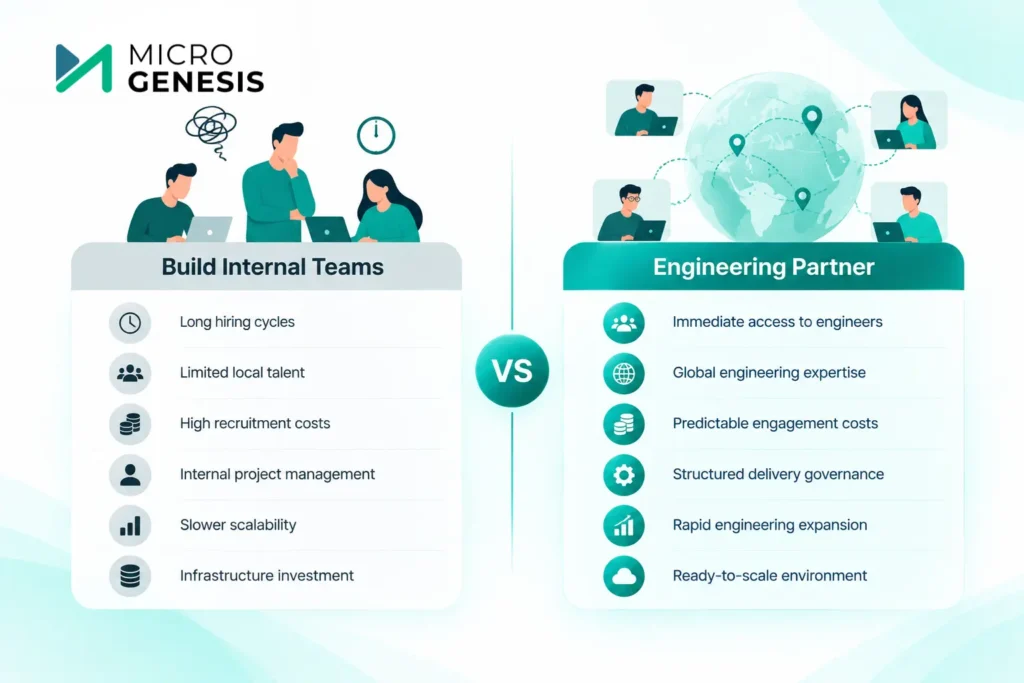
Organizations looking to accelerate product development often evaluate whether to expand internal engineering teams or partner with an external engineering organization.
| Build Internal Teams | Engineering Partner |
|---|---|
| Long hiring cycles | Immediate access to engineers |
| Limited local talent | Global engineering expertise |
| High recruitment costs | Predictable engagement costs |
| Internal project management | Structured delivery governance |
| Slower scalability | Rapid engineering expansion |
| Infrastructure investment | Ready-to-scale engineering environment |
Partnering with an experienced engineering provider allows businesses to accelerate development without disrupting ongoing operations.
Organizations evaluating different approaches can also explore Staff Augmentation vs Managed Services to understand how different engagement models can support engineering growth.
Choosing the Right Delivery Model
Every product has unique engineering requirements.
Common engagement models include:
- Dedicated engineering teams
- Managed software development
- Project-based delivery
- Hybrid engineering teams
- Global Capability Centers
Selecting the right model depends on:
- Product complexity
- Business objectives
- Time-to-market goals
- Internal engineering capacity
- Budget
- Long-term growth plans
Organizations that align delivery models with business priorities consistently achieve faster software delivery and better engineering outcomes.
Scale Engineering Teams to Support Faster Product Delivery
As product demand grows, engineering teams must scale without disrupting ongoing development. However, rapidly hiring developers often creates new challenges, including onboarding delays, inconsistent development practices, and communication bottlenecks.
Instead of focusing only on increasing headcount, organizations should build engineering capabilities that can grow with changing business needs.
Scaling engineering teams successfully enables organizations to:
- Accelerate product releases
- Support multiple product lines
- Improve engineering productivity
- Respond quickly to market opportunities
- Reduce delivery bottlenecks
- Maintain software quality as teams expand
Many organizations support long-term growth by investing in Scaling Engineering Teams, allowing them to expand engineering capacity through structured delivery models rather than relying solely on internal hiring.
For organizations planning sustained innovation, Building Extended Engineering Teams provides a scalable approach to developing long-term engineering capabilities while maintaining knowledge continuity and delivery consistency.
Choose the Right Global Delivery Model
Engineering talent is no longer limited to a single location. Modern product development often involves globally distributed teams working together to deliver software faster and more efficiently.
Choosing the right delivery model depends on collaboration requirements, project complexity, budget, and access to specialized expertise.
Nearshore Development
Nearshore engineering teams operate in nearby regions, making real-time collaboration easier.
Key advantages include:
- Better time-zone alignment
- Faster communication
- Stronger cultural compatibility
- Easier stakeholder collaboration
- Reduced travel complexity
Organizations comparing regional engineering strategies often evaluate Nearshore vs Offshore Development to determine the best balance between collaboration and scalability.
Offshore Development
Offshore engineering provides access to larger talent pools and enables organizations to expand engineering capacity quickly.
Benefits include:
- Access to specialized technical expertise
- Lower operational costs
- Rapid team expansion
- Long-term engineering capacity
- Support for continuous product development
When supported by mature engineering processes and strong governance, offshore teams become an integral part of successful product development organizations.
Hybrid Delivery Models
Many enterprises combine onsite leadership, nearshore architects, and offshore development teams to create flexible engineering organizations.
A hybrid approach offers:
- Improved collaboration
- Better resource utilization
- Increased engineering flexibility
- Faster software delivery
- Optimized operational costs
Organizations implementing Hybrid Delivery Models can respond more effectively to changing customer demands while maintaining engineering quality and delivery speed.
Looking for a delivery model that can adapt as your product roadmap changes? MicroGenesis can help you combine engineering augmentation, dedicated teams, and hybrid delivery approaches based on your business requirements.
Why Nordic Companies Are Accelerating Product Development
Organizations across Sweden and the Nordic region continue to invest heavily in software innovation, cloud modernization, artificial intelligence, and connected products. At the same time, engineering leaders face growing pressure to deliver products faster despite increasing competition for skilled talent.
To remain competitive, businesses are transforming the way they build and manage engineering teams.
Common business drivers include:
- Digital transformation initiatives
- Increasing customer expectations
- Engineering talent shortages
- Faster software release cycles
- Cloud adoption
- AI and automation initiatives
Many organizations strengthen their engineering capabilities through Software Development Outsourcing in Sweden, gaining access to experienced software professionals while maintaining the flexibility to scale projects quickly.
Growing demand for specialized engineering expertise has also highlighted significant Engineering Talent Challenges in Nordic Markets, encouraging businesses to adopt more agile and scalable delivery models.
By Building Distributed Teams for Nordic Companies, enterprises combine local business knowledge with global engineering talent, improving resilience, innovation, and long-term product development capacity.
Best Practices for Accelerating Product Development
Organizations that consistently reduce time-to-market typically follow a structured engineering strategy.
Best practices include:
✔ Adopt Agile development methodologies.
✔ Automate testing, deployment, and infrastructure.
✔ Build cross-functional engineering teams.
✔ Prioritize continuous customer feedback.
✔ Standardize engineering processes.
✔ Invest in DevOps and CI/CD.
✔ Monitor engineering performance metrics.
✔ Reduce technical debt through continuous improvement.
✔ Choose delivery models that support long-term scalability.
By combining these practices, organizations can deliver innovative products faster while maintaining quality, security, and operational efficiency.
How MicroGenesis Can Help
Accelerating product development requires more than additional developers. It requires the right engineering strategy, proven delivery frameworks, and experienced technology professionals.
At MicroGenesis Sweden AB, we help organizations reduce time-to-market through scalable engineering services that support every stage of the product development lifecycle. Whether you’re launching a new digital product, modernizing enterprise applications, or expanding engineering capacity, our experts work as an extension of your team to accelerate innovation and improve delivery outcomes.
Our Product Engineering Capabilities
- Managed Engineering Services
- Managed Software Development
- Dedicated Development Teams
- Product Engineering
- Cloud Engineering
- DevOps and CI/CD
- AI and Data Engineering
- Digital Engineering
- Quality Assurance and Test Automation
- Engineering Consulting
Why Choose MicroGenesis?
- Experienced software engineering professionals
- Agile and DevOps expertise
- Flexible onsite, nearshore, offshore, and hybrid delivery models
- Transparent project governance
- Scalable engineering teams
- Enterprise-grade quality and security standards
- Long-term engineering partnerships focused on business outcomes
Our collaborative approach helps businesses accelerate product development while improving engineering productivity, reducing delivery risks, and supporting sustainable growth.
Ready to strengthen your engineering capacity and accelerate delivery? Explore Engineering Augmentation Services to see how MicroGenesis can support your existing engineering organization.
If application modernization is slowing down your product roadmap, explore Application Modernization Services to modernize legacy applications and create a stronger foundation for future innovation.
Frequently Asked Questions
What does accelerating product development mean?
Accelerating product development involves reducing the time required to design, develop, test, and launch products while maintaining software quality, security, and customer satisfaction.
How can businesses reduce product development time?
Organizations can accelerate development by adopting Agile methodologies, implementing DevOps automation, improving engineering collaboration, building cross-functional teams, and partnering with experienced engineering providers.
What are the biggest challenges in product development?
Common challenges include engineering talent shortages, lengthy recruitment cycles, communication gaps, technical debt, manual processes, and inefficient project governance.
How do Managed Engineering Services accelerate product development?
Managed Engineering Services provide organizations with experienced engineering teams, structured delivery processes, scalable resources, and proven governance frameworks that improve software delivery speed and quality.
Why are Nordic companies investing in faster product development?
Businesses across Sweden and the Nordic region are responding to increasing customer expectations, engineering talent shortages, and digital transformation initiatives by adopting scalable engineering delivery models that reduce time-to-market.
How can MicroGenesis help accelerate product development?
MicroGenesis helps organizations build scalable engineering teams, implement Agile and DevOps practices, modernize software development processes, and deliver innovative products faster through flexible engineering engagement models.
Conclusion
In today’s fast-moving digital economy, speed is no longer a competitive advantage. It is a business necessity. Organizations that can accelerate product development are better positioned to respond to market opportunities, meet evolving customer expectations, and drive continuous innovation.
Achieving faster product delivery requires more than increasing development resources. It demands efficient engineering processes, skilled talent, automation, and delivery models that support collaboration and scalability.
By combining Managed Engineering Services, Managed Software Development, Dedicated Development Teams, and flexible global delivery models, businesses can reduce time-to-market while maintaining software quality, operational efficiency, and long-term engineering excellence.
If your organization is looking to accelerate product development, expand engineering capacity, or improve software delivery performance, MicroGenesis Sweden AB can help. Our engineering expertise, scalable delivery models, and customer-centric approach enable businesses across Sweden and the Nordic region to transform ideas into successful products faster, smarter, and with confidence.
Ready to accelerate your product development journey? Connect with MicroGenesis Sweden AB to discover how our engineering services can help you innovate faster, scale efficiently, and bring products to market with greater speed and confidence.